
Custom metal gears turn rotational motion into torque across nearly every machine built today—from automotive transmissions and industrial drives to medical actuators and robotics. When an off-the-shelf catalog gear cannot meet your load, size, or material requirements, a custom gear manufactured to your drawing is the answer. This guide explains how custom metal gears are made, which materials and processes fit which applications, and how to brief a supplier so you get parts that mesh cleanly, run quietly, and arrive on time.

Why Specify Custom Metal Gears?
Standard gears are inexpensive but rigid in geometry, material, and tolerance. A custom gear lets you control tooth profile, bore, keyway, hub, and hardness for a specific duty. If you need a non-standard module, a hardened steel pinion in a tight envelope, or a brass gear for a low-noise consumer product, custom manufacturing is the only route. Working with a shop that offers both CNC milling and CNC turning means a single partner can produce the gear and any mating shaft or housing in one workflow.
Machined Gears vs. Sintered Gears
Two processes dominate custom gear production. CNC milling cuts each gear from solid stock, delivering excellent surface finish and the tightest tooth accuracy—ideal for low-to-mid volumes and large or complex geometries. Sintered gears are pressed and sintered from metal powder, a near-net-shape method that shines at high volume with minimal scrap. Our 5-axis CNC machining cells also handle helical and bevel forms in a single setup. For a deeper look at the trade-offs, see our guide on powder metallurgy services.
Choosing the Right Material
Material sets the gear’s strength, wear resistance, and corrosion profile. Carbon and alloy steels such as 1045 or 4140 are the default for load-bearing drives and are often heat-treated after cutting. Stainless grades resist corrosion in food, medical, and marine use, and are commonly produced on Swiss turning lathes for small, precise parts. Brass quiets operation and machines freely for instruments and connectors. If you are weighing alloys for your assembly, our CNC machining services overview covers machinability and cost in detail.
Tolerances and Tooth Accuracy
Gear performance lives or dies on tooth geometry. Pitch, pressure angle, runout, and concentricity must be held so meshing stays smooth and quiet. Precision shops inspect with gear checks and CMMs and document results per batch. Tight tolerances are easier and cheaper when designed in collaboration—our engineers routinely review drawings to relax non-critical dimensions. The principles overlap with those in our precision machined parts guide. For round components, CNC turning paired with grinding controls runout on gear blanks before teeth are cut.
Heat Treatment and Surface Finish
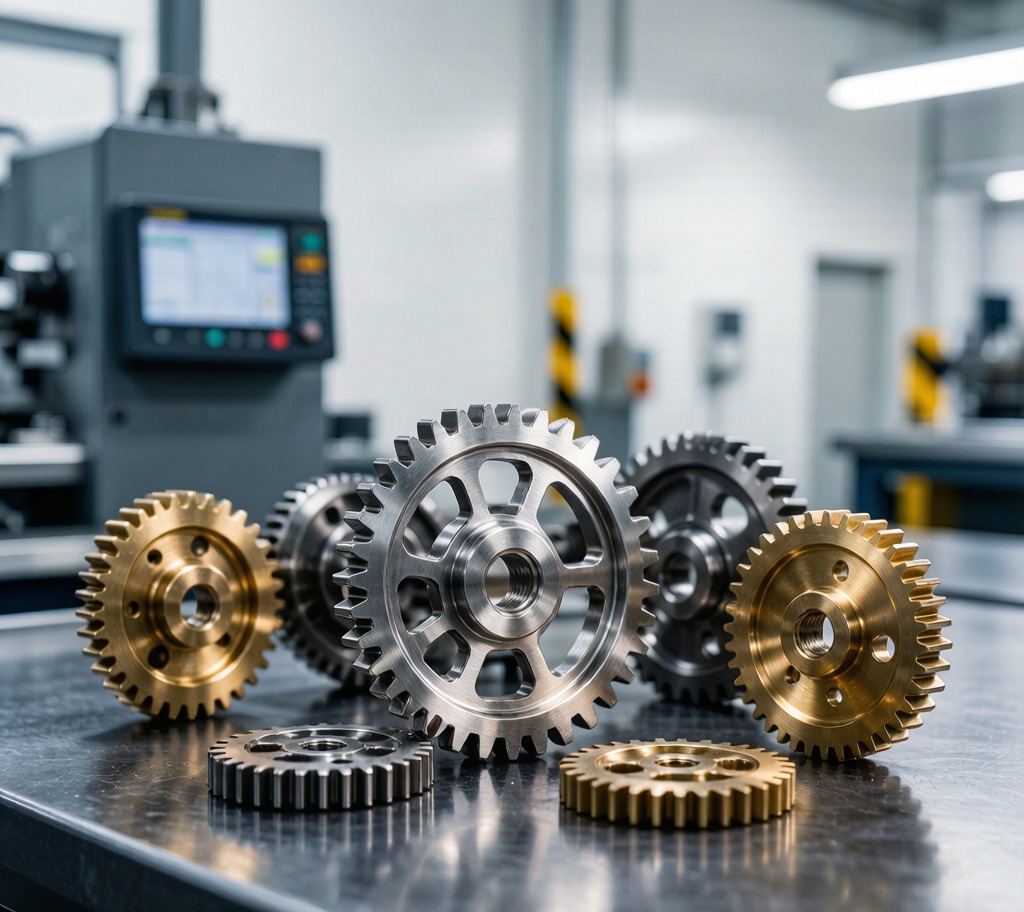
Most steel gears are case-hardened, induction-hardened, or through-hardened to survive contact fatigue. Our heat treatment options—including hardening and stress relief—are applied before final grinding. Finishes such as black oxide, zinc plating, or passivation protect against corrosion, and you can compare them in our metal surface treatment article. A well-chosen finish also improves appearance on consumer-facing products where the gear is partially visible.
How to Request a Quote
Send a dimensioned drawing (STEP, DWG, or PDF), the material and hardness, the required quantity and annual volume, and the application environment. Note any critical dimensions and the gear standard you follow (AGMA, DIN, or JIS). A sample or a physical part speeds validation considerably. The more your RFQ tells the shop about duty and volume, the tighter and more competitive the quote will be.
Common Gear Types and How to Choose
Spur gears are the simplest and most economical: straight teeth parallel to the axis, easy to machine and inspect, and fine for moderate speeds where a little noise is acceptable. Helical gears use angled teeth that mesh gradually, so they run quieter and carry higher loads—the trade-off is axial thrust that the bearing arrangement must handle. Bevel gears transmit motion between intersecting shafts, usually at 90 degrees, and need accurate cutting on 4- or 5-axis equipment. Worm sets deliver large reductions in a small envelope and can self-lock. Picking the type early shapes the whole manufacturing plan: a high-volume spur or helical gear is often cheapest as a sintered gear, while a low-volume bevel or worm form is better 5-axis CNC machined in one setup. Our team reviews ratio, load, and envelope to recommend the profile and process together, so you avoid a design that is expensive to produce or impossible to inspect at volume. Surface finish and backlash targets are then locked before the first article.
Cost for custom gears is driven by material, complexity, volume, and finish. Machined prototypes carry no tooling, so they are cheap to start but pricey per piece; sintered gears invert that—higher upfront die, lower per-part. Tighter tooth accuracy and added operations such as grinding or plating raise cost proportionally. The smartest path is to prototype by machining, validate the design, then move to sintering or high-volume milling once volume is known. Sharing annual usage lets the supplier recommend exactly that ramp, so you are not paying production tooling before the design is settled. Lead time follows the same logic: a machined sample can ship in days, while a sintered die adds weeks but pays back quickly at scale.
Frequently Asked Questions
What is the minimum order quantity for custom gears?
Prototypes can often start at a single piece via CNC machining; sintered gears need tooling, so economical volumes typically begin in the low thousands where the die cost is amortized.
Which process is cheaper: machining or sintering?
Machining wins for low volume and large gears; sintering wins at high volume once the die is paid off. The crossover depends on geometry and annual usage.
Can you match an existing gear from a sample?
Yes—reverse engineering from a worn or legacy part is routine, with tooth geometry reconstructed, verified, and sampled before production.
How are gears inspected?
Gear-tooth calipers, CMMs, and hardness testing confirm pitch, profile, and runout, with inspection reports supplied per batch for traceability.
Ready to Start Your Project?
Get a build-ready quote on your custom metal parts within 24 hours. Share your drawing and our engineers will respond with process, lead time, and pricing.

