
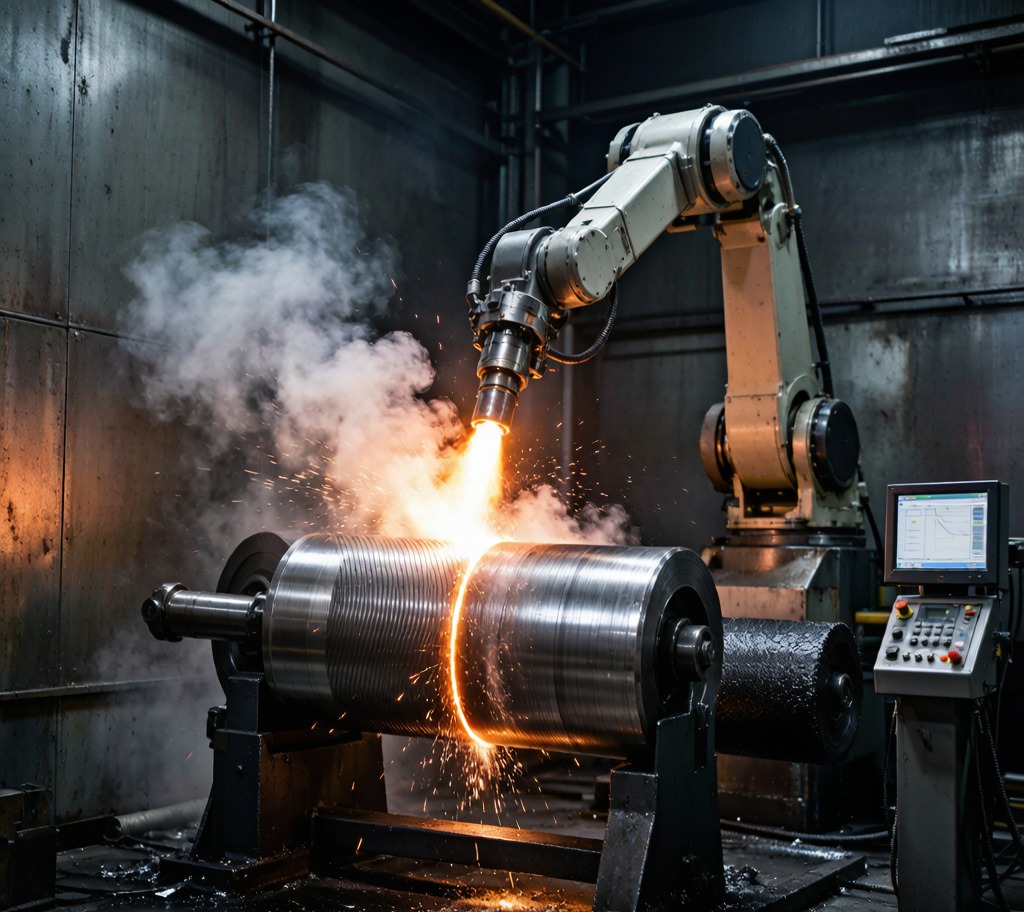
Thermal spray coating services build a new working surface onto a part rather than modifying the one it already has. Powder or wire feedstock is melted or softened in a flame, plasma jet, or electric arc, accelerated to speeds between 40 and 1,000 metres per second, and splattered onto the substrate where each droplet flattens and solidifies in microseconds. The result is a mechanically bonded layer, typically 0.05 to 3 mm thick, that can be far harder, more corrosion-resistant, or more thermally insulating than the base metal. Because the substrate stays below about 150 °C, you can coat a heat-treated shaft without ruining its temper.

The Four Main Thermal Spray Processes
HVOF, or high-velocity oxy-fuel, burns fuel gas and oxygen in a pressurised combustion chamber and expels the stream through a converging-diverging nozzle at supersonic speed. Particles arrive fast and comparatively cool, which produces coatings with porosity below 1 percent, bond strengths above 70 MPa, and very low oxide content. Tungsten carbide-cobalt applied by HVOF is the industry-standard replacement for hard chrome plating on hydraulic rods and landing gear.
Plasma spray passes an inert gas through an electric arc to create a jet at 10,000 to 15,000 °C. That temperature will melt anything, including ceramics and refractory metals that HVOF cannot process. Coatings are slightly more porous, typically 2 to 8 percent, but plasma is the only practical route for zirconia thermal barrier coatings, alumina electrical insulation, and chromium oxide wear surfaces.
Twin-wire arc spray strikes an arc between two continuously fed wires and atomises the molten tips with compressed air. It is by far the cheapest and highest deposition-rate process, laying down 10 to 25 kg per hour. Porosity runs 5 to 15 percent, which is fine for zinc and aluminium anti-corrosion coatings on steel structures, bridges, and tanks.
Flame spray, the oldest method, uses a simple oxy-acetylene torch. It is portable, inexpensive, and still widely used for rebuilding worn shaft diameters with nickel-aluminide or self-fluxing alloys, especially in field repair.
Choosing a Coating Material
Tungsten carbide-cobalt (WC-Co 88/12 or 83/17) is the default abrasion-resistant coating, reaching 1,100 to 1,400 HV. Chromium carbide-nickel chrome performs better above 540 °C where tungsten carbide oxidises, making it standard for boiler tubes and gas turbine components.
Ceramic coatings serve different duties: alumina for electrical insulation and moderate wear, alumina-titania for wear with improved toughness, chromium oxide for hard, dense surfaces in printing rolls and pump seals, and yttria-stabilised zirconia as a thermal barrier on combustion hardware, where it can drop metal temperature by 100 to 150 °C.
Metallic and alloy coatings cover corrosion and dimensional restoration. Zinc and aluminium give sacrificial protection to structural steel with service lives measured in decades — often used where galvanizing is impractical because of part size. Nickel-chrome, Inconel, and stainless overlays restore worn diameters, and molybdenum provides excellent scuff resistance on piston rings and synchroniser cones.
Where the requirement is a thin, extremely hard, low-friction film rather than a thick rebuild, physical vapour deposition is the better tool. Our guides to PVD coating services and the broader family of metal surface treatment options explain where each technology fits.
Surface Preparation Determines Bond Strength
Thermal spray coatings bond mechanically. Molten droplets key into surface asperities and lock on as they solidify and contract. If the surface is smooth or contaminated, the coating will disbond in service, usually catastrophically. Preparation is not a preliminary step — it is the process.
Parts are first degreased, then grit blasted with angular aluminium oxide to produce a clean, sharply profiled surface with roughness of 3 to 6 µm Ra. Our sandblasting cells are set up specifically for pre-spray profiling, using clean angular media rather than recycled shot. Coating must begin within four hours of blasting, before oxidation dulls the profile.
Areas that must stay uncoated are masked with high-temperature tape, silicone boots, or machined shields. Sharp edges are broken to a small radius because coatings will not adhere to a knife edge. Threads, bearing seats, and sealing faces are usually masked and machined afterwards.
Substrate condition matters too. Parts are commonly stress-relieved before spraying, and heavily worn components may need machining back to a uniform undercut so the coating thickness is even. Where the base part is machined from bar or forging, we sequence spraying between roughing and finishing operations on our heat treatment and machining lines.
Thickness, Finishing and Cost
As-sprayed surfaces are rough, typically 4 to 12 µm Ra, and are almost never used in that condition on a functional surface. Diamond grinding is the standard finishing route for carbide and ceramic coatings, taking them to 0.2 to 0.8 µm Ra, and superfinishing or lapping can reach 0.05 µm for seal faces. We finish sprayed diameters on cylindrical grinding machines using CBN and diamond wheels, and this grinding allowance must be planned into the sprayed thickness — usually 0.1 to 0.3 mm extra on radius.
Practical thickness ranges from 0.05 mm for a thin ceramic insulator to 3 mm for a heavy rebuild. Beyond about 1 mm, residual stress accumulates and can cause cracking or spalling, so thick builds are laid down in controlled passes with cooling between them.
Cost drivers are feedstock price (tungsten carbide and cobalt powders are expensive), coated area, thickness, masking complexity, and the finishing operation. A typical HVOF carbide coating with diamond grinding runs several times the cost of chrome plating per part, but it lasts three to eight times longer in abrasive service, carries no hexavalent chromium compliance burden, and does not introduce hydrogen embrittlement. On a hydraulic rod that costs a day of downtime to change, that arithmetic is easy. For parts where an ultra-hard, ultra-thin film is enough, DLC coating and PVD coating are considerably cheaper alternatives, and our full chrome plating services comparison covers the replacement decision in depth.
Frequently Asked Questions
Will thermal spray distort or soften my part? No. Substrate temperature is held below roughly 150 °C, so heat-treated and hardened components keep their properties. This is the principal advantage over weld overlay and hardfacing.
How thick can the coating be? Routinely 0.1 to 1.0 mm, and up to 3 mm for rebuild applications with staged deposition. Thicker layers accumulate residual stress and risk spalling.
Can thermal spray replace hard chrome? In most wear applications, yes. HVOF tungsten carbide typically outlasts hard chrome by a factor of three to eight, avoids hexavalent chromium regulation, and eliminates hydrogen embrittlement risk on high-strength steels.
What is the maximum service temperature? It depends entirely on the coating. Zinc and aluminium are limited to about 200 °C, tungsten carbide-cobalt to 540 °C, chromium carbide-NiCr to 900 °C, and zirconia thermal barriers exceed 1,200 °C.
Can worn parts be re-coated? Yes. Existing coating is ground off, the substrate is inspected and blasted, and a fresh layer is applied. Rebuilding a worn shaft is often 20 to 40 percent of the cost of a new one.
What do you need to quote? The part drawing with the coated area indicated, base material, service conditions (wear mode, temperature, chemical exposure, contact pressure), required coating thickness and finish, and quantity. We will recommend a process and coating chemistry and return pricing within 24 hours.
Ready to Start Your Project?
Get a build-ready quote on your custom metal parts within 24 hours. Share your drawing and our engineers will respond with process, lead time, and pricing.

