
E-coating services use electricity to do what spray guns cannot: coat every square millimetre of a complex metal part, including the inside of tubes, the backs of flanges, and the crevices inside welded assemblies, with a film of identical thickness. Parts are immersed in a waterborne paint bath and connected to a DC circuit. Charged resin particles migrate to the part, deposit on it, and as the film builds it becomes electrically insulating — so deposition slows where the coating is thick and continues where it is thin. The process self-levels. That is why an automotive body shell, with hundreds of overlapping panels and box sections, is e-coated rather than sprayed.

How an Electrocoat Line Works
A production e-coat line is a sequence of immersion tanks. Pre-treatment comes first and typically runs seven to eleven stages: alkaline cleaning to strip oils and shop soils, rinses, an activation stage, a zinc phosphate or zirconium conversion coating, more rinses, and a final deionised water rinse. The conversion coating is what gives e-coat its exceptional adhesion and corrosion performance — skip or compromise it and the whole system underperforms.
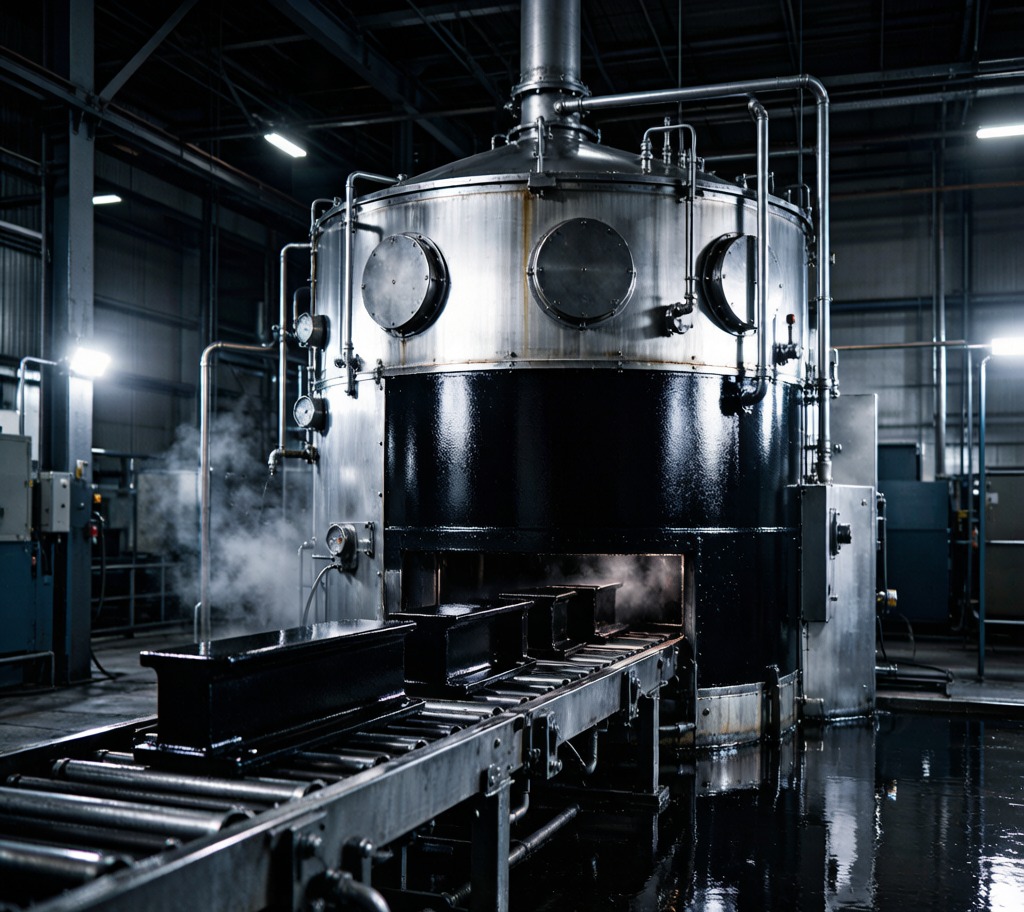
The part then enters the electrocoat tank, a large body of paint at 5 to 20 percent solids held at 28 to 32 °C with continuous circulation and ultrafiltration. Voltage between 100 and 400 V DC is applied for 90 to 180 seconds. In cathodic epoxy systems, the part is the cathode, and positively charged resin micelles migrate to it and coalesce into a tight film.
After deposition, the part passes through ultrafiltrate rinses that recover unattached paint and return it to the tank — recovery efficiency exceeds 95 percent, which is why e-coat produces so little waste. Finally the coating is cured in an oven at 160 to 200 °C for 20 to 30 minutes, where it crosslinks into a hard, chemically resistant thermoset film.
E-Coat vs Powder Coat vs Wet Paint
Powder coating gives a thicker, tougher film with excellent impact resistance and a wide range of textures and gloss levels, and it excels on visible surfaces. But electrostatic powder cannot wrap into deep recesses or interior cavities — the Faraday cage effect leaves box sections and tube interiors bare. Our guide to powder coating services covers where that limitation is and is not acceptable.
Wet paint offers unlimited colour and the finest cosmetic finishes, and it is the only sensible option for one-offs and very low volume. Transfer efficiency is poor, film thickness varies with operator skill, and coverage in recesses is inconsistent. Our metal surface treatment overview places all three in context.
E-coat wins decisively on uniformity, throwing power, and cost per part at volume. Film thickness is typically 15 to 35 µm and varies by only a few microns across the entire part. Colour choice is limited — black dominates, with grey and a handful of others available — and UV resistance of standard epoxy e-coat is poor, so exterior parts usually receive a topcoat.
That combination is in fact the strongest system available: e-coat as a uniform, deeply penetrating primer, followed by powder or wet topcoat for colour and UV durability. Automotive bodies have used exactly this stack for four decades.
Corrosion Performance and Substrates
Salt spray performance to ASTM B117 is where e-coat earns its place. Cold-rolled steel with iron phosphate pre-treatment and e-coat gives 250 to 500 hours. With zinc phosphate, 500 to 1,000 hours. On zinc-plated or galvanised steel with zinc phosphate, 1,000 to 1,500 hours or more. Add a powder topcoat and 2,000 hours becomes achievable.
Crucially, that performance is uniform. A sprayed part might show 800 hours on the flat faces and fail at 200 hours inside a channel. E-coat performs the same everywhere, which is why it is specified on chassis brackets, suspension components, fasteners, and anything with a box section.
Substrates must be electrically conductive. Cold and hot rolled steel, zinc-plated steel, hot-dip and electro-galvanised steel, aluminium, and castings all e-coat successfully. Duplex systems combining zinc plating or galvanizing with e-coat over the top deliver the longest service life for outdoor and under-vehicle applications; our guide to galvanizing services explains when the zinc layer is worth the extra step.
Castings need care. Porous surfaces can outgas during cure and blister the film, so a pre-bake is often specified. Heavily scaled hot-rolled steel and weld slag must be removed first — our sandblasting cells handle descaling ahead of pre-treatment.
Design Rules, Volume and Cost
Parts must drain. Any cup, blind pocket, or upward-facing cavity that traps solution will carry bath chemistry into the next tank, contaminate it, and leave streaks and puddle marks on the finished part. Add drain holes of at least 8 mm at the lowest point of every enclosed volume, and vent holes at the highest point to release trapped air that would otherwise leave an uncoated bubble.
Parts must also rack. Each part needs at least one reliable electrical contact point, and that contact will leave a small uncoated mark, so specify where it may be. Fully enclosed hollow sections cannot be coated internally unless there are openings for solution and current to enter — welded assemblies in particular should be reviewed at design stage, and our welded assemblies team flags these during DFM.
E-coat is a volume process. The tank must be maintained continuously whether or not parts are running, so unit economics depend on throughput. Below a few hundred parts per batch, wet painting or powder coating is usually cheaper. Above a few thousand, e-coat is typically 30 to 50 percent less expensive per part than powder while giving better corrosion coverage.
Frequently Asked Questions
What colours are available in e-coat? Black is standard and accounts for most production. Grey, white, and a limited palette of others are available but require dedicated tanks, so availability depends on the line. If colour matters, use e-coat as primer and add a topcoat.
Is e-coat UV stable? Standard cathodic epoxy e-coat chalks and fades under prolonged sunlight. Acrylic e-coat systems have much better UV resistance, and a topcoat solves the problem entirely for exterior parts.
Can threads be e-coated? Yes, and because film thickness is uniform and thin, threads usually remain functional. For close-tolerance threads, allow for 15 to 35 µm on each flank or mask the feature.
How does e-coat compare on cost? At production volume it is typically the lowest-cost durable coating per part, driven by high material utilisation above 95 percent and full automation. Setup and racking design are the main fixed costs.
Will e-coat cover inside tubes? Yes, to a depth of several tube diameters, provided the tube ends are open so solution and current can enter. This throwing power is the process’s defining advantage over spray methods.
What do you need to quote? Part drawings or models, substrate material and any prior plating, annual volume and batch size, required salt spray hours, colour and topcoat requirements, and any masking or thread-protection needs. We will confirm rack strategy and pricing within 24 hours.
Ready to Start Your Project?
Get a build-ready quote on your custom metal parts within 24 hours. Share your drawing and our engineers will respond with process, lead time, and pricing.

