
A metal bellows is asked to do something unreasonable: flex millions of times, absorb misalignment, and never leak — often while holding ultra-high vacuum on one side and 400 °C on the other. Get the design right and it outlasts the machine around it. Get it wrong and you have a fatigue crack in a sealed system that nobody can reach. Metal bellows manufacturing is therefore as much an engineering exercise as a fabrication one, and the first decision — edge-welded, hydroformed, or electroformed — sets the ceiling on everything the component can achieve.

What a Metal Bellows Is Asked to Do
Bellows serve four broad functions. As expansion joints they absorb thermal growth in piping and exhaust systems. As flexible couplings they accommodate axial, lateral, and angular misalignment between shafts or flanges while transmitting torque. As hermetic seals they let a shaft move linearly or rotate without a sliding seal — the enabling technology behind vacuum feedthroughs and semiconductor gate valves. As springs and actuators they convert pressure to precise linear motion in sensors, accumulators, and volume compensators.
All four demand the same thing: a thin-walled convoluted tube that is simultaneously flexible in one axis and completely leak-tight. That combination is why bellows fabrication sits at the demanding end of our sheet metal processing capability rather than in general fabrication.
Edge-Welded vs Hydroformed vs Electroformed
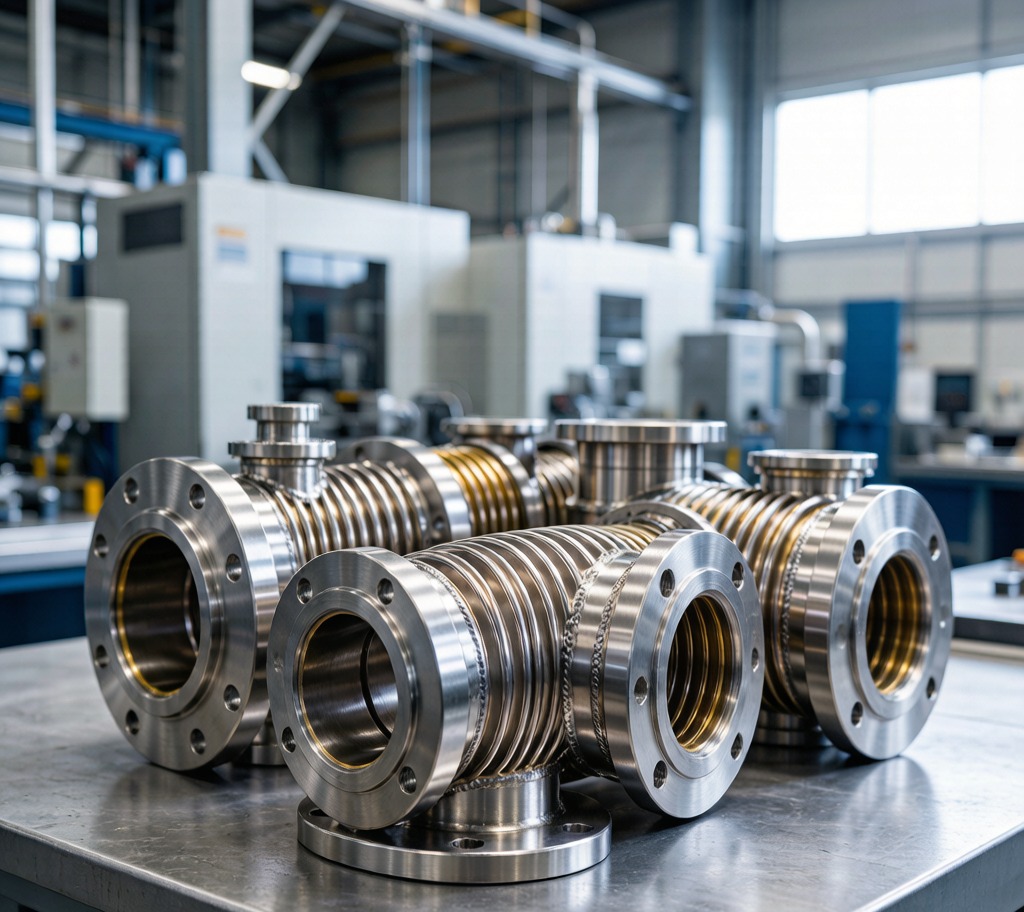
Edge-welded bellows are built from pairs of stamped annular diaphragms, welded at the inner diameter to form a convolution and at the outer diameter to join convolutions together. Because the diaphragm profile is free to be optimised, edge-welded bellows achieve by far the highest stroke per unit length — 80-90% compression is routine — and very low spring rate. Wall thickness runs 0.05-0.2 mm. They are the standard for semiconductor vacuum systems, precision actuators, and volume compensators. The trade-off is cost: hundreds of precision welds per assembly.
Hydroformed bellows start as a thin-walled welded or seamless tube. Internal hydraulic pressure combined with axial compression forms the convolutions in a die. Stroke is more limited — typically 10-30% of free length — and spring rate is higher, but pressure capability is excellent and the cost per unit at volume is far lower. This is the right choice for expansion joints, flexible hose, exhaust decouplers, and shaft couplings. The forming principles are the same ones described in our hydroforming services guide, applied to very thin material.
Electroformed bellows are grown by electrodeposition onto a mandrel that is then dissolved. Walls can go down to 0.01 mm with seamless, perfectly uniform geometry, making them ideal for miniature sensors and aerospace instruments. Material choice is limited mainly to nickel and copper, and cost is high.
Design Rules: Stroke, Spring Rate and Cycle Life
Four parameters govern almost everything:
- Convolution count — stroke and flexibility scale linearly with the number of convolutions; spring rate falls inversely
- Wall thickness — spring rate rises roughly with the cube of thickness, while pressure capacity rises linearly. Thin means flexible; thick means strong. You cannot have both.
- Ply count — multi-ply construction (2-5 thin plies instead of one thick wall) gives pressure capability with far lower spring rate, plus redundancy if one ply cracks
- Convolution profile — depth and root radius determine stress concentration and therefore fatigue life
Cycle life is the parameter engineers most often under-specify. A bellows rated for 10,000 cycles at full stroke may deliver 10 million cycles at 30% stroke. If your application is a vacuum feedthrough cycling every few seconds, tell us the duty cycle and required life up front — it changes the convolution count, and therefore the price, more than any other input. Always specify: stroke (axial, lateral, angular separately), pressure and direction, temperature range, media, required cycle life, and available envelope.
Materials and Joining
Material selection is driven by media, temperature, and fatigue:
- AM350 / 17-7 PH stainless — the workhorse for edge-welded bellows; excellent fatigue strength after age hardening
- 316L stainless — general purpose, good corrosion resistance, standard for vacuum and process applications
- Inconel 625 / 718 — high temperature and aggressive media, aerospace and energy service
- Hastelloy C-276 — severe chemical corrosion
- Titanium — lightweight and biocompatible applications
- Phosphor bronze and beryllium copper — electrical contact and low-temperature spring duty
End fittings — flanges, nipples, threaded adapters — are attached by micro-TIG or laser welding. Weld quality is the single most common failure point in a bellows assembly, because a thin diaphragm welded to a thick flange creates a heat-sink mismatch that burns through or leaves an unfused root. We use pulsed TIG welding and laser processes with controlled fixturing, and the techniques involved are covered in our laser welding services and TIG welding guides. Complete welded assemblies including brackets and mounting hardware are quoted as a single part number.
Post-weld, stainless bellows are normally passivated to restore the chromium oxide film, and vacuum-service parts are cleaned to a controlled outgassing specification. Where extreme corrosion or wear resistance is needed at the ends, electroless nickel plating is an option.
Testing, Qualification and Applications
Every bellows we ship for sealed service is leak tested. Helium mass spectrometry to 1×10⁻⁹ mbar·l/s is standard for vacuum work; pressure decay or bubble testing suffices for lower-grade applications. Additional qualification typically includes spring rate measurement, free-length and stroke verification, proof pressure, and fatigue sampling on a cycle rig for new designs.
Where they end up:
- Semiconductor — gate valve bellows, wafer handling feedthroughs, chamber isolation
- Vacuum and analytical instruments — mass spectrometers, electron microscopes, synchrotron beamlines
- Aerospace — fuel line decouplers, actuator seals, thermal expansion joints
- Energy and process — valve stem seals, heat exchanger expansion joints, exhaust decouplers
- Medical — implantable pressure compensators and surgical instrument seals
- Automotive — exhaust flex connectors and EGR components
Because a bellows behaves as a spring, the design overlaps with conventional spring engineering; our custom metal springs guide is useful background if you are trading a bellows against a diaphragm or coil solution. Complex multi-process assemblies combining cutting, forming, welding, and coating run through our laser cut, bend, weld and coat cell.
Frequently Asked Questions
Which bellows type should I choose?
If you need maximum stroke in minimum length and a low spring rate — vacuum feedthroughs, precision actuators — choose edge-welded. If you need pressure capability at lower cost in volume — expansion joints, couplings, exhaust — choose hydroformed. For sub-0.05 mm walls and miniature sizes, electroformed.
What size range can you manufacture?
Roughly 3 mm to 500 mm outside diameter. Miniature bellows below 6 mm are usually electroformed or edge-welded from very thin stock; large-diameter units above about 300 mm are typically hydroformed multi-ply.
How many cycles will a bellows last?
Anywhere from 10,000 to over 10 million, depending almost entirely on stroke as a percentage of rated capability. Running at 30-50% of rated stroke typically buys an order of magnitude in life. Give us the required cycle count and we will size the convolution count accordingly.
Can bellows handle both pressure and vacuum?
Yes, but they must be designed for it. External pressure risks squirm (column buckling) — the same failure mode as a slender column. Multi-ply construction, reinforcing rings, or added convolution support solve it. Always state pressure direction on the RFQ.
What leak rate can you achieve?
Helium leak rates better than 1×10⁻⁹ mbar·l/s are standard for edge-welded stainless assemblies, and we certify each unit. Lower-grade applications are tested to whatever specification you require.
Do you supply complete assemblies?
Yes. We supply bellows with flanges, nipples, threaded ends, mounting brackets, and internal liners as finished, leak-tested, single-part-number assemblies rather than loose components.
Send Us Your Duty Cycle, Not Just a Drawing
The most useful bellows RFQ describes the job, not only the geometry. Tell us stroke and direction, pressure and which side, temperature range, media, required cycle life, envelope constraints, and end-fitting interfaces. Our engineers will recommend edge-welded, hydroformed, or electroformed construction, propose convolution count, ply count, and material, and return spring rate, expected fatigue life, lead time, and pricing — along with any design change that would meaningfully cut cost.
Ready to Start Your Project?
Get a build-ready quote on your custom metal parts within 24 hours. Share your drawing and our engineers will respond with process, lead time, and pricing.

