
Automotive Parts Manufacturing Guide: Which Process for Engine, Transmission, Chassis and Body Components?
From engine blocks to chassis brackets — a complete process selection framework for automotive component buyers and engineers. Learn which manufacturing method suits every auto part.
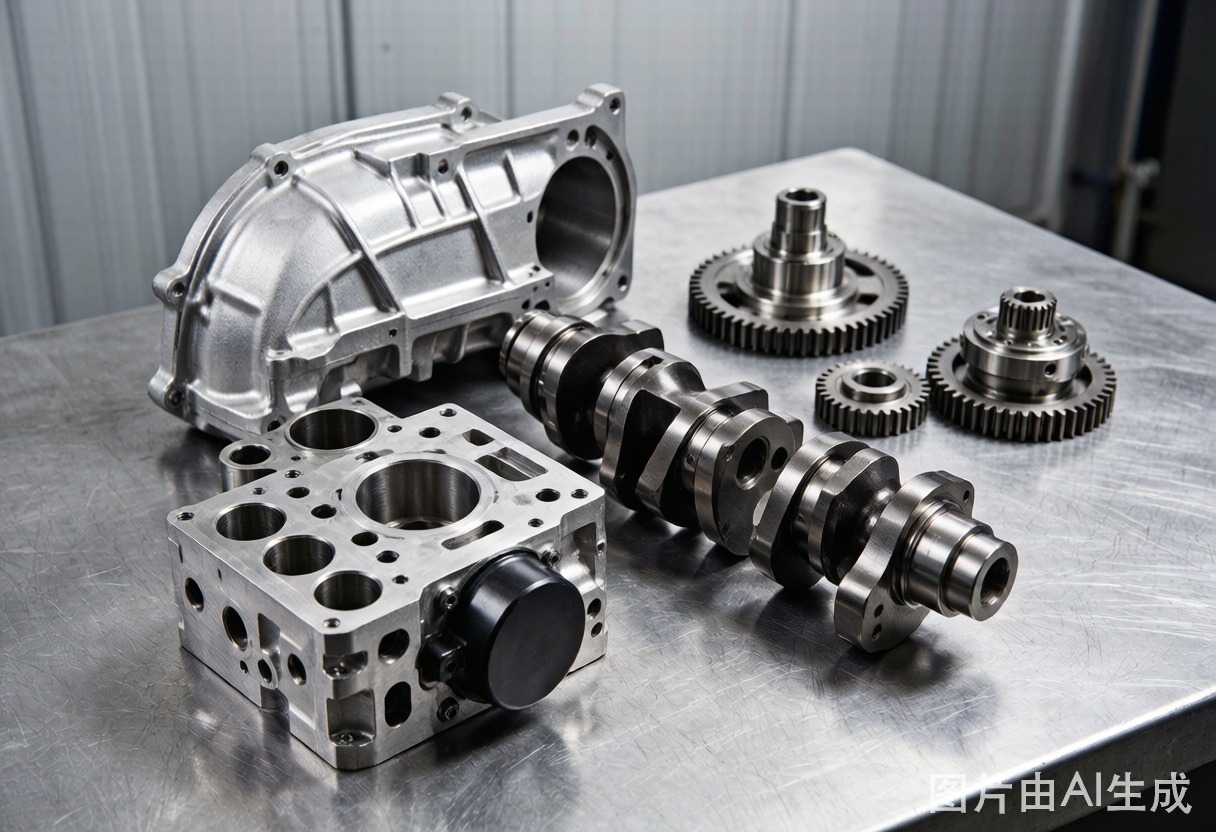
Table of Contents
- 1. Engine Components: Forging, Casting & CNC Machining
- 2. Transmission & Drivetrain: Precision Gears, Shafts & Housings
- 3. Chassis & Suspension: Stamping, Forging & Sheet Metal
- 4. Body & Exterior: Stamping, Extrusion & Laser Cutting
- 5. Braking System Components: Casting & CNC Machining
- 6. Process Comparison Table: Automotive Applications
- 7. Material Selection for Automotive Parts
- 8. How to Choose the Right Supplier for Automotive Components
1. Engine Components: Forging, Casting & CNC Machining
The engine is the heart of any vehicle, and its components face extreme conditions: temperatures exceeding 800°C, pressures over 100 bar, and rotational speeds above 6,000 RPM. Choosing the wrong manufacturing process for an engine part means catastrophic failure — not just a quality complaint, but a safety hazard.
Engine Block & Cylinder Head
Recommended process: Sand Casting or Die Casting (aluminum), Gray Iron Casting (cast iron)
Engine blocks need complex internal geometries for coolant channels and oil galleries that are impossible to machine from solid. Sand casting with CNC-machined cores achieves these internal passages while die casting delivers superior surface finish and dimensional consistency for high-volume production. Modern aluminum engine blocks are increasingly die-cast in 50,000–200,000+ unit annual volumes.
⚠ Casting Quality Warning
Porous castings lead to oil leaks and premature failure. Insist on X-ray or pressure-test inspection reports from your foundry — especially for turbocharged engine blocks where cylinder pressures are 30–50% higher than naturally aspirated.
Crankshafts & Connecting Rods
Recommended process: Hot Forging + CNC Finish Machining
Crankshafts experience cyclic bending and torsional loads millions of times over a vehicle’s lifetime. Forging aligns the metal’s grain flow along the part contour, increasing fatigue strength by 30–50% compared to cast or billet-machined equivalents. After forging, CNC machining achieves the bearing journal tolerances of ±0.005mm and surface finishes below Ra 0.4μm required for hydrodynamic bearing operation.
Pistons
Recommended process: Gravity Die Casting or Forging (aluminum alloy) + CNC Machining
Cast pistons dominate volume production due to lower cost and adequate strength for most passenger vehicles. Forged pistons are specified for high-performance and diesel applications where combustion pressures exceed 180 bar. Both require precision CNC machining of ring grooves, pin bores, and skirt profiles.
Valves & Valve Seats
Recommended process: Forging (intake/exhaust valves), Powder Metallurgy (valve seats)
Intake valves are typically forged from martensitic stainless steel; exhaust valves use nickel-based superalloys (Inconel 751) for heat resistance. Valve seats benefit from powder metallurgy’s ability to create precisely controlled porosity that retains oil for lubrication.
Key Takeaway for Engine Component Buyers
- ✓ Complex internal geometries (blocks, heads) → Casting
- ✓ High fatigue-strength parts (crankshafts, rods) → Forging + CNC
- ✓ High-precision mating surfaces → CNC finish machining after primary forming
- ✓ Small, high-volume wear parts (valve seats) → Powder Metallurgy
2. Transmission & Drivetrain: Precision Gears, Shafts & Housings
Transmission components demand the highest precision in automotive manufacturing. Gear tooth profiles with micron-level accuracy determine noise, efficiency, and service life. Unlike engine parts where strength dominates, transmission parts balance precision, surface hardness, and cost.
Gears (Helical, Spur, Bevel)
Recommended process: Forging (blank) + Hobbing/Grinding (teeth) + Heat Treatment
The gear blank is hot-forged to near-net shape, then gear teeth are cut by CNC hobbing machines. After carburizing heat treatment to achieve 58–62 HRC surface hardness, gear grinding corrects the microscopic distortion from heat treatment. This sequence achieves the DIN 5–7 gear quality class required for automotive transmissions.
For prototype and low-volume gears (1–500 pcs), CNC machining from pre-hardened steel bar stock can skip the forging step and deliver gear blanks directly to hobbing — saving 4–6 weeks of forging tooling lead time and $3,000–8,000 in tooling cost.
Transmission Shafts
Recommended process: Forging + CNC Turning/Grinding
Transmission input and output shafts are forged from medium-carbon alloy steel (SAE 8620, 20CrMnTi), then CNC-turned and ground to bearing-fit tolerances of h6 or tighter. Splines are cut by CNC hobbing or broaching depending on volume.
Transmission Housings
Recommended process: High-Pressure Die Casting (aluminum) + CNC Machining
Aluminum die casting produces transmission cases with wall thickness as thin as 2.5mm, reducing weight while maintaining structural rigidity. Post-casting CNC machining creates precision bearing bores, dowel pin holes, and sealing surfaces with flatness tolerances of 0.05mm across 400mm spans.
Differential Housings & CV Joint Components
Recommended process: Ductile Iron Casting (differential case), Forging (CV joint inner/outer races)
Differential cases in ductile iron (ASTM A536 65-45-12) offer the ideal combination of machinability, strength, and vibration damping. CV joint races require forged blanks for the grain flow needed to withstand the high contact stresses of ball-and-cage mechanisms.
3. Chassis & Suspension: Stamping, Forging & Sheet Metal
Chassis and suspension components are the structural backbone of a vehicle. They must absorb impact energy in crashes, resist fatigue from millions of road-load cycles, and maintain precise geometry for vehicle handling — all while being cost-effective to produce in volumes of 100,000+ units annually.
Control Arms & Suspension Links
Recommended process: Stamping (steel), Forging (aluminum), or Sheet Metal Fabrication (low volume)
Steel control arms for mainstream vehicles are stamped from 3–5mm HSLA steel sheet and welded into box-section structures. Aluminum control arms for premium/luxury vehicles are forged for weight savings of 30–40% per corner. For aftermarket, racing, and low-volume specialty vehicles (100–5,000 units/year), CNC-machined billet aluminum or laser-cut + TIG-welded sheet metal fabrication eliminates the $15,000–40,000 forging die investment.
Subframes & Crossmembers
Recommended process: Stamping + Welding (steel), Extrusion + Welding (aluminum)
Front and rear subframes are typically assemblies of 8–15 stamped steel components robotically MIG-welded together. Aluminum subframes use extruded profiles welded into ladder-frame structures, offering 40% weight reduction. Both require post-weld CNC machining of critical mounting points.
Springs, Stabilizer Bars & Torsion Bars
Recommended process: Hot Coiling (coil springs), Cold Forming (stabilizer bars)
Coil springs are hot-coiled from silicon-chromium steel wire, then quenched, tempered, and shot-peened for fatigue resistance. Stabilizer bars are cold-formed from solid spring steel bar, with ends flattened (forged) to create mounting eyes.
4. Body & Exterior: Stamping, Extrusion & Laser Cutting
Body panels represent the highest-volume metal forming operation in automotive manufacturing. A typical passenger car contains 300–400 stamped panels. Beyond the visual surface quality, body panels must meet crashworthiness standards and corrosion resistance requirements for 10–15 year service life.
Body Panels (Doors, Hoods, Fenders, Roof)
Recommended process: Progressive Die Stamping (steel), Superplastic Forming (aluminum, low volume)
Steel body panels are stamped in multi-stage progressive dies at rates of 10–20 parts per minute. A typical door outer panel requires 4–5 stamping operations: blanking, drawing, trimming, piercing, and flanging. The draw die alone can cost $100,000–300,000, making stamping economical only at 50,000+ annual volumes.
For low-volume vehicles, restoration parts, and prototype bodies: CNC laser cutting + CNC press brake bending can produce panels without any hard tooling. While cycle time is minutes rather than seconds, the zero-tooling approach makes it viable for runs of 10–500 parts.
Bumpers & Crash Beams
Recommended process: Roll Forming (steel beams), Aluminum Extrusion (lightweight beams)
Steel bumper reinforcement beams are roll-formed from ultra-high-strength steel (UHSS, 1,200–1,500 MPa). Aluminum alternatives are extruded in multi-chamber profiles, providing comparable energy absorption at 40–50% lower weight.
Roof Rails, Window Frames & Trim
Recommended process: Aluminum Extrusion + CNC Machining + Anodizing
Aluminum extrusions are the dominant process for roof rails and trim because the process naturally creates long, consistent profiles with complex cross-sections. Post-extrusion CNC machining adds mounting features, and anodizing provides the corrosion resistance and decorative finish.
5. Braking System Components: Casting & CNC Machining
Brake components convert kinetic energy into heat — lots of it. Brake disc temperatures can exceed 600°C during aggressive driving. The manufacturing process directly affects thermal conductivity, wear resistance, and noise/vibration characteristics.
Brake Discs (Rotors)
Recommended process: Gray Iron Casting + CNC Turning/Grinding
Gray cast iron (G3000/G3500 grade) is the universal brake disc material because its graphite flake structure provides thermal conductivity, vibration damping, and the correct friction coefficient. Discs are cast to near-net shape with internal cooling vanes formed by the sand core, then CNC-turned on both friction faces to achieve <0.05mm thickness variation — critical to avoid brake judder.
Brake Calipers
Recommended process: Gravity Die Casting or Sand Casting (aluminum) + CNC Machining
Fixed calipers (performance vehicles) are typically two-piece aluminum castings bolted together after machining the internal fluid passages. Floating calipers (mainstream vehicles) are single-piece castings with a sliding pin mechanism. CNC machining creates the piston bores with 0.02mm cylindricity tolerances and the sealing surfaces.
Brake Master Cylinders
Recommended process: Aluminum Die Casting + Honing
The master cylinder bore requires a mirror finish (Ra < 0.1μm) achieved by diamond honing after casting and pre-machining. This surface quality is essential for seal life and consistent brake pedal feel.
6. Process Comparison Table: Automotive Applications
This table maps every major automotive system to its optimal manufacturing process, with key selection criteria:
| Component | Primary Process | Typical Material | Annual Volume | Tooling Cost | Key Tolerance |
|---|---|---|---|---|---|
| Engine Block | Die Casting / Sand Casting | A356 / Gray Iron | 50K–300K | $50K–$200K | ±0.3mm |
| Crankshaft | Hot Forging + CNC Grinding | SAE 1045 / 4340 | 30K–200K | $20K–$60K | ±0.005mm |
| Connecting Rod | Hot Forging + CNC Machining | C70 Steel / 4340 | 50K–300K | $15K–$40K | ±0.01mm |
| Piston | Gravity Die Cast / Forging | Al-Si Alloy | 100K–1M | $30K–$80K | ±0.01mm |
| Transmission Gear | Forging + Hobbing + Grinding | SAE 8620 / 20CrMnTi | 30K–150K | $15K–$50K | DIN 5–7 class |
| Transmission Housing | High-Pressure Die Casting | A380 / ADC12 | 30K–200K | $60K–$180K | ±0.1mm |
| Control Arm | Stamping (steel) / Forging (Al) | HSLA Steel / 6082-T6 | 100K–500K | $30K–$120K | ±0.5mm |
| Subframe | Stamping + Welding | DP600 Steel / 6061-T6 | 50K–300K | $200K–$500K | ±0.5mm |
| Body Panel | Progressive Die Stamping | DC04 / BH Steel | 100K–1M | $100K–$300K | ±0.5mm |
| Brake Disc | Iron Casting + CNC Turning | G3000 Gray Iron | 50K–500K | $15K–$40K | 0.05mm TTV |
| Brake Caliper | Gravity Die Casting + CNC | A356 / 6082 | 30K–200K | $25K–$70K | ±0.02mm |
| Bumper Beam | Roll Forming / Extrusion | UHSS / 6082-T6 | 50K–300K | $30K–$80K | ±0.5mm |
| C.V. Joint Race | Hot Forging + CNC Grinding | SAE 8620 | 50K–300K | $15K–$40K | ±0.005mm |
| Master Cylinder | Die Casting + Honing | A380 | 30K–200K | $25K–$60K | Ra < 0.1µm |
7. Material Selection for Automotive Parts
The automotive industry uses a carefully selected palette of materials — each chosen for a specific balance of strength, weight, cost, and manufacturability:
| Material Family | Key Grades | Typical Application | Why Chosen |
|---|---|---|---|
| Gray Cast Iron | G3000, G3500, GG25 | Brake discs, flywheels | Thermal conductivity, damping, wear resistance |
| Ductile Iron | ASTM A536 65-45-12 | Crankshafts, differential cases | Strength + machinability + damping |
| Aluminum Casting | A356, A380, ADC12 | Engine blocks, transmission cases | Lightweight, castability, thermal conductivity |
| Forged Steel | SAE 8620, 4340, 20CrMnTi | Gears, shafts, connecting rods | Fatigue strength, hardenability |
| HSLA Steel | DP600, DP800, CP1000 | Body structure, chassis | High strength-to-weight, formability |
| Stainless Steel | 409, 304, 17-4PH | Exhaust systems, fasteners | Corrosion and heat resistance |
| Aluminum Alloys | 6061-T6, 6082-T6, 7075-T6 | Suspension arms, subframes | Weight reduction, extrusion compatibility |
| Spring Steel | SAE 9254, 55Cr3, SUP9 | Coil springs, stabilizer bars | High yield strength, fatigue life |
8. How to Choose the Right Supplier for Automotive Components
Selecting a manufacturing partner for automotive parts goes beyond price comparison. Here is a practical evaluation framework:
1. Process Coverage
Can your supplier handle the complete process chain? An engine bracket might need stamping, welding, CNC machining, and surface treatment. A supplier that can perform all steps in-house eliminates logistics costs, quality gaps at hand-offs, and schedule risk from multi-vendor coordination.
2. Quality Certifications
At minimum, look for ISO 9001:2015. For direct Tier-1 or Tier-2 supply, IATF 16949 is the automotive-specific quality management standard that most OEMs require. This certification includes PPAP (Production Part Approval Process), FMEA, and SPC requirements specific to automotive.
3. Volume Flexibility
Can your supplier scale with you? A supplier optimized for 100,000 units/year may struggle with 5,000/year prototype runs — and vice versa. Look for suppliers who can handle both low-volume prototype runs (50–500 pcs) and production ramp-up (50,000+).
Supplier Evaluation Checklist
- ✓ Request IATF 16949 or ISO 9001 certificate (verify expiration date)
- ✓ Ask for PPAP Level 3 documentation samples from previous projects
- ✓ Confirm in-house process coverage: forming + machining + finishing
- ✓ Verify material traceability system (heat lot tracking to mill certificates)
- ✓ Request capacity data: lead time at both 500-unit and 50,000-unit volumes
- ✓ Check CMM and surface roughness measurement capabilities in-house
Ready to Start Your Project?
Our engineering team will respond within 24 hours with a detailed quotation.