
Renewable Energy Components Manufacturing: Metal Processes for Wind, Solar & Energy Storage
From wind turbine hubs to solar tracker brackets — a complete process selection guide for renewable energy hardware. Compare casting, forging and sheet metal fabrication to balance structural strength, corrosion resistance and cost at utility scale.
Table of Contents
- 1. Wind Turbine Components: Casting & Forging
- 2. Solar Mounting & Tracking Systems
- 3. Energy Storage Enclosures
- 4. Hydrogen & Fuel Cell Metal Parts
- 5. Material Selection for Energy Components
- 6. Process Comparison Table: Energy Applications
- 7. Quality & Corrosion Requirements
- 8. How to Choose a Renewable Energy Parts Supplier
->
1. Wind Turbine Components: Casting & Forging
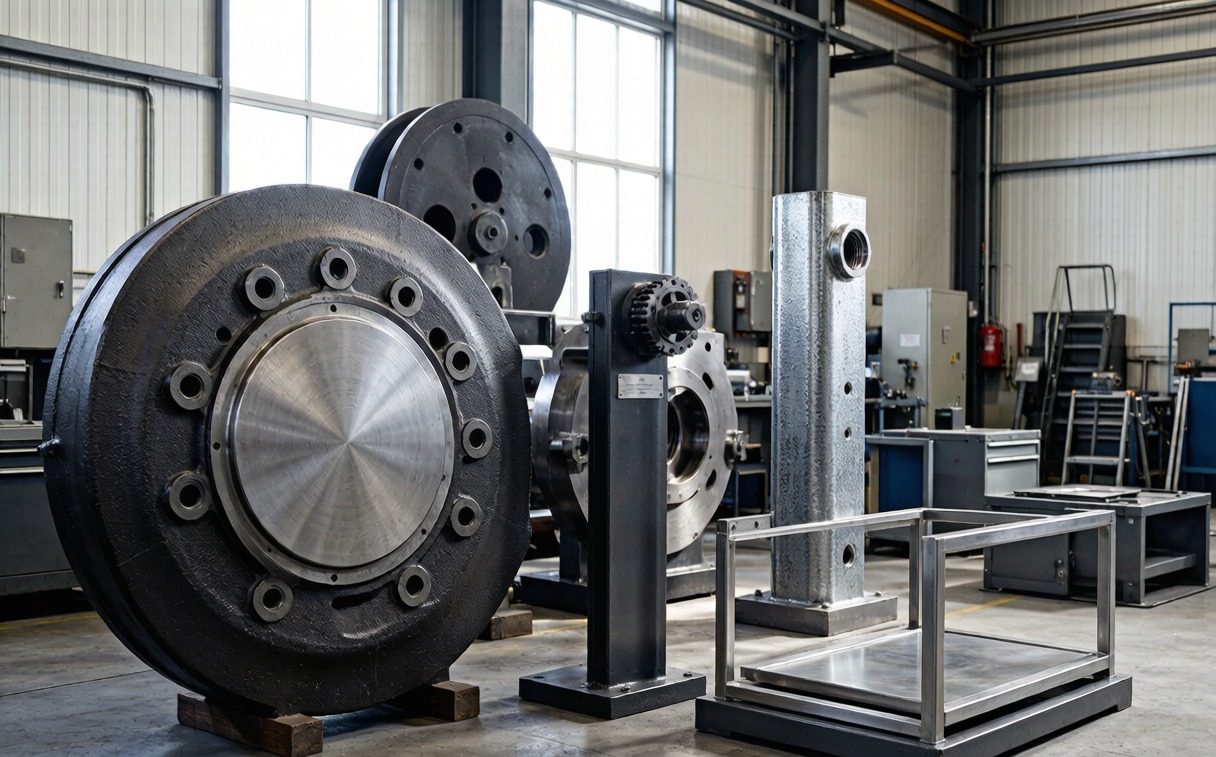
A single modern turbine contains over 8,000 components, many of them large, load-bearing castings and forgings that must survive 20+ years of cyclic wind load. The hero parts are the hub, bedplate, and rotor shafts.
Hub & Bedplate (Mainframe)
Recommended process: Ductile Iron Casting (spheroidal graphite) + CNC Machining
The hub that connects three blades and the bedplate that carries the drivetrain are among the largest castings in industry — often 10–40 tonnes each. Ductile iron (EN-GJS-400-18U-LT) combines castability of complex shapes with the toughness to survive −20°C winter loads. After casting, large gantry CNC machines finish bearing seats to ±0.1mm across spans of several meters.
Rotor & Main Shafts
Recommended process: Open-Die Forging + CNC Machining
Main shafts transfer torque from rotor to gearbox and must resist both torsion and bending fatigue. Open-die forging of alloy steel (42CrMo4 / 34CrNiMo6) aligns grain flow along the shaft axis, then large lathes and grinders achieve the journal and flange tolerances. A single forged main shaft can weigh 15–30 tonnes.
⚠ Casting Integrity Warning
Wind castings are safety-critical. Require UT (ultrasonic) and MT (magnetic particle) inspection per ISO 4990 / EN 12680, plus EN 10204 3.2 certification — never accept visual-only inspection on hub or bedplate.
2. Solar Mounting & Tracking Systems
Solar hardware is high-volume, outdoor, and cost-sensitive. The processes that win are those that scale cheaply while resisting decades of weather.
Ground-Mount Racking & Torque Tubes
Recommended process: Roll Forming + Sheet Metal Fabrication (galvanized steel) or Aluminum Extrusion
Torque tubes for single-axis trackers are roll-formed from galvanized steel at high line speed, then laser-cut and bolted into assemblies. For corrosion-sensitive coastal sites, aluminum extrusions are used despite higher material cost. A utility-scale site can need 50,000+ linear meters of tube.
Tracker Structures & Piles
Recommended process: Stamping + Welding (brackets), Driven Steel Piles (posts)
Foundation piles are driven steel sections; connection brackets are stamped and welded. Hot-dip galvanizing (ISO 1461) is the standard corrosion protection, delivering 30+ year life without maintenance.
3. Energy Storage Enclosures
Battery energy storage systems (BESS) need enclosures that are structurally robust, thermally managed, and fire-safe.
Battery Cabinet & Container Frames
Recommended process: Sheet Metal Fabrication (aluminum / steel) + Powder Coating
Cabinet enclosures are laser-cut, bent, and welded sheet, with CNC-machined busbar mounts for electrical isolation. Container-scale frames use structural steel fabrication. Powder coating provides the durable, V-0 flammability-rated exterior required for outdoor BESS deployment.
4. Hydrogen & Fuel Cell Metal Parts
The hydrogen economy demands parts that resist hydrogen embrittlement and hold gas-tight seals.
Bipolar Plates & Manifolds
Recommended process: Stamping (graphite-coated steel) or CNC / Photo-Chemical Etching (prototypes)
Bipolar plates carry reactant gases through the stack and need micro-channels at ±0.02mm. High-volume plates are progressive-die stamped from thin stainless; prototypes are CNC-milled or photo-chemically etched. Material must be selected to avoid hydrogen embrittlement.
5. Material Selection for Energy Components
| Material | Use Case | Property | Protection |
|---|---|---|---|
| Ductile Iron GJS-400 | Hub, bedplate | Castable, tough | Paint / primer |
| 42CrMo4 Forged | Main shaft | Fatigue strength | Machined + coat |
| Galvanized Steel | Racking, piles | Cheap, strong | Hot-dip Zn (ISO 1461) |
| Aluminum 6005A | Tracker extrusions | Light, corrosion-proof | Anodize / none |
| 304 / 316 Stainless | Coastal, fuel cell | Corrosion-proof | None / passivate |
6. Process Comparison Table: Energy Applications
| Component | Primary Process | Scale | Tolerance | Key Req. |
|---|---|---|---|---|
| Turbine hub | Ductile iron cast | 1–500/yr | ±0.1mm | UT/MT inspect |
| Main shaft | Open-die forge | 1–500/yr | ±0.1mm | Grain flow |
| Tracker tube | Roll form + laser | 10K–1M m | ±0.5mm | Galvanized |
| BESS cabinet | Sheet + weld | 100–50K | ±0.5mm | Powder coat |
| Bipolar plate | Stamping / etch | 1K–1M | ±0.02mm | Embrittlement-safe |
7. Quality & Corrosion Requirements
Renewable assets are warranted for 20–25 years and often sit in the harshest environments on earth. Corrosion protection (hot-dip galvanizing, anodizing, or ISO 12944 C4/C5 coating systems) and NDT inspection on structural castings/forgings are mandatory. For offshore wind, specify stainless or super-duplex to survive salt spray.
Supplier Checklist for Energy Components
- ✓ ISO 9001 + experience with large structural castings/forgings
- ✓ In-house or certified NDT (UT/MT/RT) capability
- ✓ Galvanizing / anodizing / powder coat partnerships
- ✓ EN 10204 3.1 / 3.2 material certification
- ✓ Track record on utility-scale (100MW+) projects
- ✓ Ability to hold tolerances on meter-scale parts
8. How to Choose a Renewable Energy Parts Supplier
The right partner balances heavy-process capability (casting, forging, fabrication) with the quality systems a 20-year warranty demands. Prioritize suppliers who can show certified NDT, material traceability, and previous utility-scale delivery — not just the lowest quote.
Ready to Start Your Project?
Our engineering team will respond within 24 hours with a detailed quotation.