
Custom metal screws turn up everywhere a product has to hold itself together, and off-the-shelf hardware rarely matches the geometry, material, or finish an engineered assembly actually needs. When a standard pan-head machine screw cannot clear a housing, resist vibration, or survive a corrosive environment, a made-to-print screw is the cheapest way to remove risk from the bill of materials. This guide walks through the decisions that matter when you order CNC turned screws so the first article you receive is the article you ship. We cover materials, thread forms, head styles, surface treatment, and the tolerance band that keeps cost predictable.
Why Buy Custom Instead of Standard Screws
Stock screws are optimized for volume, not for your assembly. A custom screw lets you merge a fastener and a locating feature into one part, shorten overall length to save weight, or add a shoulder that spaces a bearing. Swiss-type turning is especially effective for long, slender screws where concentricity between the thread and the shoulder must hold within a few microns.
The second reason is supply assurance. When a catalog screw is discontinued or back-ordered, production stops. A qualified shop can hold your drawing on file and run replenishment batches on a fixed schedule, which is why many buyers move recurring fasteners to a custom metal fasteners program rather than gambling on distributor stock.
Material Selection Drives Everything Else
Stainless 303 and 316 are the default for corrosion resistance, but 316 machines more slowly and work-hardens if feeds are wrong. Brass and aluminum screws are chosen for weight or electrical conductivity; low-carbon steel is the value option when plating carries the corrosion load. CNC milling is sometimes used to slot or hex a head after the body is turned.
For high-temperature or magnetic-environment service, consider precipitation-hardened grades, but confirm machinability and cost before committing. We publish a deeper comparison in our stainless steel machining guide that maps grade to cycle time.
Thread Form, Class, and How Tight Is Tight Enough
Most custom screws use metric or unified coarse threads because they resist cross-threading and assemble faster. Thread class (e.g. 6g/6H or 2A/2B) sets the clearance; tightening the class raises inspection cost without improving function for most joints. Specify the smallest class that assembles reliably.
If the screw sees cyclic load, consider a thread-locking patch or a prevailing-torque feature molded into the thread, applied after the body is finished. We can coordinate this with heat treatment when the shank needs higher strength than the base metal provides.
Head Styles and Drive Features
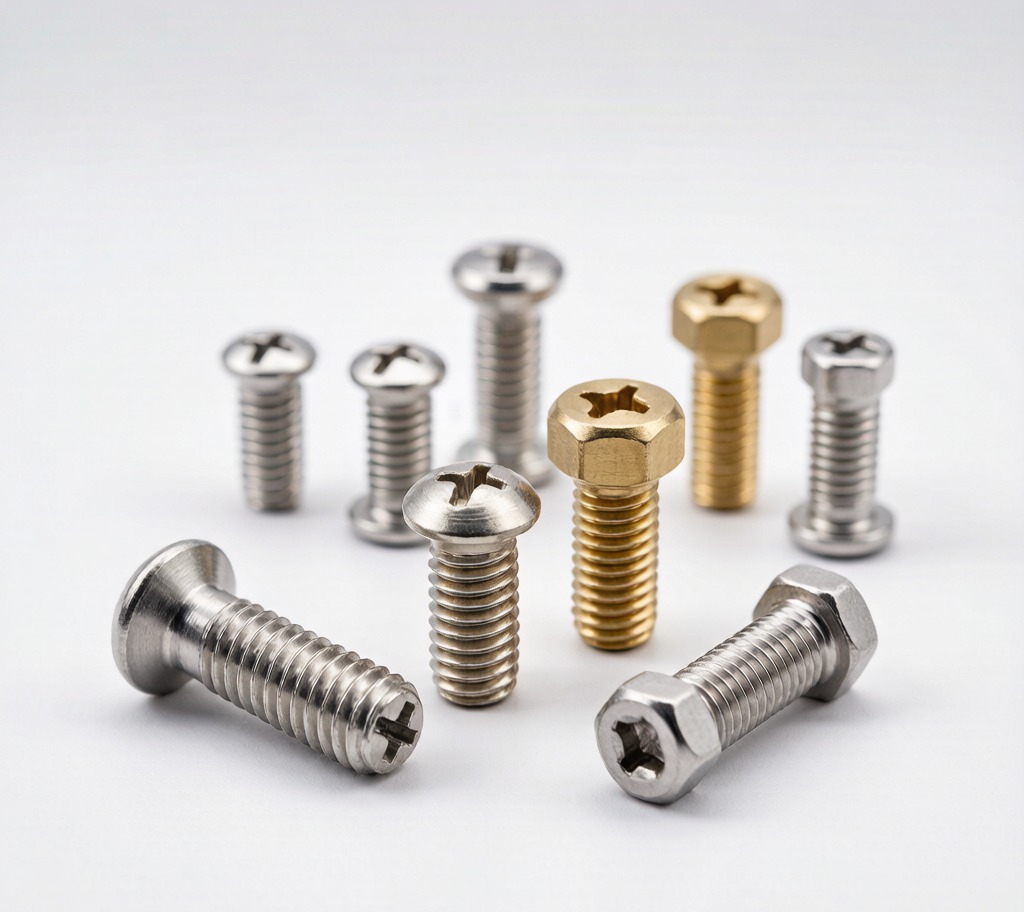
Pan, flat, button, socket, and hex heads each trade off driving torque, clearance, and tool access. A countersunk head sits flush; a truss head spreads clamp load over a larger area. Torx and hex drives resist cam-out better than slotted, which reduces assembly scrap on the line.
Custom heads can also embed a locating boss or a sealing face. These combined features are where CNC milling and turning work together to cut total part count.
Surface Treatment and Plating
Zinc and zinc-nickel plating protect steel in most indoor and light-outdoor environments; passivation restores the chromium oxide layer on stainless so it does not rust in crevices. Anodizing is for aluminum screws where color or insulation matters. Pick the finish from the service environment, not from habit.
Our plating partners run zinc plating and passivation in-house, and we can quote anodizing for aluminum bodies so you get one accountable supplier instead of three.
Tolerances That Keep Cost Predictable
Hold diameter to +/-0.02 mm and length to +/-0.05 mm for general screws; tighten only where a shoulder or thread must locate another part. Dimensional callouts that exceed the process capability simply move the job to a more expensive machine. A short precision machined parts review before release prevents this.
Ask for a first-article inspection report on the initial batch, then switch to skip-lot inspection once the process is proven. That balance keeps quality high without paying for 100 percent inspection forever.
Quality Control and Inspection
Every custom metal screws order begins with a first-article inspection. We measure the critical dimensions on a CMM or dedicated gauge and compare them to your drawing before any volume runs start. Only after you approve the report do we release production, so the first batch is already at spec rather than a learning curve.
For functional features we add targeted checks, from thread gauging on fasteners to flatness, squareness, and runout on frames and shafts, and we keep a traveller with the lot so a later question can be traced to the exact machine setup. That discipline is what keeps reject rates low across repeat orders.
We also confirm the finish and any marking against the approved sample, because a good dimension on a badly finished part still fails on the line. Surface, color, and legend are inspected alongside the numbers so what ships matches what you signed off.
Lead Time and How to Request a Quote
Quoting custom metal screws is fast when you send a drawing, a sample, or even a marked sketch with the key dimensions called out. We return a price with DFM feedback, a recommended material, and a realistic lead time, usually within one business day, so you can plan the build without waiting on a vendor.
Prototype quantities run in days; production batches scale with material and finish, and we can hold your drawing on file for fixed-schedule replenishment so you keep stock without tying up cash in inventory you do not need yet. Tell us annual volume and we set the cadence.
If you are unsure of the best process, ask. A short call before release often saves a costly rework, and we would rather steer you to the cheaper capable route than quote the one you assumed. The goal is a part that assembles first time at the right cost.
Common Specification Mistakes to Avoid
The most expensive mistake on custom metal screws is over-tightening tolerances the assembly never needed. Every step past process capability adds cost per feature, so call out only the dimensions that locate or seal another part and leave the rest to standard commercial limits. Tight where it counts, loose where it does not.
The second mistake is forgetting the datum and the environment. State which surface everything is measured from, and name the service condition, indoor, outdoor, washdown, or vacuum, so the material and finish are chosen once and not reworked after a field failure.
The third is treating finish as an afterthought. Plating, anodize, or coating change dimensions and must be in the tolerance stack from the start. Tell us the final coated size you need and we will machine to suit, instead of discovering the coat pushed you out of spec at the end.
Frequently Asked Questions
What is the minimum order for custom metal screws?
Prototype batches can start at a few hundred pieces; economical pricing typically begins around 1,000 to 5,000 pieces depending on material and finish.
Can you match an existing sample screw?
Yes. Send the sample and we reverse-engineer the thread, head, and material, then confirm with a first-article report before a production run.
Which plating resists salt spray best?
Zinc-nickel with a topcoat, or passivated 316 stainless, performs best in salt environments; plain zinc is fine for indoor use.
Do you assemble screws with thread-locker?
We can apply pre-applied micro-encapsulated thread-locker or a nylon patch after finishing so the screw arrives line-ready.
How fast is a quote?
With a drawing or sample, most quotes return within one business day including DFM feedback.
Ready to Start Your Custom Part?
Send us your drawing or sample and get a competitive quote with DFM feedback, lead time, and material recommendation within one business day.

