
Custom metal rods are the starting shape for shafts, pins, spacers, and axles, and the way you specify them decides whether the next operation is trivial or troublesome. A rod that is already round within a micron needs no pre-turning; one that is straight and cleanly cut saves a facing pass. This article compares turned, ground, and extruded rod, explains the tolerance each delivers, and shows how to brief a supplier so the bar arrives ready for the next step. We tie the choice to centerless grinding and CNC turning that finish it.
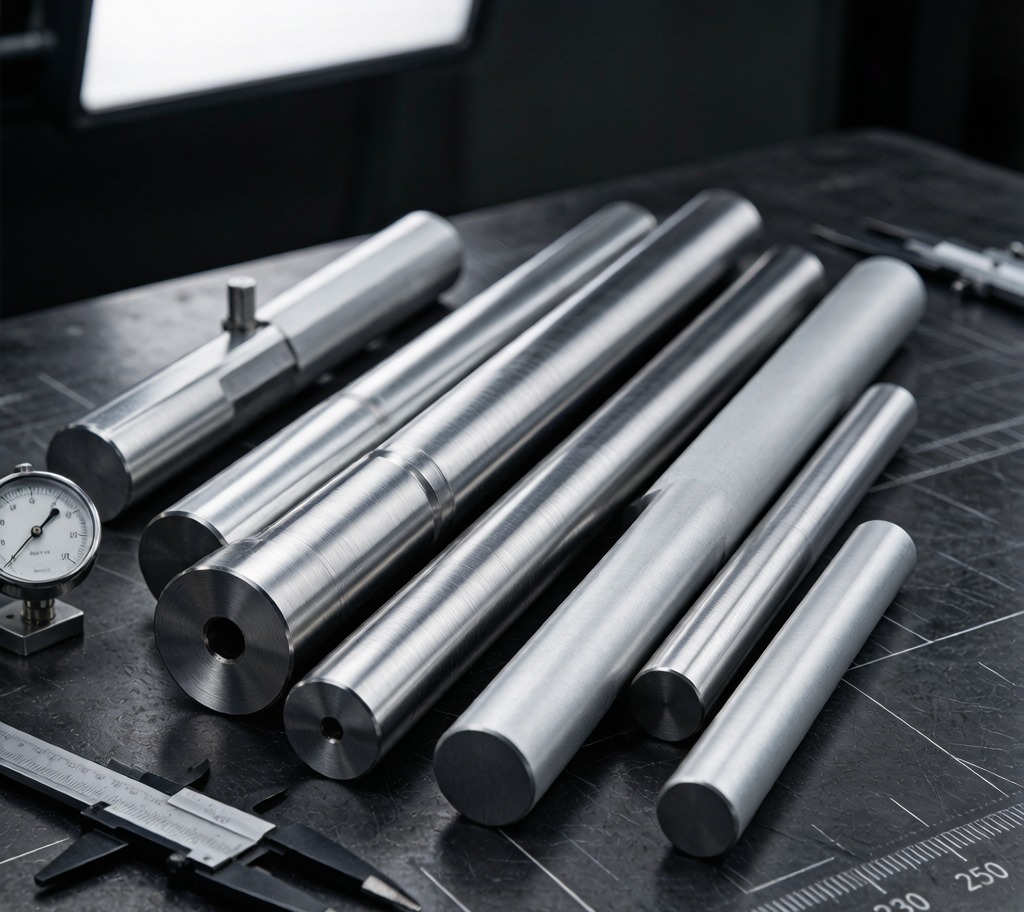
Turned Rod from Bar Stock
The most common route is to chuck bar stock and turn it to diameter, often on a Swiss machine for long thin rods. This gives you any diameter and a clean end face, and it is flexible for low volumes and mixed diameters along the length.
Turning sets the baseline; if you need better roundness you follow it with grinding. Our CNC turning services cover both bar and cut-to-length blanks.
Centerless and Cylindrical Grinding
When roundness and finish matter, centerless grinding removes a few hundredths of a millimeter to hit tight diameter bands without marking the surface. Cylindrical grinding between centers handles longer or stepped rods where the ends must locate.
Ground rod is the right feedstock for linear guides, bushings, and precision shafts where a sliding fit depends on consistency lot to lot.
Extruded Rod for Long or Shaped Sections
Aluminum extrusion and steel extrusion push heated billet through a die to make long, constant-section rod, including non-round profiles that would be costly to machine. It is the economical choice for long runs of a fixed shape.
Extrusion trades some dimensional precision for speed and material savings; plan a light machining pass on critical faces if tolerances are tight.
Material and Straightness
Choose the alloy from strength, corrosion, and weight. 303 and 316 stainless are common; 6061 and 7075 aluminum for light duty; mild and alloy steel for strength. Straightness matters for long rods that must pass through a bearing or guide.
For rotating parts, read our precision shaft manufacturing notes on runout and how grinding controls it.
Tolerance and Finish Band
Turned rod holds around +/-0.02 mm; ground rod reaches a few microns with a bright finish. Specify the band you actually assemble to and no tighter, because every step up in precision adds cost per millimeter removed.
If the rod is a spacer, length tolerance may matter more than diameter; call that out so the shop measures the right feature.
Cutting to Length and Deburring
A clean square cut with a small end chamfer prevents burrs from scratching mating parts. Specify cut length, squareness, and whether ends are faced or simply sawn.
We deburr every cut rod so it is safe to handle and will not foul an assembly, and we can combine rod supply with a steel extrusion program for shaped sections.
Quality Control and Inspection
Every custom metal rods order begins with a first-article inspection. We measure the critical dimensions on a CMM or dedicated gauge and compare them to your drawing before any volume runs start. Only after you approve the report do we release production, so the first batch is already at spec rather than a learning curve.
For functional features we add targeted checks, from thread gauging on fasteners to flatness, squareness, and runout on frames and shafts, and we keep a traveller with the lot so a later question can be traced to the exact machine setup. That discipline is what keeps reject rates low across repeat orders.
We also confirm the finish and any marking against the approved sample, because a good dimension on a badly finished part still fails on the line. Surface, color, and legend are inspected alongside the numbers so what ships matches what you signed off.
Lead Time and How to Request a Quote
Quoting custom metal rods is fast when you send a drawing, a sample, or even a marked sketch with the key dimensions called out. We return a price with DFM feedback, a recommended material, and a realistic lead time, usually within one business day, so you can plan the build without waiting on a vendor.
Prototype quantities run in days; production batches scale with material and finish, and we can hold your drawing on file for fixed-schedule replenishment so you keep stock without tying up cash in inventory you do not need yet. Tell us annual volume and we set the cadence.
If you are unsure of the best process, ask. A short call before release often saves a costly rework, and we would rather steer you to the cheaper capable route than quote the one you assumed. The goal is a part that assembles first time at the right cost.
Common Specification Mistakes to Avoid
The most expensive mistake on custom metal rods is over-tightening tolerances the assembly never needed. Every step past process capability adds cost per feature, so call out only the dimensions that locate or seal another part and leave the rest to standard commercial limits. Tight where it counts, loose where it does not.
The second mistake is forgetting the datum and the environment. State which surface everything is measured from, and name the service condition, indoor, outdoor, washdown, or vacuum, so the material and finish are chosen once and not reworked after a field failure.
The third is treating finish as an afterthought. Plating, anodize, or coating change dimensions and must be in the tolerance stack from the start. Tell us the final coated size you need and we will machine to suit, instead of discovering the coat pushed you out of spec at the end.
Frequently Asked Questions
Turned or ground rod for a sliding fit?
Ground rod; turning alone rarely holds the roundness a sliding fit needs.
Can you supply non-round rod?
Yes, via extrusion or profile grinding; tell us the cross-section tolerance.
What straightness can you hold?
Depends on length and process; we confirm achievable straightness from your drawing.
Do you cut to length?
Yes, with deburred, lightly chamfered ends and length tolerance to your spec.
Minimum order?
Prototype lengths available; coil or bar minimums apply for extrusion runs.
Ready to Start Your Custom Part?
Send us your drawing or sample and get a competitive quote with DFM feedback, lead time, and material recommendation within one business day.

