
Stress relieving services reduce the residual stresses introduced by machining, welding, forging, or cold working, without significantly changing a part’s hardness. The goal is dimensional stability: a stress-relieved component is far less likely to distort during final machining or in service. For precision parts, stress relief is often the difference between a part that holds tolerance and one that creeps out of spec after it leaves the shop, especially on large or thin sections where internal stress is hardest to predict.
This article explains what stress relieving does, when to specify it, and how it fits alongside other heat treatments in a complete process plan.
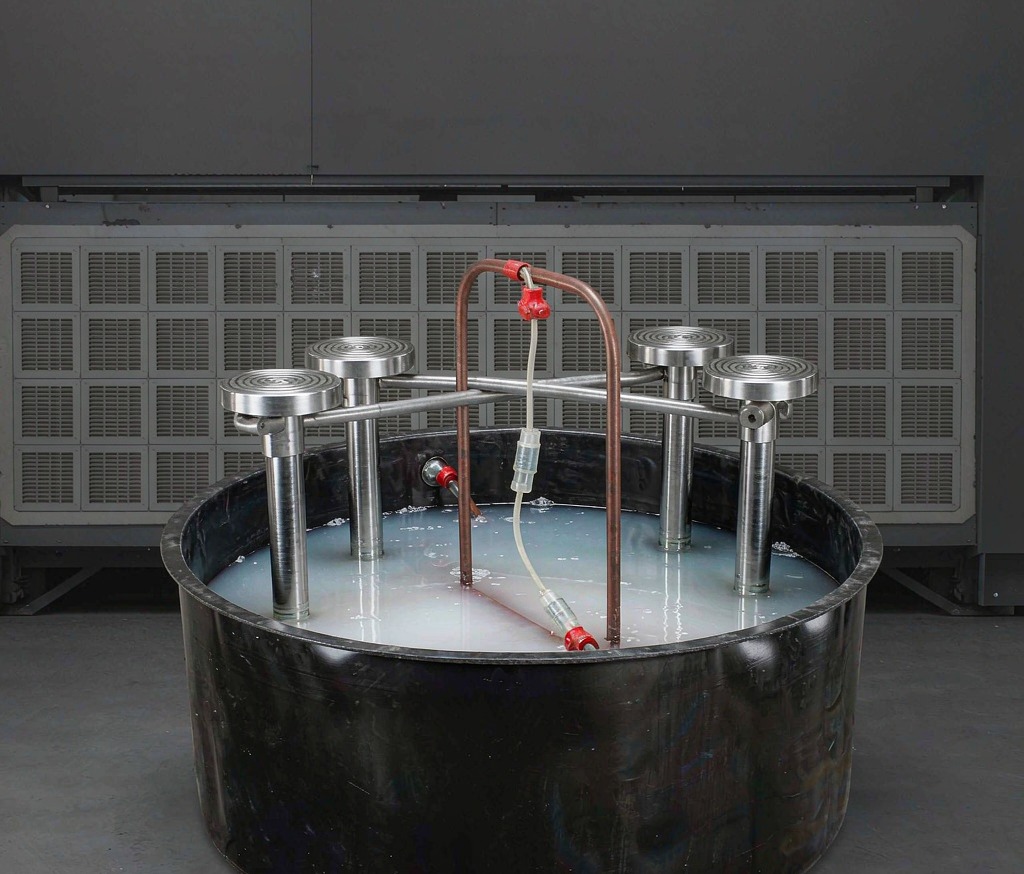
What Stress Relieving Does
Residual stress builds up as metal is cut, formed, or joined, and it stores energy that can release as distortion later. Stress relieving heats the part below the transformation temperature and holds it long enough for internal stresses to relax, then cools it slowly. The result is a more stable component. Our heat treatment“>heat treatment cell is set up for precisely this purpose, with furnaces and cycles documented for repeatability.
When to Specify Stress Relief
Specify it after heavy machining of large parts, after welding, and before final precision operations. Parts that will be finish-machined to tight tolerance benefit most, because the roughing passes that remove the most material also leave the most residual stress. Our metal forging services often include stress relief to stabilize forged geometry before any precision cutting begins.
Process Parameters and Equipment
Temperature and soak time depend on material and section thickness, and we select them from established practice for the alloy in question. We use controlled furnaces with documented cycles so results are repeatable batch to batch. Post-relief, CNC milling“>CNC milling and CNC turning“>CNC turning can be completed with much lower risk of distortion, protecting the tolerances you paid to hold.
Stress Relief vs Other Heat Treatments
Unlike hardening or aging, stress relief does not aim to change hardness. It is a stabilization step that prepares the part for the next operation. Related treatments such as annealing go further and may soften the part; our heat treatment services cover the full range so the right process is chosen for each part rather than a generic one-size-fits-all cycle.
Dimensional Stability After Machining
By removing residual stress before finish cuts, the final dimensions stay put after the part leaves the shop. Critical faces are then refined with surface grinding“>surface grinding, cylindrical grinding“>cylindrical grinding, or centerless grinding“>centerless grinding to the required flatness and roundness, with confidence that the part will not move in storage or assembly.
Quality Verification
We document furnace cycles and, where needed, verify stability by remeasuring parts after a hold period to confirm they have not moved. Our precision machined parts program depends on this discipline for tight-tolerance work where a few microns of drift is the difference between pass and scrap.
Lead Time and Quote Process
Send the part or drawing with material, size, and required stability. We quote a cycle and lead time, and can process prototypes or production batches, with first-article verification available when the application demands it.
When Stress Relief Pays for Itself
Stress relief is inexpensive relative to the cost of a scrapped finish-machined part or a field failure from distortion. The clearest payback is on large or thin sections where roughing leaves high residual stress, and on welded fabrications that would otherwise move after machining. Specifying a relief cycle before the final cut is a small addition to the process route that protects the much larger value of the finished component.
It also pays off in fewer surprises. A part that has been stabilized is predictable in storage, assembly, and service, which simplifies downstream operations and reduces the emergency reworks that disrupt a production schedule.
How We Ensure Quality on Stress Relief
We document the furnace cycle for every load and, where stability is critical, verify it by remeasuring parts after a hold period to confirm they have not moved. This evidence is what lets a tight-tolerance program trust the part after it leaves the furnace.
For parts that will be ground or finish-turned afterward, we coordinate the relief with the machining sequence so the final operations are performed on a stable workpiece, giving you the dimensions you specified rather than what the residual stress decided.
Because the process is low-risk and well understood, stress relief can often be combined with other heat-treatment steps to save handling, and we will propose that consolidation whenever it helps your lead time or cost without compromising the result.
Frequently Asked Questions
What does stress relieving actually do?
It relaxes residual stresses from machining, welding, or forming, improving dimensional stability without changing hardness much.
When should stress relief be specified?
After heavy machining, welding, or forging, and before final precision operations on tight-tolerance parts.
Does it change hardness?
Generally no; it is a stabilization step, not a hardening treatment.
How are results verified?
Furnace cycles are documented, and stability can be confirmed by remeasuring parts after a hold.
Which parts benefit most?
Large, thin, or precision parts where distortion would cause fit or function problems.
Can you stress relieve prototypes and production?
Yes. Both prototype and production batches are supported with documented cycles.
Ready to Start Your Project?
Get a build-ready quote on your custom metal parts within 24 hours. Share your drawing and our engineers will respond with process, lead time, and pricing.

