
When a component needs the strength of forged metal but the thin, precise walls of a turned part, flow forming is often the ideal process. It reshapes a metal blank by forcing it against a rotating mandrel, flowing the material into a longer, thinner, stronger shape.
This guide explains what flow forming is, how it compares with spinning and extrusion, which materials and applications suit it, and the design rules that make a program successful. It is a powerful option for cylinders, housings, and wheels.
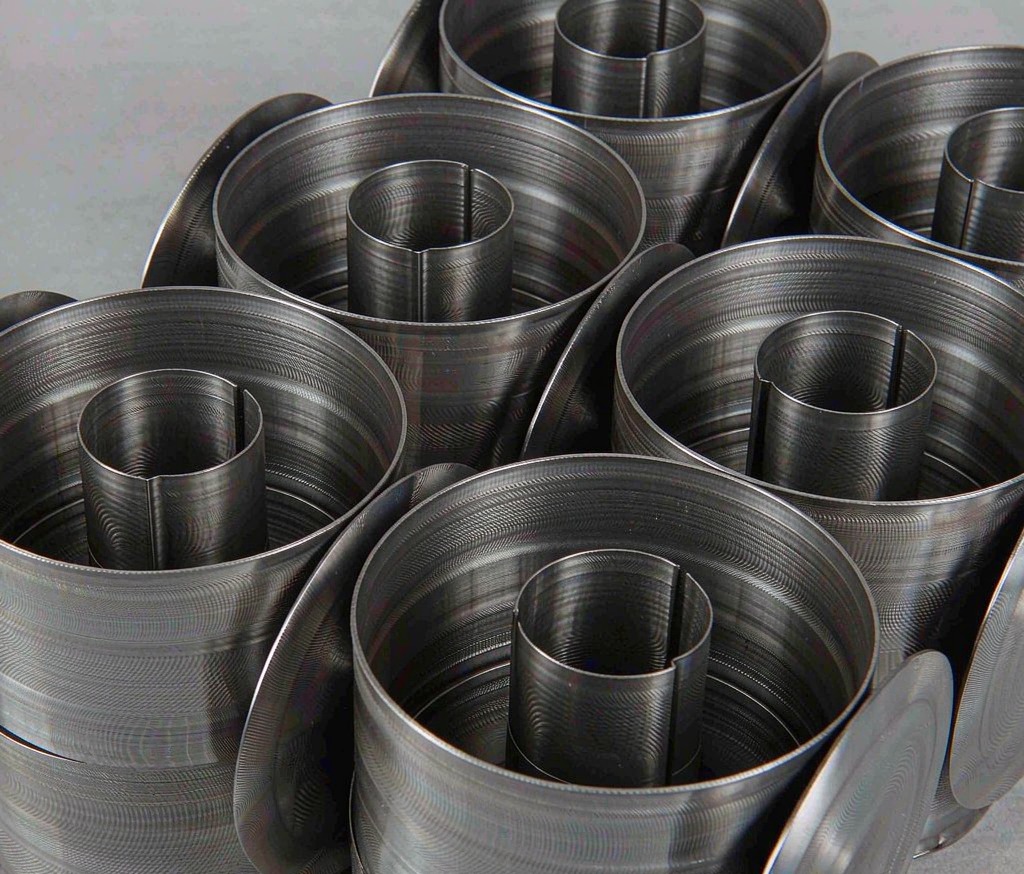
What Is Flow Forming
Flow forming – also called spin forming or shear forming – begins with a heated or cold disk or preform spun on a mandrel. One or more rollers press the material, reducing wall thickness while lengthening the part along the axis. The metal’s grain structure stretches and aligns, raising strength.
The result is a component with excellent dimensional control and mechanical properties close to forging, produced with far less material waste than machining from solid stock.
Flow Forming vs Spinning and Extrusion
Conventional metal spinning bends sheet over a mandrel but does not thin the wall as aggressively, limiting strength gains. Hot extrusion and cold extrusion push material through a die and are excellent for solid or constant sections but less flexible for precise thin walls.
Flow forming sits between them: it delivers thin, strong, accurately sized walls that neither spinning nor extrusion matches as cleanly for tubular geometries.
Materials and Wall-Thickness Control
Aluminum, carbon and stainless steel, copper, and titanium all flow well under the right temperature and roller force. Wall thickness can be reduced and held to tight tolerances, often removing the need for later surface grinding.
Starting from hot extruded or cold extruded preforms lets the process begin close to net shape, improving yield and cycle time.
Applications: Wheels, Cylinders, and Housings
Flow-formed wheels are lighter and stronger than pressed versions. Pressure vessels, sensor housings, and tube fabricated assemblies use the process for uniform thin walls. It is also common in aerospace and automotive drive components.
Where a CNC bent or laser-cut tube blank feeds the line, flow forming completes the precision geometry downstream.
Tolerances and Surface Finish
Because the mandrel defines the inner surface, bore diameter and roundness are excellent. External finish depends on roller condition and speed, and light TIG welding or heat treatment may follow for assembly or properties.
Typical tolerances rival those of machining on the controlled surface, making flow forming a true precision process rather than rough forming.
Design Guidelines
Keep wall reductions reasonable per pass, maintain generous radii at transitions, and specify the controlled surface as the bore where possible. Uniform sections flow more predictably than abrupt changes.
Sharing the end-use environment helps the shop pick temperature, reduction ratio, and post-process steps that meet both strength and tolerance goals.
Quality Control and Inspection
Flow-formed parts are checked for wall thickness, bore diameter, roundness, and surface condition, often with ultrasonic or eddy-current methods on critical items. Because the mandrel sets the bore, that surface is the most tightly controlled. Documentation of reduction ratio and temperature supports repeatability.
Lead Time and How to Request a Quote
Provide the starting preform, target wall and length, material, and tolerance. Flow forming needs a suitable blank – often ” + plink(“hot-extrusion”,”extruded”) + ” or ” + plink(“cold-extrusion”,”cold extruded”) + ” – so lead time includes preform preparation. Clear volumes help the shop balance tooling against run size.
Common Cost Drivers in Flow Forming
Flow forming pays off when wall thickness and strength matter more than raw material cost. Starting from a preform close to net shape – often an extrusion – reduces the material removed and the cycle time versus machining from a solid bar. Tooling for the mandrel and rollers is the main upfront cost, so sustained volume is what justifies the process.
Design choices control cost directly. Uniform wall sections flow more predictably than abrupt changes, and specifying the controlled surface as the bore removes most secondary operations. Providing the end-use environment lets the shop select the minimum temperature and reduction ratio that still meets properties, avoiding over-engineering that adds time without benefit.
Lead time is dominated by preform preparation and furnace scheduling rather than the forming pass itself, which is fast. Sharing annual volume helps the supplier batch work and amortize tooling, which is the most reliable way to lower the per-part price on a recurring program.
Frequently Asked Questions
How is flow forming different from metal spinning?
Spinning forms sheet without major wall thinning; flow forming reduces and elongates the wall, improving strength and tolerance.
Which materials can be flow formed?
Aluminum, steel, stainless, copper, and titanium all work with the right temperature and roller setup.
Is it good for thin walls?
Yes. Precisely controlled thin walls are the process’s signature advantage over spinning and extrusion.
Does flow forming replace machining?
Often for the formed shape, but features like holes and threads are usually added by CNC afterward.
What are typical applications?
Wheels, pressure vessels, sensor housings, and drive components where strength-to-weight matters.
How accurate are the dimensions?
Bore and roundness are excellent because the mandrel sets the inner surface; tolerances approach machined levels.
Ready to Start Your Project?
Get a build-ready quote on your custom metal parts within 24 hours. Share your drawing and our engineers will respond with process, lead time, and pricing.

