
Copper’s conductivity and corrosion resistance make it essential in electrical, thermal, and architectural hardware – but its properties only pay off if the shape is right. Copper extrusion services push heated copper billets through a die to create complex conductive profiles in one continuous operation.
This guide covers the alloys and tempers used, how dies and secondary operations shape the final part, and why extrusion often beats machining for custom copper profiles and busbar. The same press can also form near-net shapes that only need light machining, saving both material and lead time on recurring volumes.
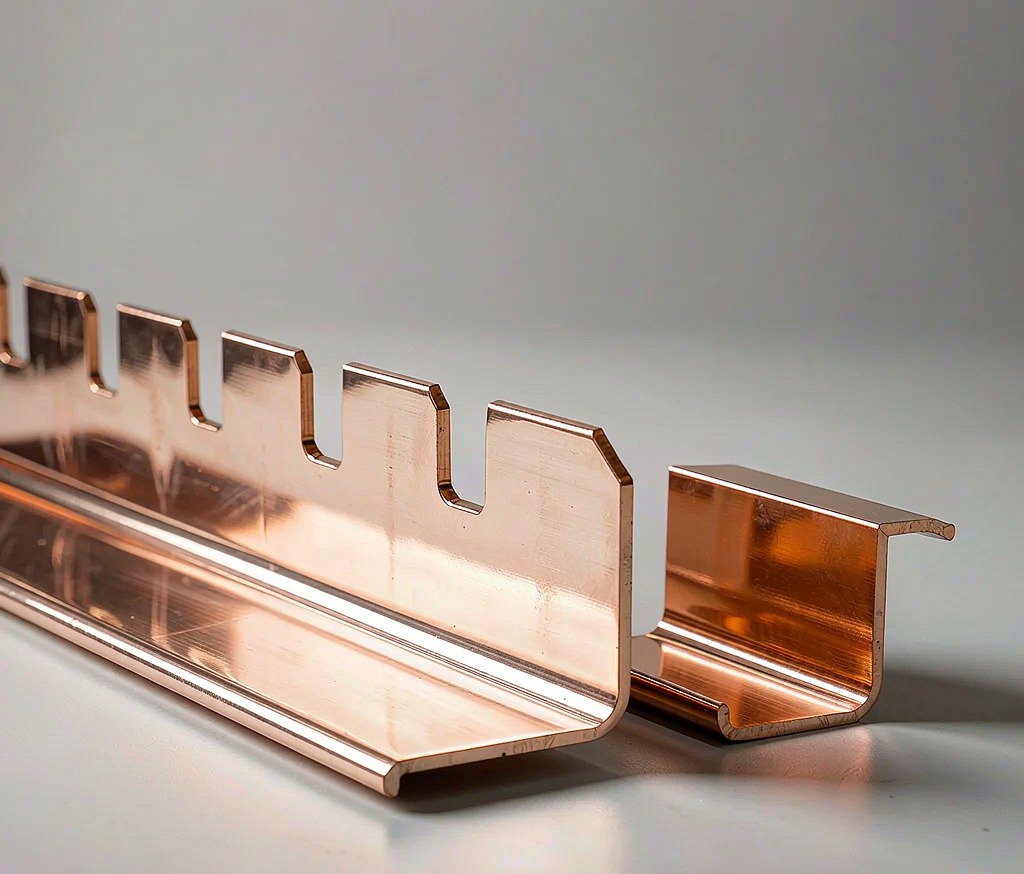
What Copper Extrusion Delivers
Extrusion produces long, uniform profiles with excellent grain flow and consistent conductivity. Because the cross-section is formed near-net, downstream machining is minimized and material waste drops versus cutting from solid bar. The uniform grain flow along the profile also improves strength at bends compared with welded assemblies.
It is the conductive cousin of aluminum extrusion, sharing die design principles with hot extrusion of steel and steel extrusion while exploiting copper’s higher conductivity. This shared know-how means a shop already extruding aluminum can usually add copper with only die changes.
Alloys and Tempers
High-conductivity C110 copper is the default, with oxygen-free grades for critical electrical use and alloys such as tellurium or chromium copper where machinability or strength matters. Tempers range from soft to hard depending on downstream forming. A soft temper bends easily for busbar risers, while a hard temper holds a thin edge that stays straight in service.
For mixed-material builds, copper and brass extrusions are quoted together so finishes and conductivity match across the assembly.
Process and Die Design
A heated billet is forced through a steel die by a hydraulic press, forming the profile. Die geometry, ramp speed, and temperature set the surface and tolerance. Complex hollow conductors need a mandrel or bridge die. Die wear is low for copper, so long runs keep a consistent cross-section without frequent tool changes.
The press discipline overlaps hot extrusion of aluminum and steel, but copper’s conductivity demands tighter control of contamination.
Secondary Operations
Extruded profiles are often cut to length, punched, drilled, bent, or plated. CNC bending forms busbar risers, while copper busbar manufacturing adds the fabrication needed for switchgear and power distribution.
Silver or tin plating of contact faces is common, applied after extrusion so the conductive core stays clean. Deburring the cut ends before plating prevents plating voids that would raise contact resistance.
Extrusion vs Machining
For a repeated complex cross-section, extrusion is faster and cheaper than machining from bar, and the grain flow improves strength at bends. Machining still wins for low volumes or features extrusion cannot form. For a one-off bracket, cutting from bar avoids die cost even if it wastes more material.
When a part is mostly round, cold extrusion or drawing may be the better near-net route instead, and copper-brass extrusion handles mixed-alloy profiles in one press.
Where Copper Extrusion Pays Off
Busbar, grounding connectors, terminal blocks, heat sinks, and architectural trim are classic uses. Anywhere a custom conductive shape repeats in volume is a fit.
Specifying the cross-section sketch, alloy, temper, and finish lets the shop quote tooling and lead time accurately. Early involvement also lets the shop suggest a symmetrised section that extrudes more stably and costs less to tool.
Quality Control and Inspection
Extruded profiles are verified for cross-section dimensions, length, straightness, and surface condition, with conductivity and hardness tested where the application requires. Mill test certificates document alloy and temper from billet to finished profile. Dimensional scans confirm the cross-section holds across the full length, not just at the ends.
Lead Time and How to Request a Quote
Send a cross-section sketch or sample, alloy and temper, length, quantity, and any bending or plating needs. Copper busbar fabrication is quoted with the extrusion so the full part is one order. Tooling lead dominates the first run. Once the die exists, repeat orders are largely a scheduling matter, so recurring volumes ship faster.
Common Cost Drivers in Copper Extrusion
Die design and press setup are the main first-run costs; repeat runs are driven by alloy, temper, and secondary operations. Complex hollow profiles need costlier mandrel dies. Sharing annual volume lets the shop amortize tooling and quote a fair unit price. Tighter straightness or twist specs add straightening steps, so only call them out where the assembly truly needs them. Profile length and pack density on the press also affect setup time, so sharing the longest and shortest cut lengths helps the shop nest runs efficiently and hold price.
Frequently Asked Questions
Which copper alloy is best for busbar?
C110 offers the best conductivity; oxygen-free grades suit critical electrical service.
Can extruded copper be plated?
Yes. Silver or tin on contact faces is common after extrusion and cutting.
Is extrusion cheaper than machining copper?
For repeated complex profiles, yes – less waste and less machining than cutting from bar.
What tolerances can extrusions hold?
Good dimensional consistency along the length, with machining added for tight features.
Can you make hollow copper profiles?
Yes, using mandrel or bridge dies for hollow conductors and complex shapes.
How are profiles inspected?
By dimensional check, conductivity test, and hardness or temper verification as required.
Ready to Start Your Project?
Get a build-ready quote on your custom metal parts within 24 hours. Share your drawing and our engineers will respond with process, lead time, and pricing.

