
Rollers carry load, set web tension, transfer heat and define surface quality in almost every continuous process line. A conveyor idler, a printing nip roll, a laminating drum and a guide roller share the same core engineering problems: concentricity, straightness, balance, surface finish and a bearing arrangement that survives the duty cycle.
This guide covers roller types and construction, the machining and grinding sequence that produces true running surfaces, material and coating selection, balancing and inspection, and how to specify a custom roller so the quote reflects the performance you actually need.
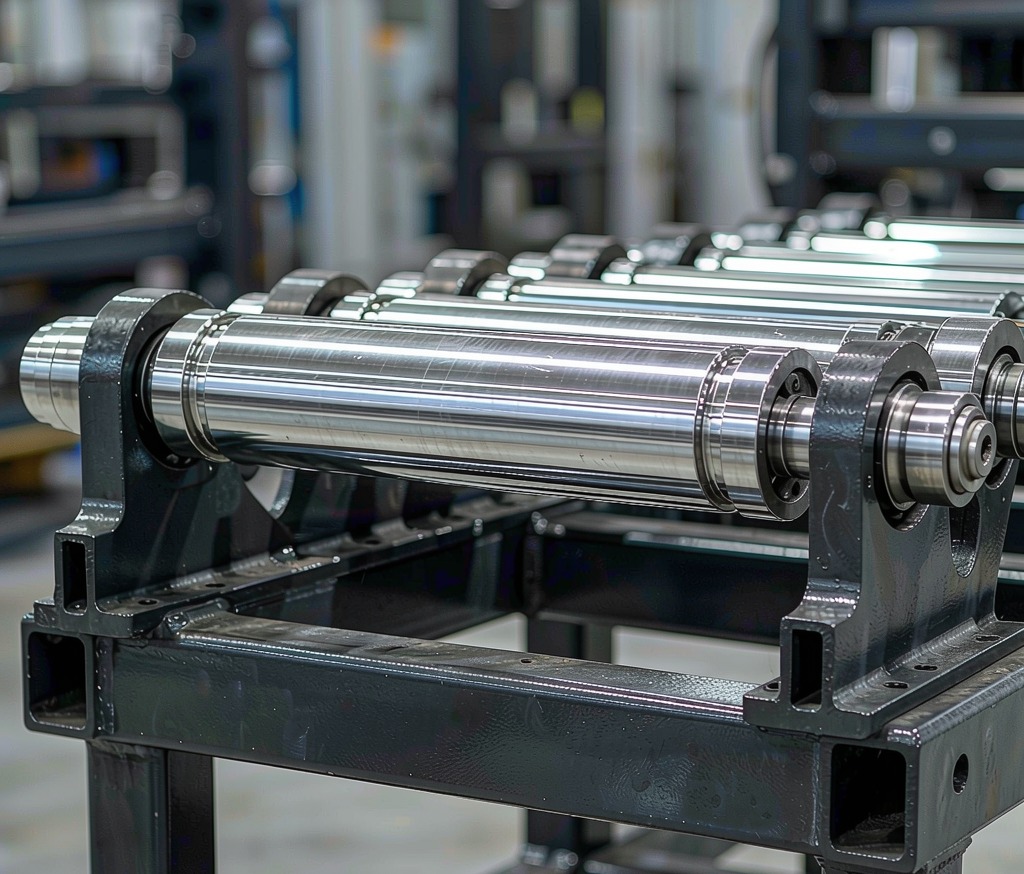
Roller Types and Construction
Conveyor idlers and gravity rollers are tube-based with pressed or welded end caps and sealed bearings. Drive and nip rollers use a thicker shell over a through shaft or stub shafts for torque transmission. Heat transfer and chill rolls are double-shell or spiral-baffled for internal fluid flow. Guide and tension rollers are lightweight, often aluminium, with very low inertia.
Construction decides everything downstream. A tube-and-cap roller is cheap and adequate for gravity conveyors but cannot hold tight runout. A shell machined and ground between centres on a shaft can hold a few hundredths of a millimetre total indicated runout, which is what web handling and printing need.
Shaft design matters as much as the shell. Deflection under load, bearing seat tolerance and keyway or spline detail all affect life. Our precision shaft manufacturing guide covers straightness, hardening and grinding practice for the shaft side of the assembly.
Machining and Grinding for True Running
The route for a precision roller is: rough turn, stress relieve, semi-finish, heat treat if required, then finish grind. Skipping the stress relief is the classic cause of a roller that runs true on the machine and bows a week later in service.
Shell and journals are turned on CNC turning centres, then journals and the working surface are ground. Cylindrical grinding between centres is used for shafted rollers, while centerless grinding suits high volumes of plain rolls and shafting. Practical detail on the latter is in our centerless grinding services guide.
Crowning is a common requirement on web handling rolls, where a few hundredths of a millimetre of diameter increase at mid-span keeps the web centred. Crown must be specified as a profile, not as a single number, and it is ground rather than turned.
Materials, Surface Treatments and Coatings
Carbon steel tube with a machined shell is the volume default. Stainless 304 and 316 serve food, pharmaceutical and washdown lines. Aluminium gives low inertia for dancer and guide rolls. Cast iron and ductile iron suit heavy chill rolls where thermal mass and damping matter.
Working surfaces are usually treated. Hard chrome plating over a ground shell gives a hard, low-friction, corrosion-resistant surface that can be reground at overhaul. Polishing to a mirror finish is required for optical and film applications, and textured or engraved surfaces are used for coating control.
Rubber and polyurethane covering is applied where grip or compliance is needed, and the steel core must be prepared and keyed for it. For hygiene lines the whole assembly specification, including seal and bearing choice, follows the requirements set out in our food grade metal parts guide.
Bearings, Balance and Inspection
Bearing selection follows load, speed and environment. Sealed deep-groove ball bearings cover most conveyor duty; tapered rollers handle combined loads; self-lubricating bearings and sintered bushings suit low-speed or maintenance-free applications. Housings and seats are machined to the bearing manufacturer tolerance, not to a general fit.
Above roughly 300 to 500 rpm, dynamic balancing becomes necessary. We balance to ISO 1940 grades appropriate to the speed and report residual unbalance. Static balance is adequate for slow conveyor rolls, but web and printing rolls need dynamic balance to avoid vibration marking the product.
Inspection covers total indicated runout on the working surface relative to the journals, straightness over length, diameter and crown profile, surface roughness, hardness where applicable, and a concentricity check after any coating. Bushing and bearing seat practice is discussed further in our custom metal bushings guide.
Cost Drivers and Specification Advice
Runout tolerance is the biggest single cost multiplier. Moving from 0.2 mm total indicated runout to 0.02 mm changes the whole routing from turned to ground-between-centres with stress relief, and can double or triple the price. Specify the number your process needs and no tighter.
Length to diameter ratio is next. Long slender rollers need steady rests, careful stress relief and sometimes internal support to stay straight, all of which add hours. If your design allows a slightly larger diameter, deflection and cost both improve.
Coatings and coverings are a significant line item, so specify the working surface treatment by function rather than by habit. Hard chrome is excellent but not needed on a dry indoor conveyor. Batch quantity helps: grinding several identical rolls in one setup is far cheaper per piece than singles, and repeat annual releases let us hold fixtures.
Lead Time and RFQ Checklist
Standard conveyor rollers ship in 8 to 12 working days. Precision ground rollers with stress relief run 15 to 22 days. Hard chrome plating or rubber covering adds five to eight days, and dynamic balancing plus documentation adds two to three.
To quote we need overall length and face length, shell diameter and wall thickness, shaft or journal detail with bearing type, material, working surface treatment, runout and crown requirements, operating speed and load, quantity and annual volume.
If you are replacing an existing roller, send the old one or a dimensioned photograph with the failure mode. Knowing whether it failed by bearing wear, surface damage or bending tells us far more than the drawing does, and our engineers will propose a design change that removes the root cause rather than repeating it.
Frequently Asked Questions
What runout can you hold on a custom roller?
Turned conveyor rollers typically hold 0.1 to 0.2 mm total indicated runout. Ground precision rollers with stress relief reach 0.02 to 0.05 mm on the working surface relative to the journals, which is the range web handling and printing applications require.
Which surface treatment should I specify?
Hard chrome plating over a ground shell is the standard for wear, low friction and corrosion resistance, and it can be reground at overhaul. Mirror polishing suits film and optical lines, and rubber or polyurethane covering is used where grip or compliance is needed.
Do rollers need dynamic balancing?
Above roughly 300 to 500 rpm, yes. We balance to the appropriate ISO 1940 grade for the operating speed and report residual unbalance. Slow conveyor rollers are usually fine with static balance only.
What is crowning and when do I need it?
Crowning is a slight diameter increase at mid-span, typically a few hundredths of a millimetre, that helps keep a web centred and compensates for deflection. Specify it as a profile over the face length rather than as a single diameter figure.
Which material suits washdown and food lines?
Stainless 304 or 316 shell and shaft with sealed or food-grade bearings and appropriate seals. Surface finish and the absence of crevices matter as much as the alloy, so specify the finish and the seal arrangement together.
Can you copy an existing roller without drawings?
Yes. Send the sample or a dimensioned photograph together with the operating speed, load and how the old roller failed. We will reverse engineer it, correct the root cause where we can identify one, and supply a drawing with the quote.
Ready to Start Your Project?
Get a build-ready quote on your custom metal parts within 24 hours. Share your drawing and our engineers will respond with process, lead time, and pricing.

