
Copper-nickel alloys are one of the few engineering materials that actually improve their own corrosion resistance the longer they sit in seawater. That self-protecting behaviour, combined with natural resistance to biofouling, is why cupronickel machining services are concentrated almost entirely in marine, desalination, and shipbuilding supply chains. This guide covers the two standard grades, how they machine, and what to specify so your components survive a 20-year service life in salt water.
What Cupronickel Is and Where It Is Used
Cupronickel is a copper alloy with 10 to 30 percent nickel plus small additions of iron and manganese for strength and erosion resistance. Its signature property is a stable, adherent oxide film that resists chloride attack and discourages marine organism growth. That combination makes it the default material for seawater piping, heat exchanger tubing, condenser plates, and hull fittings where steel would rust and even stainless would eventually pit.
Beyond marine work, cupronickel appears in coinage, architectural roofing, and some cryogenic and antimicrobial applications. But for most buyers requesting precision machined parts, the driver is salt water. Our CNC turning and CNC milling cells cut cupronickel tubing fittings, valve bodies, and manifold blocks to the tolerances ship systems demand.
90/10 Versus 70/30: Choosing the Grade
The two workhorse grades are 90/10 and 70/30, meaning roughly 90 percent copper with 10 percent nickel, or 70 percent copper with 30 percent nickel. 90/10 (C70600) is the general-purpose seawater grade, offering good corrosion resistance, reasonable strength, and easier fabrication. It is the standard for most shipboard piping and desalination tubing.
70/30 (C71500) trades some cost for higher strength and better erosion-corrosion resistance in high-velocity flow, making it the choice for pump impellers, high-pressure heat exchanger tubes, and parts exposed to fast-moving or sandy seawater. Where a part sees both pressure and velocity, 70/30 usually wins. Our marine metal parts guide explains how these grades compare against stainless and duplex in immersed service.
Machining Characteristics and Strategy
Cupronickel machines broadly like a free-cutting copper alloy: it is gummy, work-hardens under light cuts, and tends to build up on the tool edge if speeds are wrong. The corrective strategy is the same one used across copper alloys: positive rake tooling, moderate surface speeds, and steady feeds that keep the edge cutting rather than rubbing. Light, hesitant passes smear the surface and accelerate wear.
High-pressure coolant helps flush the long, stringy chips that cupronickel produces, and sharp uncoated or lightly coated carbide keeps the edge clean. For complex tube-sheet and manifold geometry we run 5-axis CNC machining to hold interrelated features in a single setup, and CNC drilling with peck cycles to break chips in deep holes. Tight-tolerance diameters are finished by CNC grinding where required.
Typical Components We Produce
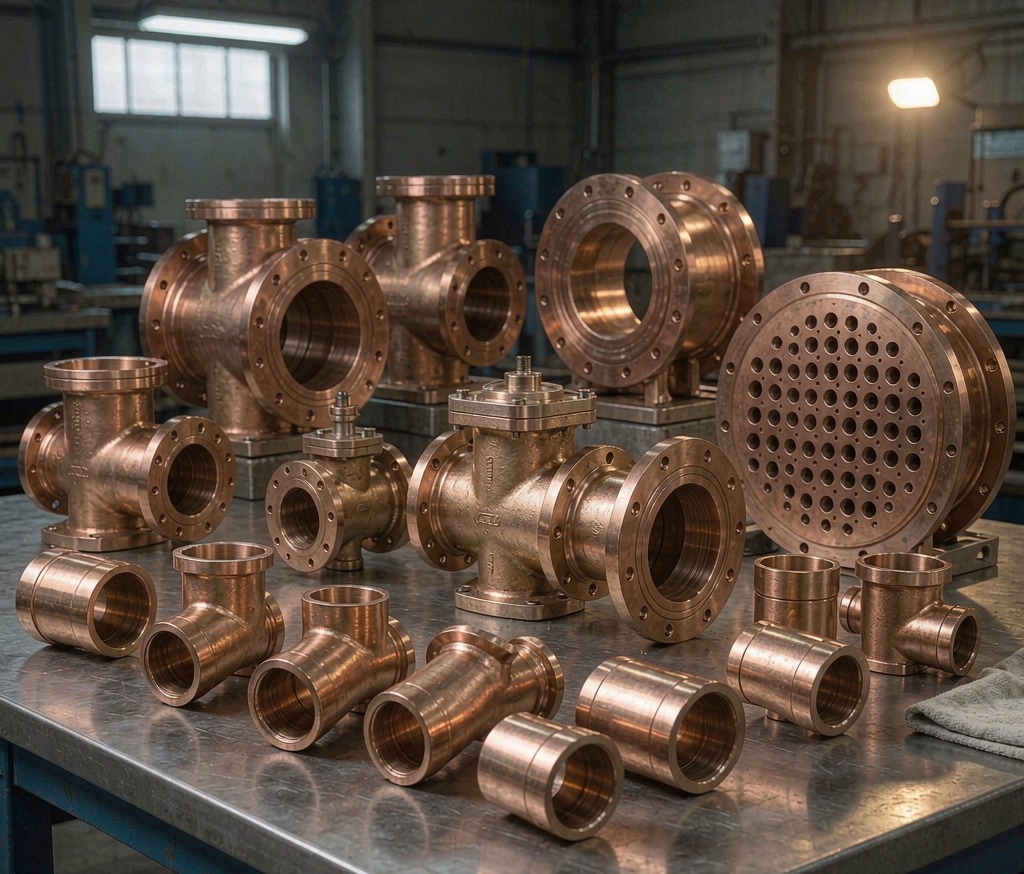
The recurring cupronickel parts are tube fittings and flanges for seawater lines, valve bodies and trim, heat exchanger tube sheets, pump housings and impellers, condenser end plates, and custom manifolds for ballast and firewater systems. Many of these are fabricated from tube or plate rather than solid, which means forming and welding join machining in the build sequence.
Cupronickel welds well with the right filler and shielding, so fabricated assemblies are common. Our custom metal fasteners and fitting work frequently pairs machined cupronickel with compatible alloys to avoid galvanic attack at joints. When a design calls for a different copper alloy family, our copper and brass extrusion capability supplies the stock shapes that machining starts from.
Surface Finish and Corrosion Protection
One of cupronickel’s advantages is that it needs almost no separate coating in seawater. A clean machined surface develops its protective oxide naturally, so aggressive post-treatment is rarely required. That said, embedded iron from tooling or fixturing can seed local corrosion, so a final clean and passivation-style decontamination is good practice on critical surfaces, along with thorough fresh-water rinsing.
For threads and sealing faces, control of surface finish matters more than any coating. A tube-sheet face is typically finished to a specified roughness so gaskets and rolling operations seat correctly. Our polishing and nickel plating lines handle the occasional component that needs a smoother or harder surface than machining alone provides.
How to Specify Cupronickel Parts Correctly
A complete drawing names the grade (C70600 or C71500), the temper, the applicable standard such as ASTM B171 or B466, dimensional tolerances with explicit notes on tube-fit and sealing surfaces, and any hydrostatic or dye-penetrant test requirement. Material certification traceable to heat lot should be requested for class-approved or safety-critical systems.
Lead time on cupronickel is usually driven by material availability rather than machining, since the alloys are less commonly stocked than 316 stainless. Plan procurement early, and where a part must interface with stainless or aluminium structures, design in isolation to prevent galvanic corrosion. Our stainless steel machining page covers the alloy pairing rules that keep mixed-material assemblies reliable.
Frequently Asked Questions
Which grade should I choose, 90/10 or 70/30?
Use 90/10 for general seawater piping and 70/30 where higher strength or fast-flow erosion resistance is needed.
Does cupronickel need a corrosion coating?
Usually not in seawater; its natural oxide film protects it. Cleaning off embedded iron is the main surface step.
Is cupronickel difficult to machine?
It is gummy and work-hardens, so sharp positive-rake tooling and steady feeds are required, but it is routine work.
Can you weld cupronickel assemblies?
Yes, with proper filler and shielding gas, fabricated fittings and manifolds are standard.
Do you provide material traceability?
Yes, certified mill test reports traceable to heat lot are available for class-approved work.
What is the lead time driver?
Material availability, since cupronickel stock is less common than 316 stainless and must often be sourced to order.
Ready to Start Your Project?
Get a build-ready quote on your custom metal parts within 24 hours. Share your drawing and our engineers will respond with process, lead time, and pricing.

