
Ti-6Al-4V is the aluminium-vanadium titanium alloy that built modern aerospace, and it is now the default titanium grade for medical implants, racing components, and high-end industrial hardware. It offers a strength-to-weight ratio close to many steels at roughly 60 percent of the mass, with excellent corrosion resistance. That combination is exactly why Ti-6Al-4V titanium machining services are in constant demand, and why the alloy needs a disciplined machining approach. This guide explains how to machine it correctly.
What Makes Ti-6Al-4V Special
Ti-6Al-4V, also written Ti64 or Grade 5, is an alpha-beta titanium alloy containing about 6 percent aluminium and 4 percent vanadium. The aluminium stabilises strength at temperature while the vanadium improves hardenability and formability. The result is a material with roughly 900 MPa tensile strength, good fracture toughness, and biocompatibility that lets it sit inside the human body.
Those same traits create the machining difficulty. Titanium has very low thermal conductivity, so the heat generated at the cutting edge has nowhere to go and stays in the tool. It has a narrow, sticky plastic zone at the edge that promotes built-up edge. And it work-hardens and springs back elastically, so thin features deflect under the tool and then relax. Our titanium machining services overview covers the broader family of grades and when Ti64 is the right call.
The Three Rules of Titanium Machining
Rule one: keep the tool cool and the cut continuous. Low thermal conductivity means you must get heat out with copious high-pressure coolant or, for some geometries, through-tool coolant, rather than letting it soak into the insert. Rule two: use sharp, positive-rake tooling with generous chip clearance and avoid any dwell or rub, because rubbing work-hardens the surface and smears the edge. Rule three: maintain a steady feed that always takes a fresh bite, never a light skimming pass.
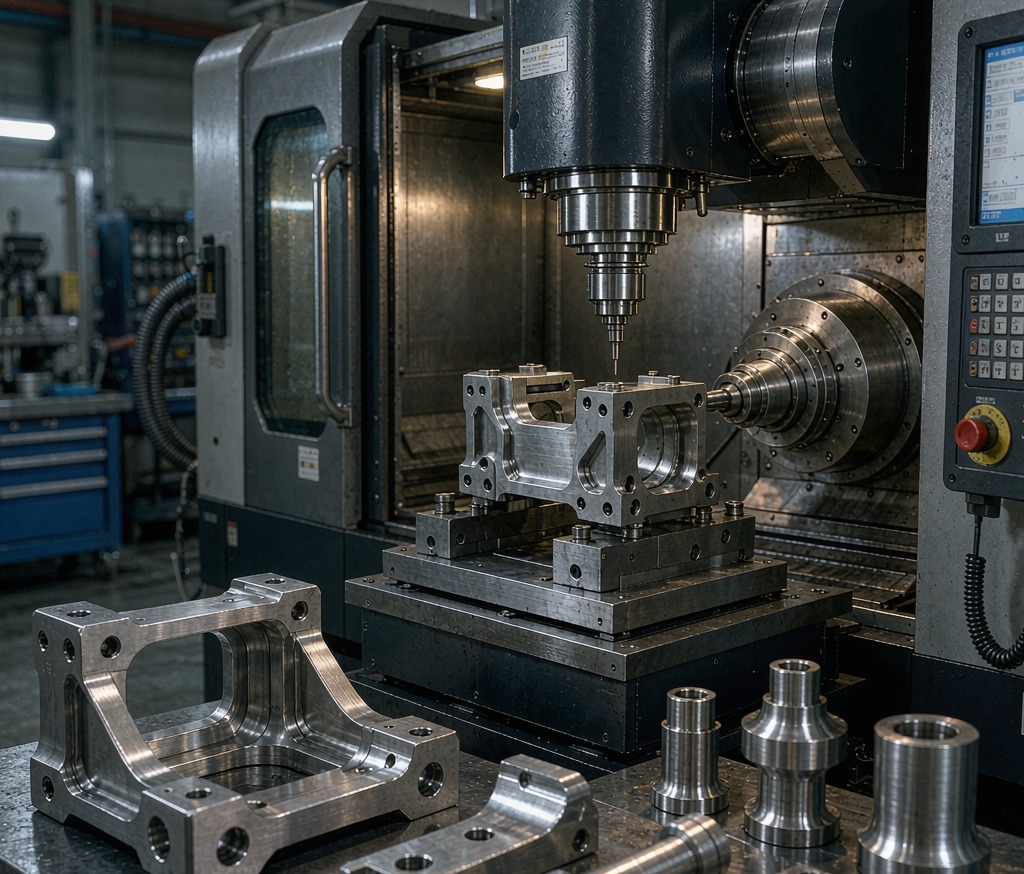
We run Ti64 on rigid CNC turning and CNC milling centres, and on 5-axis CNC machining cells for the complex impeller and bracket geometry common in aerospace. Deep holes and features go to CNC drilling with peck cycles, and fine slots or tight-radius contours are finished on wire EDM where tool access is impossible.
Tooling That Works on Titanium
Uncoated or PVD-coated carbide with a sharp positive rake is the standard for Ti64. CVD coatings are generally avoided because they are brittle and can flake in interrupted cuts. High-positive-rake end mills with polished flutes shed chips and reduce built-up edge. Tool life is shorter than on aluminium by a wide margin and is managed on a scheduled index to protect tolerance on near-finished features.
Surface speeds run low, typically 30 to 60 m/min for milling depending on tooling and rigidity, with feed held steady. Rigidity of the machine, holder, and workpiece cannot be overstated; any chatter multiplies heat and work hardening. Our titanium CNC machining page details the parameter window we hold for flight-critical parts.
Surface Finish, Burrs, and Stress
Titanium springs back, so achieving a flat or straight feature means accounting for elastic recovery and often taking a second light pass after the part relaxes. Burrs form readily at exits and edges, so deburring is a specified operation rather than an afterthought. For sealing and bearing surfaces, surface grinding and CNC grinding deliver the geometry milling leaves behind.
Residual stress from roughing can move a thin wall, so a stress-relief between rough and finish cuts is standard practice on critical hardware. This is one reason titanium lead times run longer than the raw chip time suggests: the process is sequenced, not rushed.
Surface Treatment and Coatings
Ti64 is already corrosion resistant, but it benefits from specific finishes. Anodizing produces a controlled oxide layer used for colour identification, wear resistance, and electrical isolation in medical and aerospace parts. For implants, stricter surface preparation and cleaning protocols apply. Where two titanium surfaces slide, a surface treatment or solid-lubricant coating reduces galling.
Our aerospace machining services guide explains the quality system and inspection levels these parts are built and documented against, and our aluminium CNC machining page contrasts the very different cutting behaviour when a design pairs titanium with light alloys.
How to Specify Ti-6Al-4V Parts
Name the specification (AMS 4928, ASTM B348 Grade 5, or equivalent), the condition (annealed or solution treated and aged), the inspection level for flight or implant use, and any non-destructive test such as fluorescent penetrant inspection. Provide material certification traceable to melt, and for medical work the appropriate biocompatibility and cleaning documentation. If you can supply stock in the soft annealed condition, machining is more predictable and lead time shorter.
Frequently Asked Questions
Why is titanium hard to machine?
Low thermal conductivity traps heat at the tool, it work-hardens, and it springs back elastically, all of which demand sharp tooling and steady feeds.
What coolant strategy works best?
Copious high-pressure or through-tool coolant to pull heat away from the edge; rubbing without coolant work-hardens the surface.
Can you anodize titanium parts?
Yes, anodizing produces a controlled oxide for colour, wear, and isolation, including medical-grade surface preparation.
Do you provide melt traceability?
Yes, material certification traceable to melt lot is standard, with CMM and NDT reporting where required.
How does Ti64 compare to aluminium for machining?
Ti64 cuts far more slowly with shorter tool life, but delivers a much higher strength-to-weight ratio.
What finishes can you hold?
Sealing and bearing surfaces are finished by grinding to specified geometry and roughness.
Ready to Start Your Project?
Get a build-ready quote on your custom metal parts within 24 hours. Share your drawing and our engineers will respond with process, lead time, and pricing.

