
Vacuum casting sits in a useful niche between 3D printing and production moulding. It uses a silicone mould built around a master pattern, casts polyurethane or epoxy resin under vacuum to eliminate bubbles, and delivers 10 to 50 near-production parts in days rather than months. That makes vacuum casting services the standard route for pre-tooling prototypes, bridge production, and low-volume custom enclosures. This guide explains when vacuum casting beats the alternatives and how to specify it.
What Vacuum Casting Actually Is
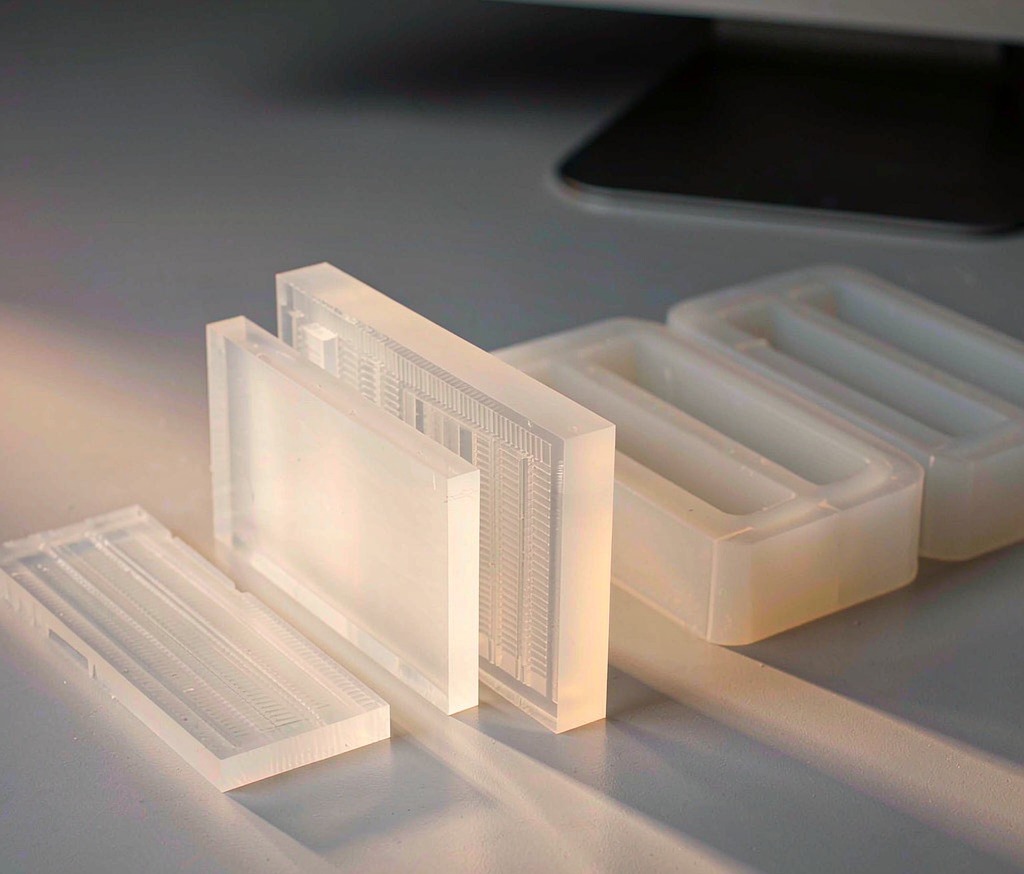
The process starts with a master pattern, usually an SLA, SLS, or CNC-machined model of the part. That master is suspended in a casting box and encapsulated in liquid silicone, which cures around it. The silicone block is then cut open, the master removed, and the resulting cavity becomes a flexible mould. Resin is mixed, degassed, and cast into the mould under vacuum so no air is trapped, then cured and demoulded.
Because the mould is flexible, parts with undercuts and complex geometry release cleanly without draft angles or parting-line gymnastics. Multiple identical moulds can be cast from one master, and each silicone mould typically yields 15 to 25 good shots before degrading. Our rapid tooling services guide compares this with aluminium and steel tooling for true production volumes.
When Vacuum Casting Is the Right Choice
Vacuum casting wins on speed and cost for quantities from one to a few dozen. It delivers parts in days, captures fine surface detail and texture, and lets you evaluate a design or run a small market test before committing to injection tooling that may cost tens of thousands. It is the bridge between a single prototype and a moulded production run.
It is the wrong choice above roughly 50 to 100 pieces, where the per-part silicone mould cost and manual labour exceed the economics of a machined or moulded route. For those volumes, investment casting, sand casting, or die casting become competitive. Our forging versus casting guide maps the broader process decision.
Materials You Can Cast
The material library is the real strength of the process. Polyurethane and epoxy resins are formulated to mimic ABS, polypropylene, polycarbonate, and even some rubber-like and translucent properties. Rigid, flexible, high-temperature, and optically clear grades are all available, so a vacuum-cast part can behave much like the intended production polymer for functional testing.
Colour and finish are built in: pigments are mixed into the resin, and the silicone surface texture transfers directly to the part, so a grained master yields a grained casting. Post-machining, inserts, and polishing refine critical features. For metal prototypes the parallel route is investment casting services, which delivers actual metal parts at low volume.
Design and Tolerance Considerations
Vacuum-cast parts hold looser tolerances than machined or injection-moulded parts, typically plus or minus 0.2 to 0.5 percent of dimension with a floor around 0.1 to 0.2 mm. Shrinkage varies with resin and wall thickness, so critical dimensions are best machined after casting or validated on a first article. Wall thickness should be kept uniform to control sink and warpage, and very thin sections may not fill completely.
Because the silicone mould flexes, fine detail reproduces well but very tight positional accuracy between distant features can drift. Designing generous radii and avoiding abrupt thick-to-thin transitions improves yield. Our precision casting page covers the tolerance envelope of the metal casting routes when a design graduates to production metal.
Surface Finish and Secondary Operations
As-cast surfaces carry the texture of the master and the fine matte of the silicone, which is often exactly what a visual prototype needs. For higher gloss, the master is polished so the mould transfers shine. Functional features such as threaded holes, bearing seats, or sealing faces are usually machined after casting, and metal inserts can be placed in the mould before casting so they are bonded into the part.
Painting, plating, and soft-touch coatings are applied as secondary operations where the prototype must look production-real. These finishes are the same ones used on sand-cast and gravity-cast metal parts, so the visual language carries through the development programme.
How to Specify a Vacuum Casting Job
Provide the master model or the CAD to make it, the resin property target (rigid ABS-like, flexible, high-temp, clear, and so on), the quantity, any colour, and the tolerance on critical features. State which features must be machined after casting and whether inserts are needed. Naming the intended production process helps the supplier choose a resin that behaves like the final material, so your test results actually predict production performance.
Frequently Asked Questions
How many parts can one silicone mould make?
Typically 15 to 25 good shots before the flexible mould degrades, and multiple moulds can be cast from one master.
What tolerances can vacuum casting hold?
Roughly plus or minus 0.2 to 0.5 percent of dimension, with critical features usually machined after casting.
Can it mimic production plastics?
Yes, resins are formulated to behave like ABS, polypropylene, polycarbonate, and rubber-like materials.
When should I choose it over die casting?
For quantities under roughly 50 to 100 pieces, where tooling cost and lead time would not be justified.
Does surface texture transfer from the master?
Yes, grain and gloss transfer directly, so a polished master yields a glossy casting.
Can you cast in metal inserts?
Yes, inserts are placed in the mould before casting and bond into the part.
Ready to Start Your Project?
Get a build-ready quote on your custom metal parts within 24 hours. Share your drawing and our engineers will respond with process, lead time, and pricing.

