
Copper is the backbone of electrical and thermal hardware, but its high ductility and tendency to build up on the cutter make it trickier to machine than it looks. Our copper machining services are built around sharp tooling, rigid setups and careful chip control so you get clean, conductive surfaces on busbars, connectors, heat sinks and waveguide parts. Here is how we approach copper from raw stock to finished component.
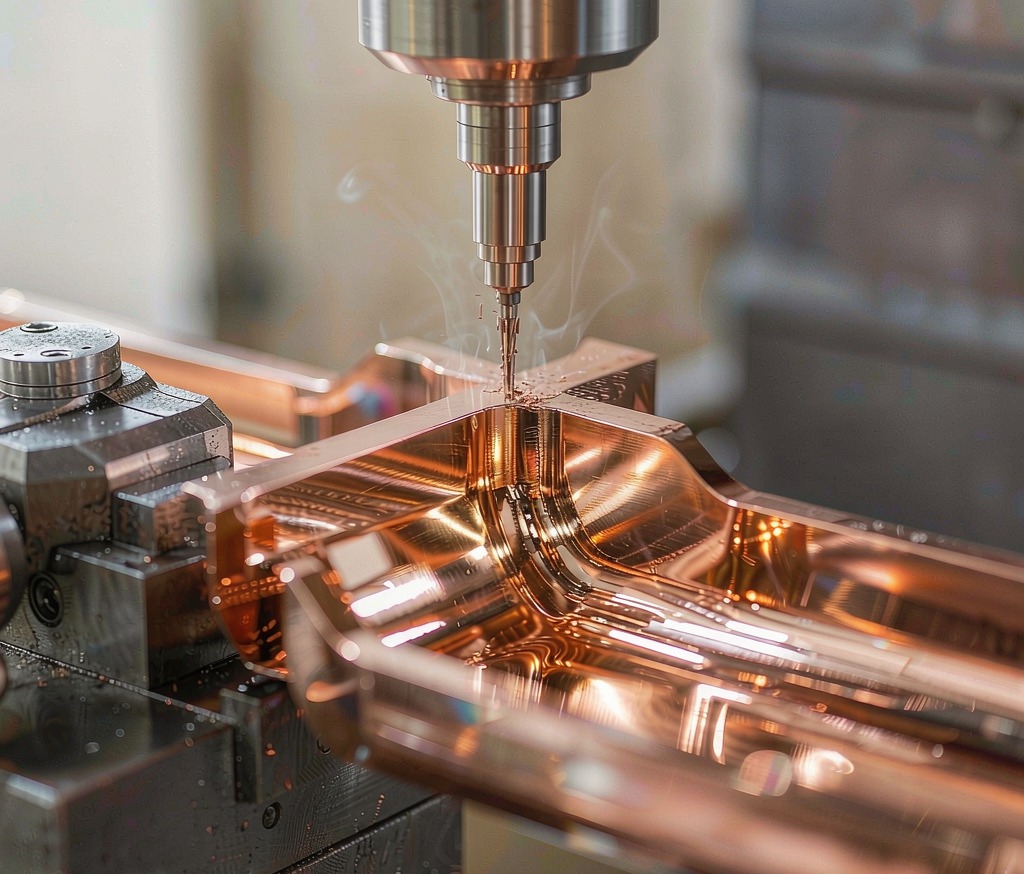
Machining Copper: What Makes It Different
Pure copper (C11000) is soft and gummy, so it smears rather than shears. We combat this with polished flutes, positive rake angles and lower feed-per-tooth than we would use on brass. The payoff is a bright, oxide-free cut face that conducts as intended. Our CNC turning cells run copper rods and tubes for terminals and fittings, while our CNC milling centres profile busbars and heat-spreader plates. For a deep dive on turning copper, see our copper CNC machining guide.
CNC Turning of Copper Rods and Fittings
Round copper parts — studs, nuts, sleeve contacts — are best produced on the lathe. We hold OD and thread tolerances even on soft stock by supporting the part close to the cut and using chip breakers. When a design needs very long, slender copper pins, our Swiss turning process keeps deflection under control.
Milling Busbars and Connectors
Busbars are flat copper bars with precisely located holes, slots and bends. We mill the profile, then drill and tap mounting features in the same fixture. Our copper busbar manufacturing page covers the typical laminated and edge-plated configurations we build for power-distribution customers.
Extrusion and Secondary Machining
Many copper parts begin as extruded bar or profile. We machine extrusions to final tolerance using copper and brass extrusion stock, then deburr and clean. This hybrid route is cost-effective for Long, constant-cross-section parts that still need precise end features. Our copper-brass extrusion services explain when to extrude versus solid mill.
Cleaning, Passivation and Plating
After cutting, copper needs de-greasing and often a protective finish. We offer silver or tin plating for solderability, and passivation alongside anodizing for mixed-material assemblies. Bare copper left unprotected will tarnish, so we recommend a coating for any part that ships or sits in inventory.
Applications in Electrical and Thermal Systems
Copper machined parts appear in switchgear, EV battery interconnects, transformers, RF shielding and liquid-cooling plates. If your design needs both conductivity and a custom shape, copper machining beats stamping on low-to-mid volumes.
Avoiding Built-Up Edge on Copper
The single biggest copper-machining problem is built-up edge — soft material welds to the tool tip, ruins finish and grows the effective cutting diameter. We prevent it with polished, high-rake carbide, generous coolant and climbs milling, plus lower chip loads than brass would allow. When BUE still appears on long runs, we switch to a sharper uncoated grade or a diamond-like-coated tool. The result is a bright, dimensionally stable surface that needs minimal cleanup. Our deburring pass then removes only the few edges the process leaves, keeping the conductive face flat.
Coolant strategy matters more on copper than on most metals. A mist or flood that clears chips immediately stops them being re-cut and work-hardened. We also avoid sharp direction changes that trap swarf. For busbars, we often rough and finish in separate passes so heat does not distort the thin web between holes.
When to Machine Copper vs Stamp It
Stamping wins on very high volumes of simple, flat shapes; machining wins on low-to-mid volume, complex 3D features and tight tolerances. If you need a busbar with located threaded bosses and precise step heights, machining beats a stamped-and-riveted assembly on both accuracy and part count. Where a profile is long and constant, start from copper extrusion and machine only the features that matter, as described in our copper-brass extrusion services. The hybrid route often halves cost versus solid milling a long bar.
Copper Grades and What They Mean for Conductivity
Not all copper machines the same. C11000 (electrolytic tough pitch) conducts at about 100 percent IACS and is the default for busbars, but its oxygen content can cause porosity if welded. C10100 (oxygen-free) welds cleanly for vacuum and cryogenic use. Tell us your conductivity target and we select the grade, then prove it with a resistivity check on request. For parts that combine copper with steel or aluminium, our copper busbar manufacturing process handles the mixed-metal stack-up so thermal expansion does not crack joints.
Workholding for Thin Copper
Soft copper dents under aggressive clamps, so we use soft jaws, locating pins and gentle pressure to hold it true without marking the surface. For busbars we often fixture on the featureless face and machine the opposite side, then flip with a dedicated nest so both faces stay parallel. Good workholding is most of the battle on copper, and getting it right is why your parts come out flat, unmarked and ready to plate.
Frequently Asked Questions
Which copper grade should I specify?
C11000 (ETP) is the default for conductivity. C10100 (OFHC) is used where purity matters; tell us your IACS target and we will advise.
Can you plate copper for soldering?
Yes. Silver and tin plating improve solderability and prevent oxidation; we manage thickness to your drawing.
How do you avoid burrs on soft copper?
Sharp tools, climb milling and deburring after machining keep edges clean and contact faces flat.
Is copper machining more expensive than brass?
Material cost is higher and speeds are lower, but it is the right choice wherever conductivity is required.
Ready to Start Your Project?
Get a build-ready quote on your custom metal parts within 24 hours. Share your drawing and our engineers will respond with process, lead time, and pricing.

