
Copper and its alloys are the materials buyers reach for when electrical or thermal conductivity, corrosion resistance or simply a distinctive finish matter more than strength. From busbars and electrical connectors to bearings, plumbing fittings and architectural pieces, cast copper parts are everywhere — yet the family is broad enough that choosing the right alloy and process decides both performance and cost. Casting is usually the most economical way to get a complex conductive shape without machining it from expensive bar.
This guide covers copper casting services in practice: when to sand-cast, die-cast or invest-cast; the alloys involved; achievable tolerances and finishes; and how machining and conductivity requirements shape the job. If you are sourcing a busbar, a connector or a bearing, the points below show where casting fits.
Why Cast Copper
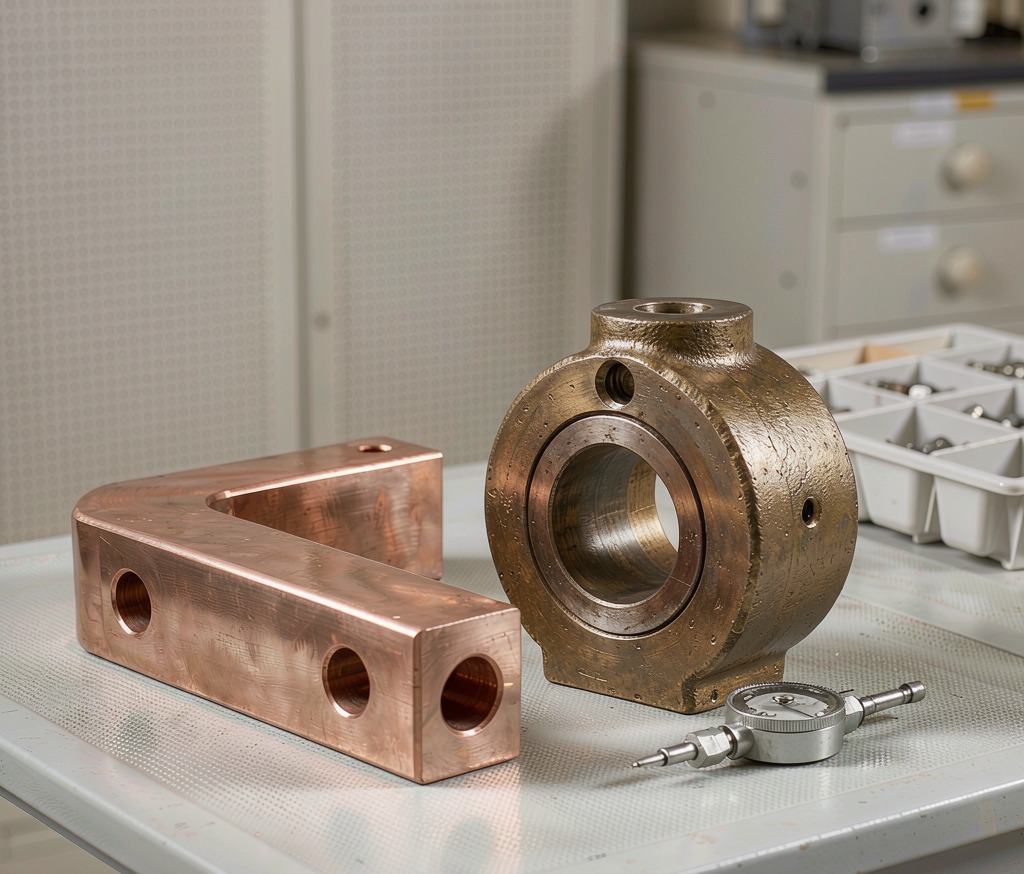
Pure copper (C110) is the benchmark for electrical and thermal conductivity at roughly 100 percent IACS, but it is soft and difficult to cast cleanly because of its high thermal conductivity and tendency to gas porosity. Copper alloys — brasses, bronzes, aluminum bronze, silicon bronze — trade a little conductivity for castability, strength, wear resistance and corrosion performance. That trade is exactly why most “copper” castings are actually alloys chosen for the job.
Our copper machining services page covers CNC routes when a casting is not suitable, and copper CNC machining details cutting strategy once a casting needs finishing. For high-volume conductive shapes, copper busbar manufacturing explains the fabrication route specifically.
Sand vs Die vs Investment Casting
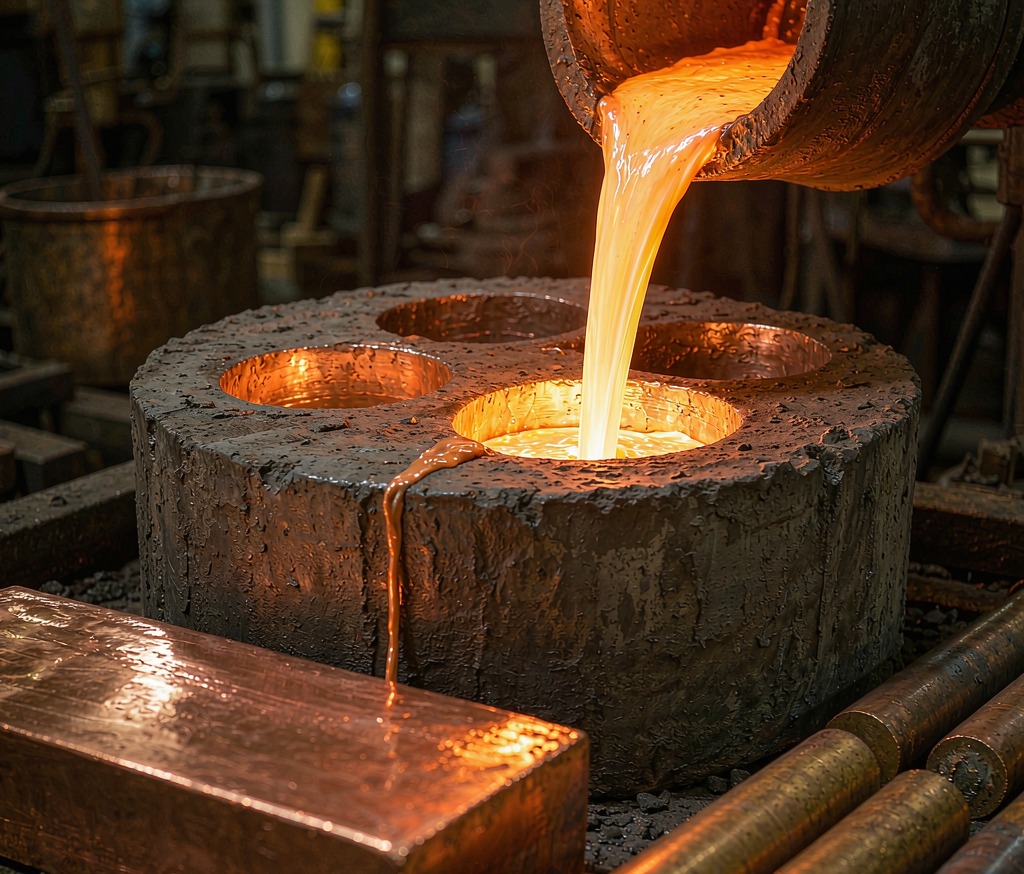
Sand casting is the flexible default: low tooling cost, large or one-off parts, and a wide alloy range including pure copper and bronzes. It suits busbars, manhole covers, architectural pieces and low-volume fittings. Sand casting is the right call when quantities are modest or the part is large.
Die casting (or permanent mold) suits higher volumes of smaller, thinner-walled parts in free-machining brasses, giving better dimensional repeatability and surface finish than sand. Die casting is economical once tooling is amortised across a run. Investment casting yields fine detail and thin sections for premium components where surface quality and complexity matter more than unit cost; our investment casting process handles these precision parts.
Alloys: C110, C845, Aluminum Bronze and More
C110 (electrolytic tough pitch) is chosen when conductivity is paramount, though it needs careful degassing. Red and leaded brasses (C836, C844, C845) are easy to cast and machine, ideal for plumbing and ornamental work. Tin bronzes (C905) and aluminum bronzes (C954) deliver outstanding wear and corrosion resistance for bearings, gears and marine hardware. Silicon bronze offers a pleasing finish for architectural and art castings. Alloy choice is the single biggest lever on both performance and price.
Design for Casting
Cast-friendly geometry — uniform wall thickness, generous fillets and proper draft — prevents shrinkage porosity and hot tearing. Isolate heavy sections so feeders can feed them, and avoid thin-to-thick transitions that create hot spots. For busbars and connectors, design the conductor cross-section for current capacity first, then shape the casting around it.
Achievable Tolerances and Surface Finish
Sand-cast copper alloys typically hold CT9–CT11 with as-cast finish around Ra 6.3–12.5 µm; die and investment routes are tighter. Sealing faces, bearing bores and threaded features are left with finish stock and completed by CNC turning or CNC milling. Reference faces get a dedicated grinding operation where flatness matters.
Machining After Casting
Most copper castings need some machining for datums, bores, threads and sealing faces. Free-machining brasses cut beautifully; pure copper and some bronzes are gummy and need sharp tooling and positive rake. Our finishing cells complete cast blanks efficiently, and where a conductive shape is better formed than cast, copper extrusion services offer an alternative for long constant-section profiles.
Conductivity Considerations
Every alloy choice is a conductivity-versus-properties trade. Specify the required percent IACS if the part carries current; some bronzes drop to 10–15 percent IACS, fine for structural or wear parts but fatal for a busbar. Plating or surface treatment can improve contact resistance at mating faces without compromising the bulk alloy.
Cost and DFM
Sand casting wins on low tooling and small batches; die casting wins on high-volume repeatability. The biggest savings come from designing for the chosen process up front and avoiding features that need extensive post-cast machining. For constant-section conductive parts, extrusion often beats casting entirely on cost per metre.
Frequently Asked Questions
Which copper alloy should I cast?
C110 for maximum conductivity; free-machining brass for plumbing and ornamental work; tin or aluminum bronze for wear- and corrosion-resistant bearings and marine parts.
Sand, die or investment — which process?
Sand for low volume or large parts, die for high-volume repeatable small parts, investment for fine detail and complex thin-section premium components.
What tolerances can copper casting hold?
Sand casting roughly CT9–CT11 with Ra 6.3–12.5 µm as cast; critical faces are finished by CNC turning or milling.
Does casting hurt electrical conductivity?
Alloying always reduces conductivity versus pure copper. State the required percent IACS; bronzes may fall to 10–15 percent IACS, which is fine for structural parts but not busbars.
Where is extrusion better than casting?
For long, constant-cross-section conductive profiles — busbars, bars, rods — extrusion is usually cheaper per metre and gives excellent conductivity.
Ready to Start Your Project?
Get a build-ready quote on your custom metal parts within 24 hours. Share your drawing and our engineers will respond with process, lead time, and pricing.

