
For strong, wear-resistant iron components at a fraction of steel-forging cost, ductile iron casting services are hard to beat. Ductile (nodular) iron delivers tensile strength approaching cast steel while keeping the excellent castability and damping of iron — making it the default for housings, brackets, and rotating parts that must absorb shock and vibration. This guide covers what ductile iron is, how it compares to gray iron, and how to get a reliable quote.
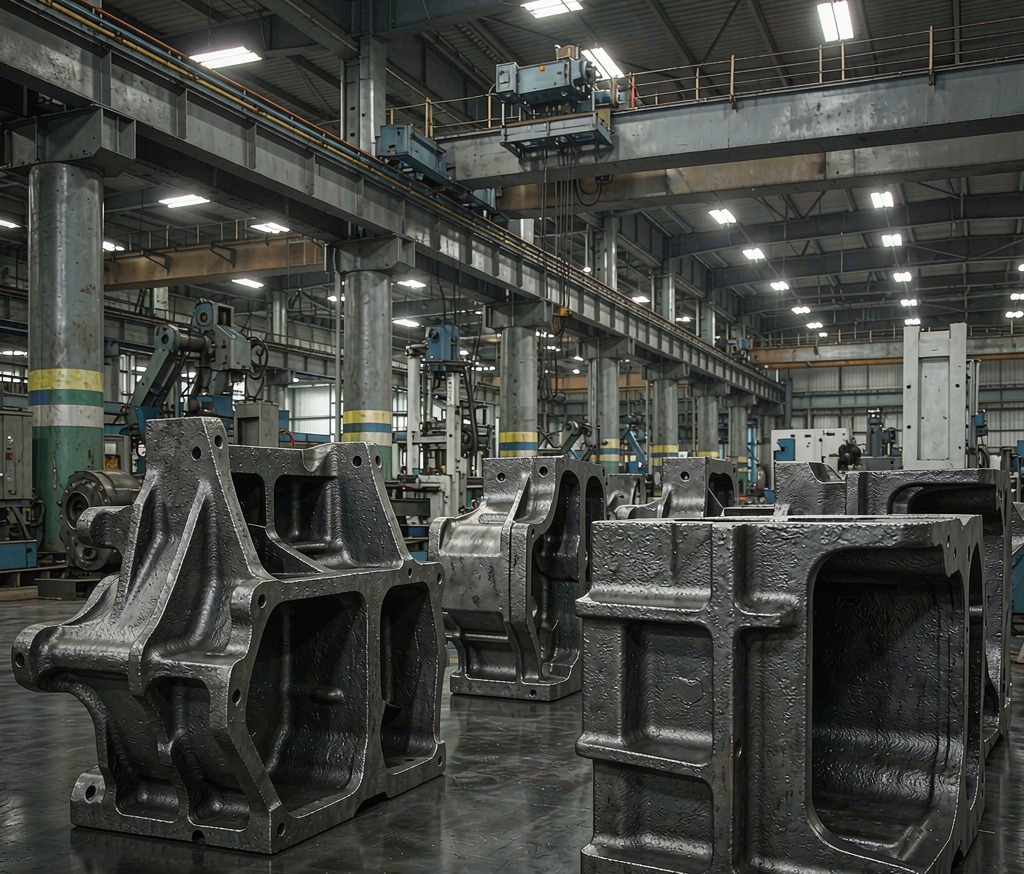
What Is Ductile Iron
Ductile iron is cast iron in which the graphite forms spherical nodules rather than flakes. Those nodules stop cracks from propagating, giving the material measurable elongation and impact resistance. Common grades such as ASTM A536 65-45-12 and 80-55-06 cover a wide range of strength and ductility, and the material machines predictably on CNC turning and milling centers after casting.
The nodulizing treatment — adding magnesium to the melt — is what transforms ordinary iron into ductile iron. Done correctly, it yields a material that, on a strength-to-cost basis, competes with cast steel while remaining far easier to cast into complex shapes. That is why it is so widely specified for safety-relevant structural parts.
Ductile vs Gray Iron
Gray iron is cheaper and easier to cast, but its flake graphite makes it brittle — fine for static, compressive loads, poor for parts that take impacts. Ductile iron costs a bit more yet survives fatigue and shock, which is why it replaced gray iron in many automotive and machinery applications. If your part sees dynamic loading, the small premium for ductile iron pays for itself in the field.
The damping capacity of ductile iron is another underrated advantage: it absorbs vibration better than steel, reducing noise and fatigue in rotating assemblies. For brackets, housings, and mounts that live next to rotating shafts, that damping extends the life of everything bolted to them.
Casting Processes for Ductile Iron
Most ductile iron parts are produced by sand casting, including green-sand and chemically bonded molds, or by investment casting for smaller, finer-featured components. Sand casting handles the large, thick-section housings typical of ductile iron work; investment casting suits compact precision pieces. Either way, our casting plus machining process finishes the critical surfaces so the part drops straight into your assembly.
Process control during melting and pouring is what separates good ductile iron from bad. We monitor chemistry, inoculation, and cooling rate so the nodule count and matrix are consistent from the first pour to the last. That consistency is what lets you trust the mechanical properties on the certificate rather than hoping they hold.
Machining and Heat Treatment
Ductile iron machines cleanly but work-hardens if tools dwell, so we use sharp inserts and appropriate speeds on our CNC milling lines. Depending on the grade, a heat treatment such as annealing, normalizing, or quenching and tempering tunes hardness and matrix structure. Our broader steel casting services and iron programs share the same quality system, so mixed-material bills of materials are easy to manage with one supplier.
Heat treatment is also how we hit conflicting goals at once — a softer, machinable structure before cutting, then a harder, stronger matrix after. Planning that sequence up front avoids distortion and rework, and keeps your lead time predictable.
Typical Applications
You will find ductile iron in automotive suspension and steering knuckles, engine brackets, pump and valve bodies, wind-turbine hubs, agricultural machinery, and heavy equipment frames. It is the pragmatic choice whenever you need steel-like toughness at iron-like cost. Our precision casting services help standardize quality across high-volume runs.
Because it is readily cast into large, thick sections, ductile iron also replaces fabricated weldments in many frames and housings — eliminating weld distortion and inspection overhead in the process.
Quality and Traceability
Because ductile iron is often specified for safety-related structural parts, documentation matters as much as the metal. We maintain melt records, nodularity checks, and mechanical test coupons so each lot can be traced back to its heat, and pairing casting with our in-house casting plus machining means one certificate covers the whole part rather than just the raw casting.
For buyers, this means fewer suppliers to audit and fewer handoffs where responsibility can blur. When one team pours, machines, and certifies the part, the question of who owns a defect has a simple answer, and that simplicity is worth as much as the metal itself.
Requesting a Ductile Iron Quote
Share your drawing, grade requirement, volume, and any mechanical-property or certification needs. We scope pattern or tooling, pouring method, machining, and inspection, then return a transparent quote with lead time. Early input from our heat treatment services team can optimize the matrix for your exact load case.
Frequently Asked Questions
Is ductile iron stronger than gray iron?
Yes. Ductile iron has significantly higher tensile and yield strength plus real ductility, while gray iron is brittle and best for static compressive loads.
Can ductile iron replace cast steel?
In many structural and dynamic-load parts it can, at lower cost, though steel still wins for the highest toughness and weldability requirements.
Do you heat treat ductile iron?
We offer annealing, normalizing, and quench-and-temper cycles to hit the mechanical properties your application needs.
What volumes make sense for sand casting?
Sand casting is economical from prototypes through very large runs, especially for bigger, thicker-section parts.
Can you machine the castings after pouring?
Yes. We finish datums, bores, and threads on CNC turning and milling so the part arrives ready for assembly.
Ready to Start Your Project?
Get a build-ready quote on your custom metal parts within 24 hours. Share your drawing and our engineers will respond with process, lead time, and pricing.

