
When you need long, consistent, lightweight sections — rails, enclosures, heatsinks, or structural frames — custom aluminum extrusion profiles are the most efficient way to make them. Extrusion turns a single die into kilometers of identical profile at low unit cost. This guide walks from die design through machining and finishing so you can take a sketch from concept to a finished, anodized part.
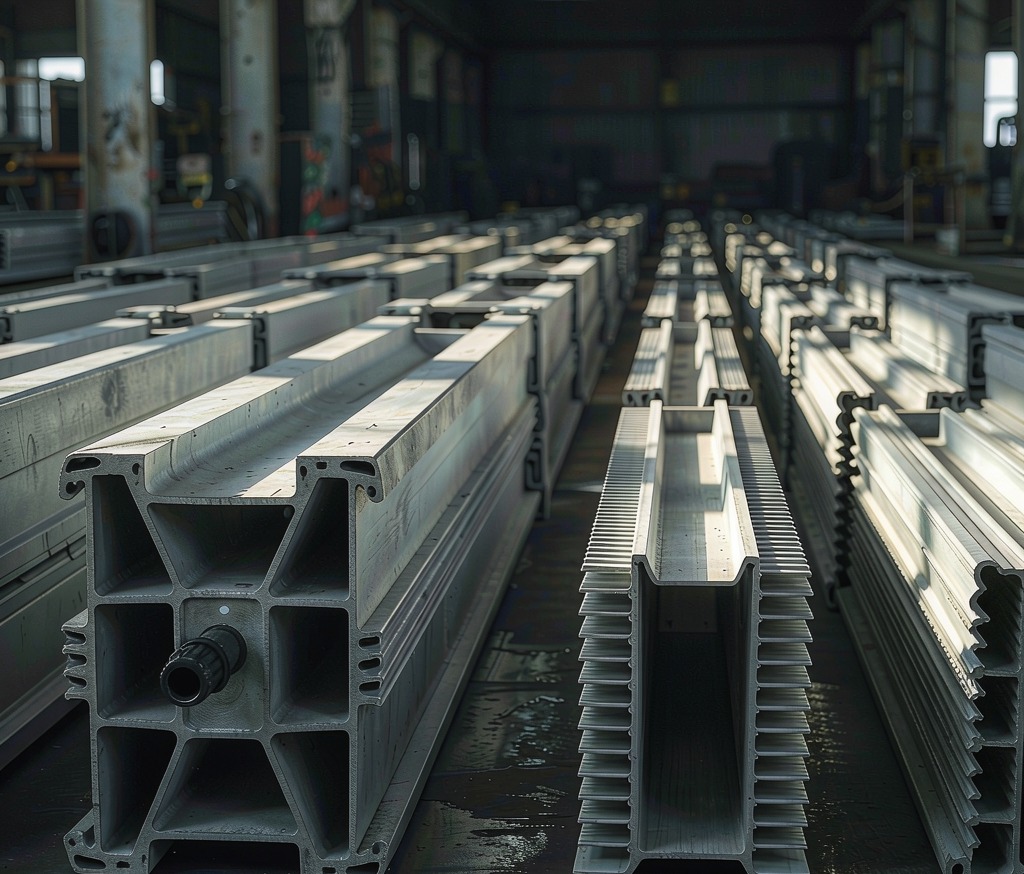
How Aluminum Extrusion Works
A heated aluminum billet is forced through a shaped die, emerging as a continuous profile that is then cooled, stretched, and cut to length. Because the cross-section is fixed by the die, extrusion is ideal for constant-section parts produced in volume. Our aluminum extrusion line handles solid, hollow, and semi-hollow shapes, and our extrusion plus fabrication workflow adds holes, slots, and bends after extrusion.
The die is essentially a negative of your profile. Designing it well means balancing metal flow so all walls fill at the same rate; otherwise you get distortion and dimension drift. We simulate and tune the die before production so the first commercial run is already in spec.
Die Design and Tooling
The die is everything. We engineer the die for balanced metal flow, avoiding twisting and uneven wall thickness, then prove it before your production run. A well-designed die delivers tight dimensional repeatability across the whole run. For parts that also need cut features, our CNC milling and CNC bending services finish the profile to your assembly.
Tooling cost for a new profile is modest compared with die casting or molding, and lead time is typically a few weeks. That makes extrusion attractive even for mid-volume programs where you want a custom section without a huge upfront commitment.
Alloy and Temper Selection
6063 is the architectural extrusion favorite — smooth finish, easy anodize. 6061 is stronger and used for structural frames. Tempers like T5 or T6 set hardness and straightness. The choice affects both extrudability and final strength, so we align alloy with your application and finishing plan up front.
For heatsinks, the alloy’s thermal conductivity matters as much as its shape; for structural frames, strength and straightness lead. We pick the temper that delivers the property you care about without making extrusion or machining harder than it needs to be.
Secondary Machining and Finishing
Raw extrusions are rarely final parts. We cut to length, CNC mill holes and pockets, and apply anodizing for corrosion resistance and color. Detailed cutouts can also be produced by fiber laser cutting for complex end plates. This combination — extrude, machine, finish — is how a simple profile becomes a ready-to-build component.
Finishing also sets the look: a clear anodize on 6063 is the classic satin silver; black or colored anodize gives a premium feel for consumer products. Because we control extrusion and finishing together, color and dimension are consistent lot to lot.
Common Profile Applications
Extruded profiles appear in LED lighting heatsinks, enclosure rails, conveyor frames, solar mounting, and furniture. Our aluminum extrusion services support everything from one-off prototypes to container-load production, and our aluminum CNC machining team handles the precision features extrusions alone cannot.
Extrusion vs Machining a Profile
If you need a constant cross-section, extrusion is almost always cheaper per meter than machining that shape from solid stock, because the die does the forming in one continuous pass. Machining only makes sense for the cut features — holes, slots, and end forms — that extrusion cannot create. The hybrid we offer, extrude then machine, captures both advantages: low material cost from the die, and precise features from CNC milling. For one-off or very short runs, though, a machined bar may avoid even the modest die cost.
The decision also depends on annual volume and how many sections you need. A single custom profile amortizes its die over the whole program, but if you need dozens of different shapes in tiny quantities, machining each from stock may be simpler. We model that trade with you during quoting so the process you choose stays economical as volumes change.
Either way, the goal is the same: spend tooling only where volume justifies it, and keep the part as simple to make as the function allows. We are happy to show you both routes side by side so the economics are transparent before you commit.
Starting Your Profile Project
Send a cross-section sketch or CAD, target alloy, tolerances, and volume. We scope die cost, lead time, and finishing, then deliver samples for approval. Our metal fabrication services overview explains how extrusion fits a broader part strategy.
Frequently Asked Questions
What is the minimum order for a custom die?
We build custom dies for both prototype and production volumes; die cost is amortized over your run, so even modest volumes are viable.
Which alloy extrudes best?
6063 gives the smoothest finish and easiest anodizing; 6061 is stronger for structural use. We help you choose based on function.
Can you machine features into the extrusion?
Yes. We mill holes, pockets, and slots and add bends so the profile arrives ready for assembly.
How long does a new profile take?
Die design and proofing typically take a few weeks; we give a firm lead time after reviewing your section.
Is extrusion more economical than machining a profile?
For constant cross-sections at volume, extrusion is dramatically cheaper per meter than machining the same shape from solid stock.
Ready to Start Your Project?
Get a build-ready quote on your custom metal parts within 24 hours. Share your drawing and our engineers will respond with process, lead time, and pricing.

