
“Should this part be CNC or manual machined?” sounds like a question about machines, but it is really a question about risk. CNC machining vs manual machining is a trade between perfect repeatability and hands-on flexibility. Knowing which to use—and when to blend them—keeps your parts accurate and your budget sane.
What Each Method Means
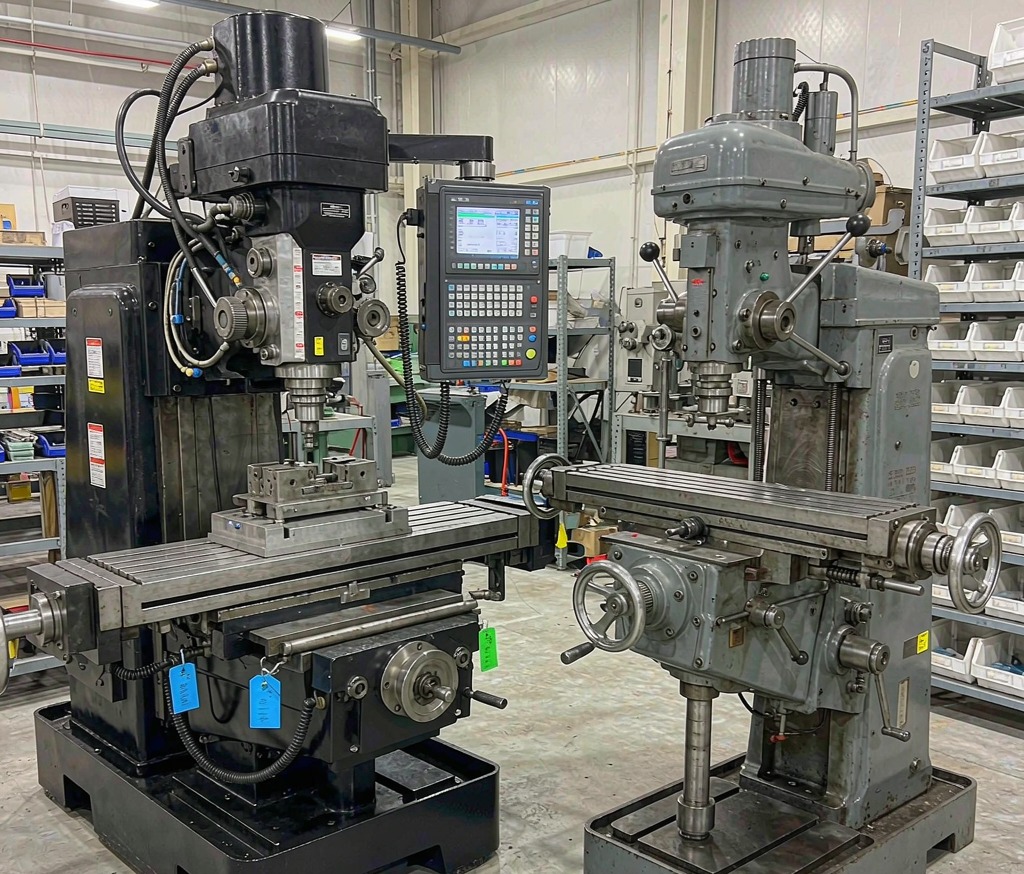
Manual machining relies on a skilled operator turning handwheels and reading dials to position the cutter. It is fast for one-off fixes and simple shapes. CNC machining runs programmed toolpaths on CNC milling and CNC turning centers, executing the same routine identically every time. The program, not the operator’s feel, defines the part. Both still cut metal the same physical way; the difference is who decides each move.
Accuracy and Repeatability
Manual machining accuracy depends on the operator and drifts across a shift. CNC holds tolerances part after part because the controller repeats the path to microns. For a single bracket, a good manual machinist is plenty. For five hundred identical brackets, only CNC stays consistent. 5 axis CNC machining takes this further, cutting complex surfaces in fewer setups so feature alignment beats anything manual.
Repeatability is what buyers feel in assembly. A drawer slide, a mounting pattern, a sealing face—if those dimensions vary part to part, the whole product feels cheap or fails fit-up. CNC removes the human variable; manual reintroduces it every shift. That is why any part that mates with others in volume belongs on CNC, regardless of how skilled the operator is.
Cost and Lead Time
Manual wins on setup for a one-off: no programming, just clamp and cut. CNC carries programming and fixturing cost up front, which it amortizes across the run. That is why CNC machining cost drops sharply per part as quantity rises. For a prototype, manual or a quick CNC program may tie; for production, CNC is cheaper per unit every time.
Lead time tells the same story in reverse. A manual machinist can often start a simple part within minutes. A CNC job needs a program, a prove-out, and first-article checks before it runs—hours of non-cutting work. So for a genuine one-off needed today, manual is faster; for anything repeated or high-precision, the CNC overhead pays for itself and then some.
Complexity and Geometry
Manual machines struggle with 3D contours, deep cavities, and simultaneous moves. CNC handles them routinely, and Swiss Turning produces long, slender, high-precision rotational parts that manual lathes cannot match for volume. For fine features and tight corners, EDM machining complements CNC where cutting tools cannot reach.
Geometry also drives setup count. A manual part that needs five flips on the bench becomes five chances for error; a CNC program handles those moves in one clamped routine. Fewer setups mean fewer datum shifts and better true-position across features—often the difference between a part that assembles first try and one that needs rework.
Best Use Cases
Choose manual machining for fixtures, repairs, and simple one-offs where speed-to-first-chip matters more than repeatability. Choose CNC for any repeated quantity, tight tolerance, or complex geometry. A 3 axis CNC machining center covers most prismatic parts; step up to 5-axis for sculpted or multi-sided work.
A practical rule: if you will ever reorder the part, treat the first one as CNC too, because the program then becomes a reusable asset. Manual skill does not transfer to the next order the way a verified CNC program does. The only cases that truly favor manual are unique, non-repeating jobs where no program will ever be reused.
When to Combine Both
The smartest shops blend them. Manual roughed a block to save CNC time, or CNC roughs and a manual hand finishes a cosmetic edge. Surface Grinding after either method delivers the flatness and finish that matter for sealing faces. The method is a tool, not a loyalty.
The blend also helps with cost. Letting a manual operator remove most of the stock before CNC finish-machines the critical features can shorten expensive machine time on a tight-tolerance part. The reverse—CNC roughing, manual touch-up—keeps a one-off cheap while still hitting the dimensions that matter. Decide per operation, not per part, and the result is both accurate and economical.
Before you decide, read our CNC machining services overview, the CNC machining tolerances guide on what CNC can hold, and the choosing CNC supplier checklist for picking a partner who uses the right method per part.
Frequently Asked Questions
Is CNC always more accurate?
For repeatability across a run, yes. A skilled manual machinist can match CNC on a single part but cannot repeat it identically hundreds of times.
Which is faster?
Manual for a one-off with no program; CNC for anything repeated, because setup cost spreads over the quantity.
Can manual and CNC be used together?
Often, yes—manual roughing saves machine time, CNC finishes critical features. Many shops combine both.
Does CNC cost more for prototypes?
Slightly, due to programming, but it de-risks fit and lets you reorder identical parts later.
What about very complex shapes?
CNC, especially 5-axis, handles contours manual machines cannot. EDM covers features no cutter reaches.
How do I know which my supplier used?
Ask for the process route. A good quote states CNC vs manual per operation and why.
Ready to Start Your Project?
Send us your drawings and requirements. Our engineering team will review manufacturability and return a competitive quote with realistic lead time—usually within 1–2 business days.

