
Consumer Electronics & Hardware Enclosures: Metal Manufacturing Processes for Premium Housings
From smartphone chassis to custom IoT enclosures — a complete process selection guide for electronics hardware. Compare CNC machining, die casting and extrusion to balance premium feel, tight tolerances and unit cost at scale.
Table of Contents
- 1. Smartphone & Laptop Chassis: CNC & Die Casting
- 2. Custom Enclosures: CNC Machining for Low Volume
- 3. Heat Sinks & Thermal Components
- 4. Connectors, Brackets & Small Parts
- 5. Surface Finishing: Anodizing & Bead Blasting
- 6. Material Selection for Electronics
- 7. Process Comparison Table: Electronics Applications
- 8. How to Choose an Electronics Enclosure Supplier
->
1. Smartphone & Laptop Chassis: CNC & Die Casting
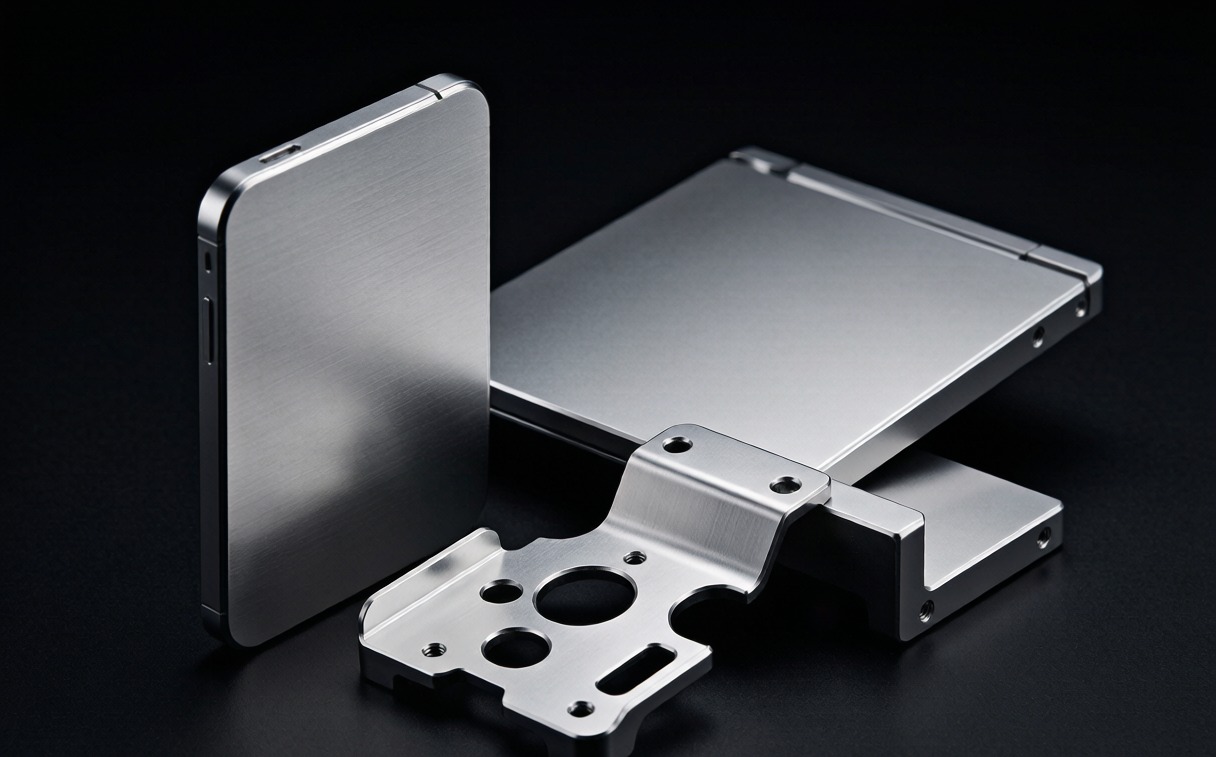
The unibody enclosure defines both the premium feel and the structural integrity of a device. Two processes dominate: CNC machining for flagship and low-volume products, and die casting for mass production.
Unibody Phone & Laptop Frames
Recommended process: CNC Machining (flagship / <50K/yr) or High-Pressure Die Casting (mass / >100K/yr)
CNC-machined aluminum unibodies (from 6061 or 7075 billet) deliver the tightest tolerances (±0.05mm) and the seamless look flagship brands favor, but material removal exceeds 70% — expensive at scale. Die casting of ADC12 or A380 aluminum achieves the same shape at a fraction of cost for high-volume runs, with CNC only for the critical antenna and camera-mount surfaces.
⚠ Wall Thickness Trade-off
Die-cast enclosures need minimum wall thickness of 1.0–1.5mm for fill; CNC-machined walls can go as thin as 0.6mm. Specify the process before finalizing the design.
Internal Brackets & Mid-Frames
Recommended process: Stamping or Die Casting (high volume)
Internal structural brackets are rarely CNC-machined at volume. Progressive die stamping of 0.4–1.0mm steel or stainless produces them at cents per piece; magnesium die casting is used where weight matters most.
2. Custom Enclosures: CNC Machining for Low Volume
For IoT gateways, industrial controllers, and prototype hardware, CNC machining is the default. It needs zero tooling, supports same-day design changes, and handles everything from a 10-piece pilot to a 5,000-piece bridge run.
Prototypes & Pilot Runs
Recommended process: 3-Axis / 5-Axis CNC Machining (6061 aluminum)
A custom enclosure can go from CAD to machined part in 3–7 days with no mold cost. 5-axis machining produces draft-free walls and undercuts in a single setup, eliminating the seam lines that 3-axis requires. This is the fastest path to a functional, marketable sample.
Bridge & Mid Volume
Recommended process: Extrusion + CNC (aluminum) or Urethane Casting (appearance models)
For 500–5,000 pieces, extruded aluminum profiles milled to length with CNC-cut end plates can cut cost 40% versus full machining. Urethane casting reproduces the exact appearance of the CNC master for cosmetic validation at low cost.
Key Takeaway for Enclosure Buyers
- ✓ Prototype / <500 pcs → CNC machining (no tooling)
- ✓ Flagship feel → CNC unibody in 7075 aluminum
- ✓ Mass market >100K → die casting + selective CNC
- ✓ Thermal parts → skived or CNC heat sinks
3. Heat Sinks & Thermal Components
Power electronics generate heat that must be dissipated fast. Thermal components reward processes that maximize surface area and thermal conductivity.
CPU / GPU Heat Sinks
Recommended process: Skiving (high volume) or CNC Machining (prototype)
Skived fin heat sinks produce ultra-thin fins (0.2mm) bonded to the base in one piece — no interface resistance. For low volume, CNC machining of 6063 aluminum delivers fins down to 0.8mm with excellent flatness on the contact base (<0.02mm).
4. Connectors, Brackets & Small Parts
The thousands of small metal parts inside a device — shields, brackets, contacts — are produced by progressive die stamping and zinc die casting.
EMI Shields & Brackets
Recommended process: Progressive Die Stamping (0.1–0.5mm stainless / beryllium copper)
Stamping produces EMI shields and spring contacts at fractions of a cent each. Beryllium copper is specified where the part must retain spring force through thousands of insertion cycles.
5. Surface Finishing: Anodizing & Bead Blasting
The finish is what the customer actually touches. Type II anodizing adds corrosion resistance and color; bead blasting creates the matte premium texture; powder coating suits industrial enclosures.
Finish Selection Guide
- ✓ Premium matte look → bead blast + Type II anodize (clear or black)
- ✓ Color branding → dyed Type II anodize (limit to certified batches)
- ✓ Industrial / outdoor → powder coat (thicker, more durable)
- ✓ Conductive surfaces → avoid anodize on contact areas
6. Material Selection for Electronics
| Material | Property | Best For | Note |
|---|---|---|---|
| Aluminum 6061 | Easy machine, anodizes well | General enclosures, brackets | Cheapest workhorse |
| Aluminum 7075 | High strength | Flagship unibodies | Harder to anodize evenly |
| Magnesium AZ91D | Lightest structural | Weight-critical parts | Needs corrosion protection |
| Stainless 304 | Corrosion-proof | Indoor brackets, shields | Work-hardens when machined |
| Beryllium Copper | Spring + conductive | Contacts, EMI clips | Expensive; spring retain |
7. Process Comparison Table: Electronics Applications
| Component | Primary Process | Volume Range | Tolerance | Tooling |
|---|---|---|---|---|
| Phone unibody | CNC / die cast | CNC <50K; cast >100K | ±0.05mm | CNC none; cast high |
| Custom enclosure | CNC machining | 10–5,000 | ±0.05mm | None |
| Heat sink | Skive / CNC | 100–100K | flat <0.02mm | Skive die |
| EMI shield | Stamping | 10K–1M | ±0.1mm | Progressive die |
| Bracket | Stamping / cast | 5K–500K | ±0.1mm | Die |
8. How to Choose an Electronics Enclosure Supplier
Supplier Checklist for Electronics Hardware
- ✓ In-house anodizing and bead blasting (avoids sub-supplier delays)
- ✓ 5-axis CNC for draft-free, seamless enclosures
- ✓ DFM feedback on wall thickness and draft angles
- ✓ Cosmetic standard (A/B/C surface grading) agreed upfront
- ✓ IP rating validation (IP65/IP67) if outdoor-rated
- ✓ Fast prototype turnaround (under 7 days)
Ready to Start Your Project?
Our engineering team will respond within 24 hours with a detailed quotation.