
304 stainless steel machining is the backbone of corrosion-resistant components across food, medical, and chemical equipment. 304 is austenitic, non-magnetic in the annealed state, and famously tough on tooling because it work-hardens if you let it. Done right, however, it machines into beautiful, hygienic, long-lived parts. Huaxiao runs 304 on turning and milling centers with the correct tool geometry and coolant strategy, then grinds and finishes to print. This article covers how to machine 304 successfully, from tool selection to the finishing steps that make the part last.
Why Machine 304 Stainless Steel
304 offers excellent corrosion resistance, easy cleaning, and weldability at a reasonable price, which is why it is everywhere from dairy fittings to enclosures. When a part must resist rust without coating, CNC turning of 304 is often the fastest route to a finished component.
The trade-off is machinability: 304 is gummy and strain-hardens, so process discipline matters more than on mild steel. Buyers should brief their shop on finish and tolerance so the right inserts and speeds are chosen.
304 also work-hardens locally, which is a feature you can use: a lightly peened or rolled edge gains wear resistance. But in cutting, uncontrolled hardening ruins the next pass, so the entire process is built around keeping the tool cutting, never rubbing.
CNC Turning and Milling of 304
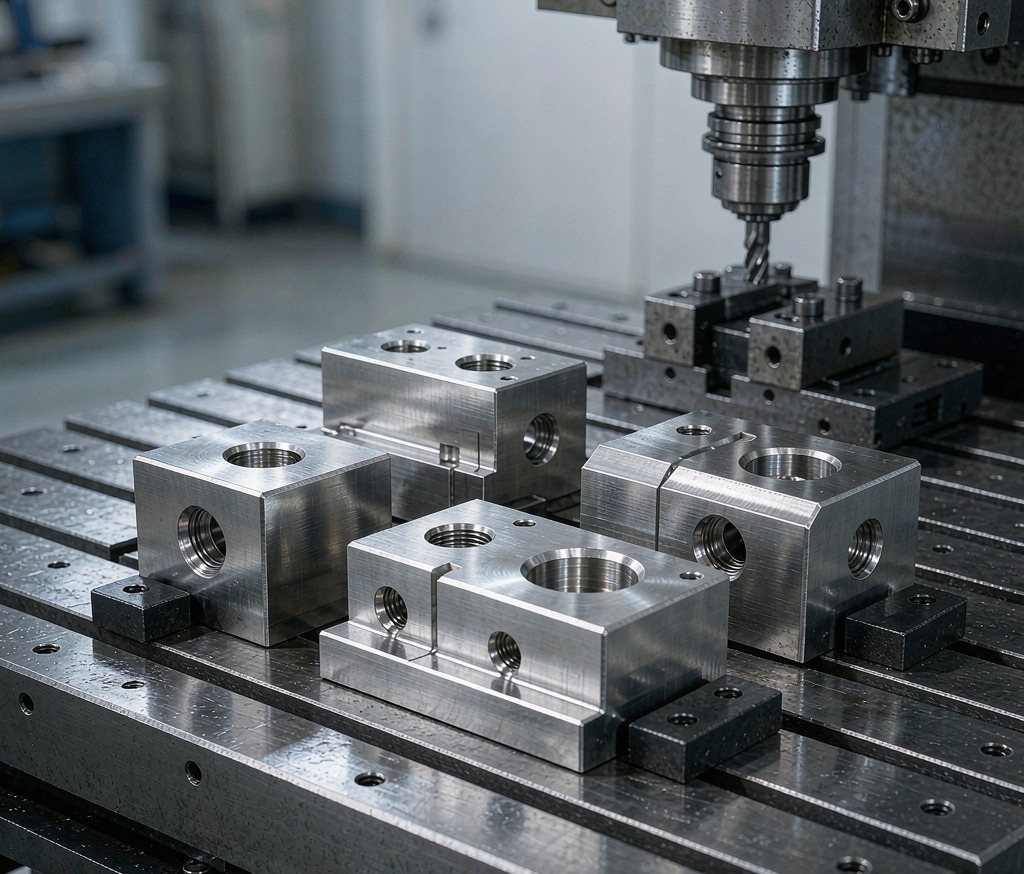
On the lathe, rigid setups and sharp carbide with positive rake keep heat down and chips breaking. On the mill, CNC milling of 304 rewards climb cutting and flood coolant. We also CNC drill and bore 304 for housings and manifolds where holes must stay true.
For deeper background see our stainless steel machining guide and the CNC turning services overview.
Tool coating is the quiet hero: TiAlN or AlTiN coatings tolerate the heat 304 generates and let us push speed without welding chips to the edge. We match coating and geometry to the operation so tools last and the surface stays bright rather than smeared.
Rigidity beats raw power on 304: a stout holder and short stick-out let us take a heavier cut without chatter, which is the real productivity gain. We routinely push harder on a rigid setup than a flexible one would dare, and the surface finish tells the story of that discipline.
Avoiding Work Hardening and Chatter
The golden rule of 304 machining is never let the tool rub. Light, consistent depths of cut with sharp edges prevent the surface from hardening ahead of the tool. Avoid dwelling, use enough feed, and keep the tool engaged. Chatter both ruins finish and accelerates hardening.
We tune speeds and use geometries designed for stainless to keep the cut clean, which protects both tolerance and tool life.
When a feature must be finished to a mirror, we take a final spring pass at a calibrated depth rather than polishing a hardened skin. That order of operations is the difference between a part that looks good and a part that measures good.
Tolerances and Surface Finish
304 holds tight tolerances well once the process is stable. Sealing and bearing features are often CNC ground or surface ground after roughing to reach micron-level flatness. Our CNC machining tolerances guide explains achievable numbers by process.
Electropolish or passivation after machining improves both corrosion life and cleanability for hygienic service.
Surface finish also drives cleanability: a 32 microinch ground seat wipes clean, while a smeared turned surface traps bacteria in a food line. For hygienic duty we specify the finish by number, not by adjective, so the inspector and the operator agree.
Grinding and Deburring 304 Parts
Because 304 work-hardens, grinding must be done with the correct wheel and coolant to avoid a smeared, hardened skin. We deburr by tumbling or hand where geometry allows, and deburr critical edges for safety and assembly.
Proper finishing is what separates a cosmetic stainless part from one that lasts in service.
Edge condition is a safety and function issue, not just appearance: a sharp burr on a 304 bracket will cut an assembler and can break off into an assembly. We radius or break edges by print and verify the critical ones under magnification.
Industries and Applications
304 machined parts appear in food processing, pharma, marine hardware, and architectural trim. Its balance of cost and corrosion resistance is hard to beat. Where higher strength or chloride resistance is needed, 316 is the usual upgrade.
For assemblies, we often pair 304 machining with passivation and light fabrication so the part ships ready to install.
In sanitary design the part is only as good as its dead legs and crevices, so we machine smooth transitions and avoid threaded pockets where fluid can stagnate. That application knowledge is why a 304 specialist beats a general shop for food and pharma work.
Frequently Asked Questions
Is 304 hard to machine?
It work-hardens and is gummy, but with sharp tools, proper feeds, and coolant it machines reliably to tight tolerance.
What coolant strategy works best?
Flood or high-pressure coolant to evacuate chips and control heat; avoid dry machining which accelerates hardening.
Can 304 be ground to a flat seat?
Yes, surface and cylindrical grinding reach micron flatness on sealing faces after rough machining.
Should I passivate machined 304?
Recommended for hygienic or corrosive service; it restores the chromium oxide layer and improves cleanability.
304 or 316 for my part?
304 for general corrosion resistance; 316 where chlorides or seawater are present.
Do you hold tight tolerances on 304?
Yes, with stable setups and finish grinding we hold standard CNC tolerances and tighter on ground features.
Ready to Start Your Project?
Get a build-ready quote on your custom metal parts within 24 hours. Share your drawing and our engineers will respond with process, lead time, and pricing.

