
316 stainless steel is the alloy buyers reach for when a part has to survive chlorides, steam, cleaning chemicals or salt spray for years without pitting. Its molybdenum content gives it markedly better pitting resistance than 304, which is why it dominates marine hardware, food and beverage equipment, pharmaceutical fittings, heat exchanger components and offshore instrumentation.
It is also one of the more demanding alloys to machine well. This guide covers what 316 stainless steel machining requires in practice — realistic tolerances, tooling and feed strategy, the difference between 316 and 316L, and how passivation and electropolishing turn a machined surface into a genuinely corrosion-resistant one.
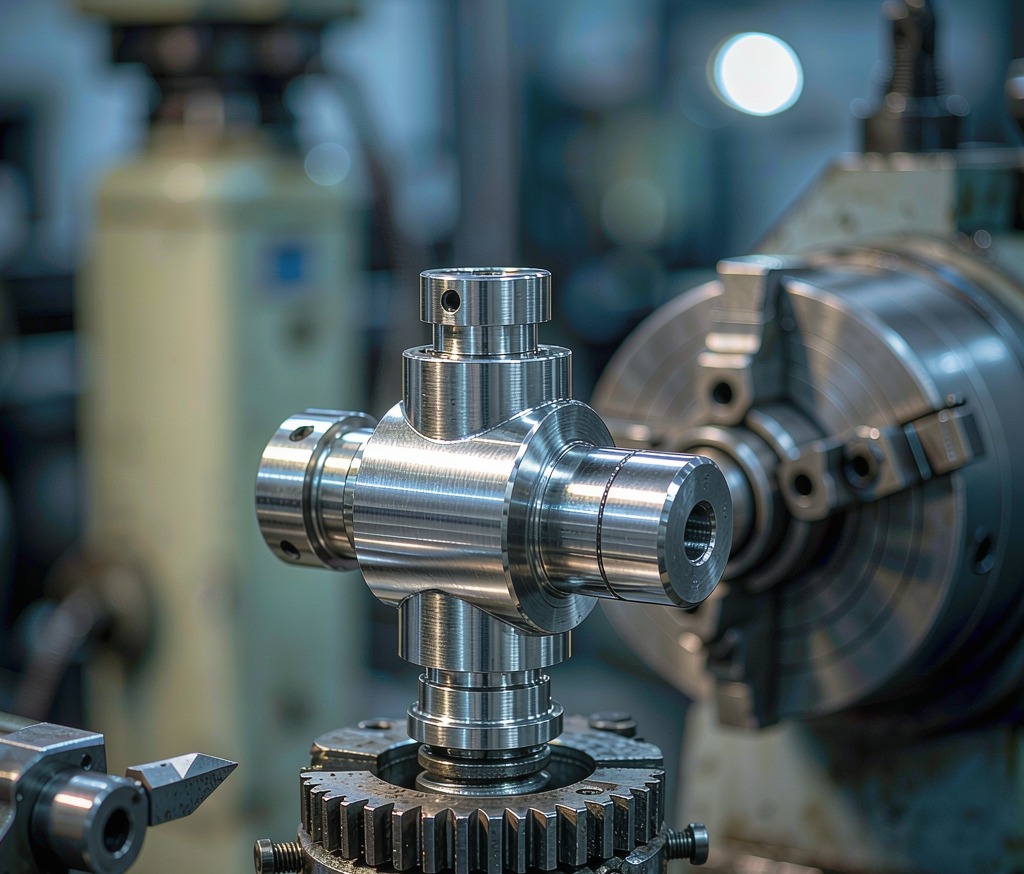
Why 316 and 316L Are Specified
316 contains roughly 16 to 18 percent chromium, 10 to 14 percent nickel and 2 to 3 percent molybdenum. That molybdenum is the entire point: it stabilises the passive oxide film against chloride attack, giving a pitting resistance equivalent number around 24 to 26 versus about 18 for 304. In seawater splash zones, chlorinated wash-down and salt-laden air, that difference decides whether a part lasts two years or twenty.
The alloy is fully austenitic, non-magnetic in the annealed condition, tough down to cryogenic temperatures and readily weldable. Typical parts we machine in 316 include valve bodies, manifolds, sanitary fittings, shafts, pump components, sensor housings and fastener-style turned parts. Our general stainless steel machining services page covers the wider grade family, and for chloride environments beyond 316’s limits, duplex stainless steel machining is the next step up.
316 vs 316L vs 304: Practical Selection
316L is the low-carbon variant, capped near 0.03 percent carbon. If your part will be welded and then exposed to a corrosive service, specify 316L. The lower carbon prevents chromium carbide precipitation at grain boundaries in the heat-affected zone, which is the mechanism behind weld-decay corrosion. For machined-only parts that are never welded, standard 316 is mechanically slightly stronger and usually cheaper to source.
Choose 304 when the environment is dry, indoor or only mildly corrosive and cost matters — it machines somewhat more easily and costs less. Choose 316 or 316L when chlorides, acids, steam sterilisation or salt exposure are present. Where surfaces contact food or pharmaceutical product, the finish specification usually matters as much as the grade; see our guide to food-grade metal parts for the finish and cleanability requirements that typically apply.
Machining 316: Work Hardening, Tooling and Feeds
316 work hardens aggressively. Dwell in one place, rub instead of cut, or let a tool go dull, and the surface layer hardens ahead of the cutting edge — then the next pass cuts a much harder material and tool life collapses. The countermeasures are unglamorous but decisive: rigid setups, sharp coated carbide, a constant chip load and feeds that never allow rubbing.
For turned work we use positive-rake inserts with a sharp edge preparation, cutting speeds of roughly 60 to 120 m/min and a healthy feed per revolution to keep the chip thick enough to carry heat away. High-pressure coolant directed at the cutting zone is the single biggest lever on tool life. Small-diameter, high-precision turned parts route to Swiss turning where guide-bushing support prevents the deflection that would otherwise chatter.
Milled features use trochoidal roughing to limit tool engagement time and heat build-up, then a separate finishing pass with a fresh tool. Complex bodies are cut on metal CNC machining centres in as few setups as possible, and precision bores and grooves are completed with CNC turning or CNC milling operations sequenced so that the critical feature is always the last one cut.
Achievable Tolerances and Surface Finish
On 316 we hold ±0.05 mm on general machined features and ±0.02 mm on critical bores, seal seats and locating diameters. Where a hard-to-hold requirement exists — a sealing face flat within 0.01 mm, or a shaft round within 0.005 mm — the part gets a dedicated surface grinding or cylindrical grinding operation rather than a heroic turning pass.
Surface finish deserves explicit attention on stainless parts because it drives both cleanability and corrosion performance. As-machined finish typically lands at Ra 1.6 to 3.2 µm. Mechanical polishing brings that to Ra 0.4 to 0.8 µm, and electropolishing takes sanitary surfaces below Ra 0.4 µm while also removing embedded iron. State the required Ra and the surfaces it applies to; polishing every face when only the seal land matters is pure cost.
Passivation, Electropolishing and Corrosion Performance
Machining leaves free iron, tool debris and a disturbed surface layer on stainless steel. Until that is removed, the part will rust in service even though the bulk alloy is corrosion resistant. Passivation in nitric or citric acid dissolves the surface iron and lets a uniform chromium-rich oxide reform, typically per ASTM A967 or AMS 2700.
For sanitary, semiconductor and high-purity applications, electropolishing goes further: it removes a controlled thickness of material electrochemically, rounds micro-peaks, raises the chromium-to-iron ratio at the surface and produces a bright, easily cleaned finish. Our electropolishing services page explains when the extra step is justified, and the passivation services guide covers acceptance testing including water immersion and copper sulfate checks.
One practical warning: never let carbon steel tooling, fixtures or brushes contact finished stainless parts. Cross-contamination is the most common cause of surface rust on otherwise correct 316 components, so we keep dedicated tooling and handling for stainless work.
Cost Drivers and Design Choices That Save Money
Expect 316 machining to run roughly 1.6 to 2.5 times the cost of the equivalent aluminum part, driven by slower cutting speeds, higher tool consumption and more expensive raw material. Cycle time dominates, so anything that reduces cutting time reduces price directly.
The highest-leverage design changes are: avoid deep narrow pockets with small corner radii, use corner radii of at least one third of the pocket depth, keep thread depths to 1.5 times the diameter, and consolidate hole sizes so one tool serves many features. Replacing a machined-from-solid body with a near-net investment cast blank plus finishing operations is often the right move above a few thousand pieces.
Also be explicit about which faces need which finish. A drawing that says “polish all over” on a part where only two sealing faces are functional can easily double the finishing bill for no functional gain.
Inspection and Traceability
316 parts headed for marine, food, medical or offshore service almost always require documentation. We supply mill test certificates traceable to heat number, dimensional inspection reports from first article through final lot, passivation certificates referencing the applicable specification, and surface roughness measurements where Ra is specified.
Positive material identification by handheld XRF or optical emission spectrometry is available when a program needs verified alloy confirmation on the finished part — a sensible precaution when 304 and 316 parts run through the same facility.
Lead Time and Quoting
Prototype 316 parts typically ship in 8 to 14 working days; production lots run 18 to 28 working days depending on quantity, finishing and inspection scope. Passivation adds 2 to 4 days and electropolishing 3 to 6 days to the routing.
Send a STEP file plus a dimensioned drawing showing the grade (316 or 316L), tolerances and datums, required surface finish by face, passivation or electropolishing specification, quantity and annual volume. We return process routing, unit price, lead time and DFM notes identifying anything on the drawing that is adding cost without adding function.
Frequently Asked Questions
Is 316 harder to machine than 304?
Slightly. 316 has similar work-hardening behaviour but the molybdenum content makes it a little tougher and more abrasive on tooling, so expect modestly lower cutting speeds and shorter tool life than 304 for the same part.
Do I need 316 or is 316L enough?
Specify 316L if the part will be welded and then exposed to corrosion; the low carbon prevents weld-zone sensitisation. For machined-only parts, standard 316 is fine and usually cheaper.
Is passivation always required?
For any 316 part exposed to moisture, chlorides or wash-down, yes. Machining leaves free iron on the surface that will rust regardless of the bulk alloy, and passivation removes it.
What surface finish do sanitary parts need?
Food and pharmaceutical contact surfaces are commonly specified at Ra 0.8 µm or better, with high-purity applications requiring electropolished surfaces below Ra 0.4 µm.
Can you hold tight tolerances on thin-wall 316 parts?
Yes, with staged machining and stress relief between roughing and finishing. Tell us which walls are functional so fixturing and pass sequence can be planned around them.
How much more does 316 cost than aluminum?
Typically 1.6 to 2.5 times, mostly from longer cycle times and tooling consumption rather than raw material price alone.
Ready to Start Your Project?
Get a build-ready quote on your custom metal parts within 24 hours. Share your drawing and our engineers will respond with process, lead time, and pricing.

