
7050-T7451 aluminum is the aerospace structural alloy: high strength, excellent damage tolerance, and superior resistance to stress corrosion cracking in thick sections. It builds fuselage frames, wing spars, bulkheads, and military structures where 6061 simply is not strong enough. This guide covers machining 7050, anodizing caveats, and the tolerances aerospace programs demand.
Why 7050 for Aerospace Structures
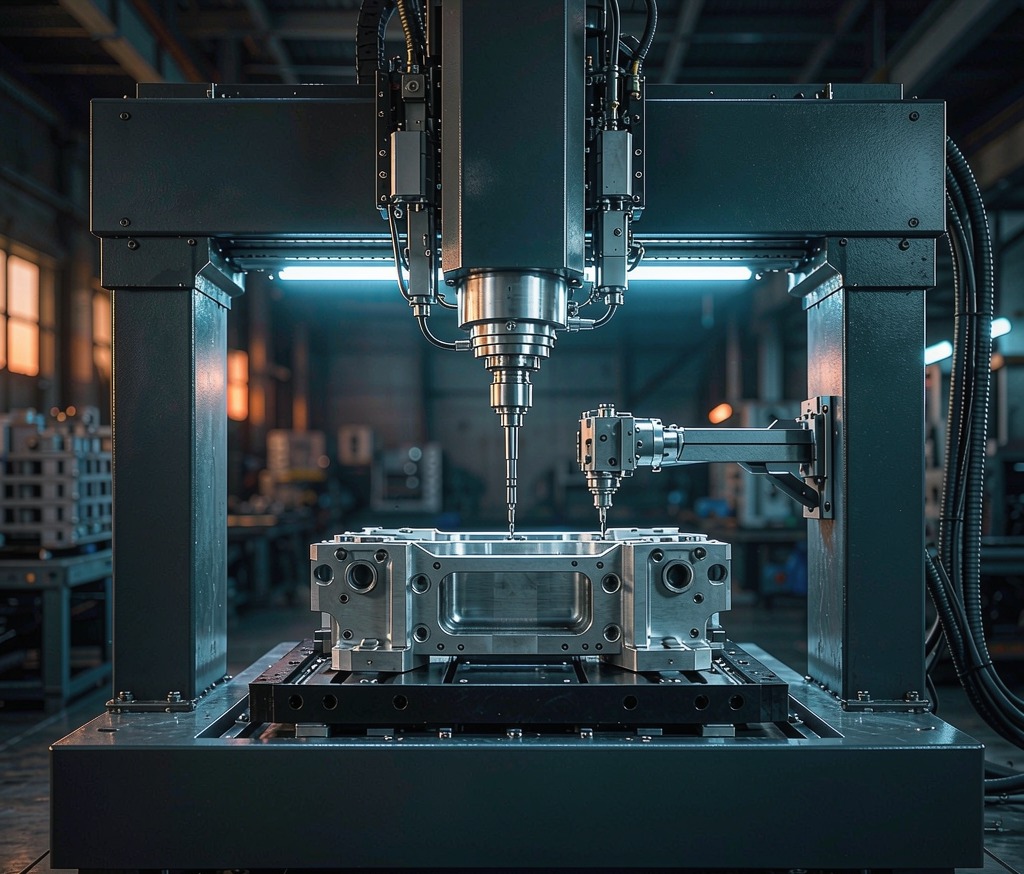
7050 belongs to the 7000 series (Al-Zn-Mg-Cu) and is heat-treated to T7451 for the best balance of strength and stress-corrosion resistance. With tensile strength around 470–530 MPa and yield near 390–460 MPa, it is one of the strongest common aluminum alloys, yet light. We cut it on CNC milling and 5-axis CNC machining centers for large, complex structural parts.
Machining 7050: Heat and Chips
7050 is harder than 6061 and work-hardens if mishandled. Use TiAlN or TiCN coated carbide, positive rake with chip breakers, and flood coolant (≥30 bar) to control heat and built-up edge. Climb milling and stable fixturing prevent deflection on long, thin sections. Roughing at 100–150 m/min and finishing at 180–250 m/min keeps tool life and surface quality up. Our aluminum CNC machining guide covers alloy-specific parameters.
Anodizing and Finish
7050 anodizes, but its high zinc content can leave dark spots, so Type II and hard anodizing need process care; Alodine (MIL-DTL-5541) chromate conversion is common for aerospace electronics housings. Anodizing plus surface grinding delivers the wear and corrosion protection flight structures need. Pair with CNC turning for round features on the same part.
Tolerances and Certification
Aerospace 7050 parts routinely hold ±0.01 mm on critical press-fit diameters, verified by CMM, with material certs to AMS 4050 and ultrasonic testing on thick section. Aerospace machining services add AS9100 discipline, first-article inspection, and full traceability expected by airframers and defense programs.
Frequently Asked Questions
Is 7050 weldable?
Poorly — like most 7000 alloys it is prone to stress corrosion after welding. Mechanical fastening is preferred; fusion welds need careful post-treatment.
How does it compare to 7075?
7050 offers better stress-corrosion resistance in thick sections and higher fracture toughness, making it the choice for large structural parts.
What tolerance is typical?
±0.01 mm on critical features; standard profiles around ±0.05 mm, CMM-verified.
Can you anodize 7050?
Yes, with process care to avoid dark staining; Alodine conversion coating is an alternative for electronics housings.
Inspection, NDT, and Certification
Aerospace 7050 parts are qualified as much by paperwork as by geometry. We machine to AMS 4050 stock with ultrasonic testing on thick section, and verify critical dimensions by CMM against the first-article report. For flight-critical structure, we add penetrant or eddy-current inspection to catch surface anomalies, and we document every setup so a auditor can trace a dimension back to the program and machine. Lead time is typically 1–2 weeks for prototypes and 3–5 weeks for production of large structural parts, longer when multiple operations stack. 5-axis machining lets us reach deep pockets and compound angles in fewer setups, improving accuracy and reducing handling; anodizing and Alodine conversion coating are applied in-house to control thickness and masking. If your program requires AS9100, PPAP, or full lot traceability, state it in the RFQ — we build the inspection plan around the airframe or defense standard rather than treating certification as an afterthought, because a missing report can ground a shipment as surely as a missing tolerance.
Choosing a 7050 Supplier
Shortlist a 7050 partner on evidence: AMS 4050 material with UT, 5-axis capability for deep pockets, in-house anodizing or Alodine, and AS9100 paperwork. A shop that machines and finishes under one roof avoids the dimensional risk of moving a large, stress-prone part between vendors. Ask for a sample first-article report on a similar structural part so you can judge their inspection depth before committing a flight-critical run.
Request a 7050 Quote
Share your 3D model, temper, quantity, and certification needs. We return DFM feedback, a quote, and AS9100-grade documentation for aerospace and defense programs.
Ready to Start Your Project?
Get a build-ready quote on your custom metal parts within 24 hours. Share your drawing and our engineers will respond with process, lead time, and pricing.

