
When a bushing, sleeve, or cylinder liner fails prematurely, the root cause is very often porosity — trapped gas and shrinkage voids left behind by a static casting process. Centrifugal casting services attack that problem with physics rather than with inspection. By pouring molten metal into a mould spinning at 300-3,000 rpm, centrifugal force drives the dense metal hard against the mould wall while lighter slag, oxides, and gas migrate inward toward the bore, where they are simply machined away. What remains is a fine-grained, directionally solidified, essentially pore-free wall. For rotationally symmetric parts, no other casting method delivers comparable soundness at comparable cost.

How Centrifugal Casting Works
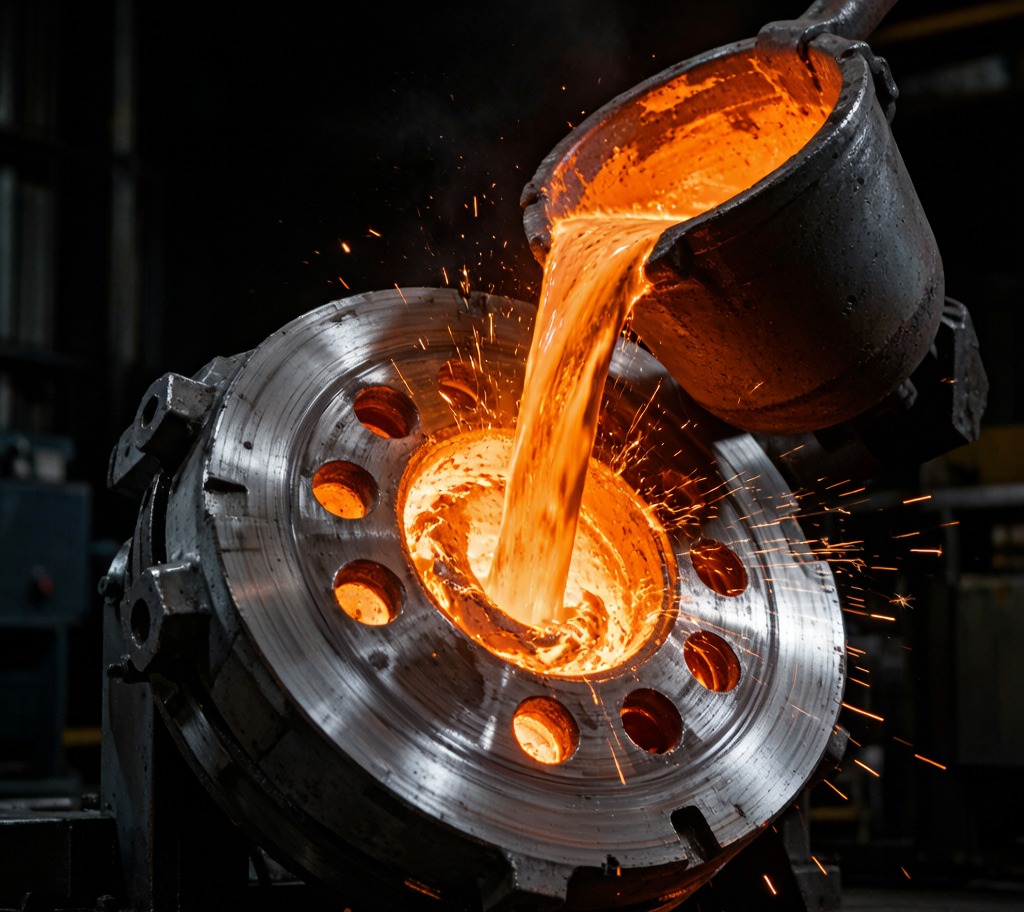
A cylindrical mould — usually a water-cooled steel die, sometimes a graphite or sand-lined shell — is brought up to speed. Molten metal is poured through a launder into the rotating cavity, where centrifugal acceleration of 60-100 g pins it against the wall and forces it to solidify from the outside inward. No core is needed to create the bore; the spin creates it. No riser is needed either, because the pressure gradient continuously feeds the solidification front.
The metallurgical consequences are significant. Grain structure is fine and columnar, oriented radially. Density approaches wrought levels. Inclusions concentrate at the inner diameter, so a standard 3-6 mm machining allowance on the bore removes them completely. Mechanical properties frequently exceed those of an equivalent sand cast part by 20-30%.
Three Variants and When Each Applies
- True centrifugal casting — horizontal or vertical axis, no core, produces plain cylinders: bushings, sleeves, liners, pipe, and rings. Wall thickness is set purely by how much metal is poured. This is the highest-volume variant.
- Semi-centrifugal casting — the mould has a central sprue and the rotation feeds metal outward into a shaped cavity. Used for wheels, pulleys, sheaves, and flanged parts where the centre is later drilled out anyway.
- Centrifuge (pressure) casting — multiple small cavities are arranged around a central sprue like spokes; rotation pressure-feeds each one. Ideal for small, intricate parts and effectively a low-cost alternative to investment casting for certain geometries.
All three are available within our wider metal casting capability, alongside sand casting, gravity casting, and investment casting, so we can benchmark your part across processes before committing tooling.
Alloys, Sizes and Wall Thickness
Centrifugal casting handles a wide alloy range. The most common in our shop:
- Bronzes — tin bronze (C90300, C90500), aluminium bronze (C95400, C95500), leaded bronze for bearings. By far the largest application area.
- Cast iron — grey and ductile iron for cylinder liners, pipe, and rolls
- Carbon and alloy steel — rings, sleeves, and pressure-containing components
- Stainless steel — 304, 316, duplex grades for corrosion service
- Nickel alloys — Inconel and Hastelloy for high-temperature and chemical duty
- Copper and brass — worm wheel blanks, electrical components
Practical dimensional envelope runs from about 25 mm to 2,000 mm outside diameter and up to 6 m in length, with wall thickness from around 5 mm to 200 mm. There is no core to collapse and no riser to feed, so wall thickness variation across the length is limited only by pour control.
One important restriction: alloys with large differences in constituent density can segregate under high g-force. That is occasionally exploited deliberately — bi-metallic liners with a hard wear layer bonded to a tough backing are made this way — but it needs to be designed in, not discovered at first article.
Tolerances, Machining Allowance and Finishing
As-cast, expect:
- Outside diameter: ±0.5-2 mm depending on size and mould type (metal moulds are tighter than sand-lined)
- Wall thickness variation: ±1-3 mm
- Bore: rough and irregular by design — always allow 3-6 mm per side for machining
- Surface finish: Ra 6-25 µm on the outside diameter against a metal mould
Virtually every centrifugal casting is finish machined. We take the raw cylinder straight to CNC turning for the outside diameter and faces, then to CNC boring for the bore, holding H7 fits on bearing applications. Where the part needs flanges, keyways, or oil grooves, our casting plus machining cell handles the complete routing so you take delivery of a finished, inspected component rather than a rough casting that still needs a second supplier.
Applications and Process Comparison
The classic use cases are all rotational: bearing bushings and wear sleeves, engine cylinder liners, pump casings and wear rings, gearbox worm wheel blanks, paper mill and steel mill rolls, pressure pipe, hydraulic cylinder tubes, valve seats, and nozzle bodies for chemical plant.
Choosing between processes for a cylindrical part usually comes down to volume and soundness:
- Centrifugal casting — best density and mechanical properties for hollow rotational shapes, low tooling cost, economical from single pieces to thousands. No pattern and no core box required.
- Sand casting — better for complex non-rotational geometry, but requires cores for hollow features and cannot match centrifugal density.
- Forging — superior directional grain flow and toughness for solid shapes, higher tooling and material cost. Our forging vs casting guide works through the decision in detail.
- Powder metallurgy — cheapest at very high volume for small bushings, but with inherent porosity. Where self-lubrication is desirable that porosity is a feature, as explained in our sintered bushings article; where strength matters, centrifugal casting wins.
A practical rule: if the part is hollow, rotationally symmetric, and needs to be leak-tight or highly loaded, centrifugal casting deserves a quote.
Frequently Asked Questions
What is the minimum order quantity?
There is effectively none. Because a permanent metal mould covers a range of diameters and there is no pattern to build, we quote single prototype pieces as readily as production batches. Tooling cost is a fraction of that for sand or investment casting.
How much machining stock should I allow?
Plan on 3-6 mm per side on the bore, where the inclusions concentrate, and 2-4 mm on the outside diameter. On very large or long parts we may recommend more. We confirm the exact allowance at quotation.
Is centrifugal casting really free of porosity?
The load-bearing wall is essentially free of gas porosity and shrinkage once the inner allowance is machined off. It is one of the soundest casting processes available, which is why it is used for pressure-containing and safety-critical rotational parts.
Can you produce bi-metallic parts?
Yes. By pouring a second alloy after the first has partially solidified, we can create a metallurgically bonded bi-metallic sleeve — for example a hard wear layer over a tough steel backing. This must be designed in from the start.
What is the maximum size you can cast?
Up to roughly 2 m outside diameter and 6 m length depending on alloy and machine. Send us the envelope dimensions and weight and we will confirm capacity quickly.
Do centrifugal castings need heat treatment?
Often yes. Steel and ductile iron castings are normalised, quenched and tempered, or solution treated depending on grade. Bronzes are usually used as-cast. We handle this in-house as part of the routing.
Request a Centrifugal Casting Quote
Send a drawing or STEP file with outside diameter, bore, length, alloy, quantity, and the mechanical or pressure requirements the part must meet. If you currently buy the part as a sand casting, a forging, or a machined-from-solid tube, include the current cost — centrifugal casting frequently undercuts all three on hollow rotational geometry while improving material soundness. Our engineers will return an alloy recommendation, machining allowance, finished tolerances, lead time, and pricing.
Ready to Start Your Project?
Get a build-ready quote on your custom metal parts within 24 hours. Share your drawing and our engineers will respond with process, lead time, and pricing.

