
Round and cylindrical parts are the natural home of the lathe, and CNC lathes have made turning faster, tighter and more repeatable than ever. Our CNC lathe services produce shafts, bushings, pins, spacers, nuts and threaded fittings with live tooling that also mills, drills and taps in a single setup. This guide covers what a modern CNC lathe can do and when to choose turning over other processes.
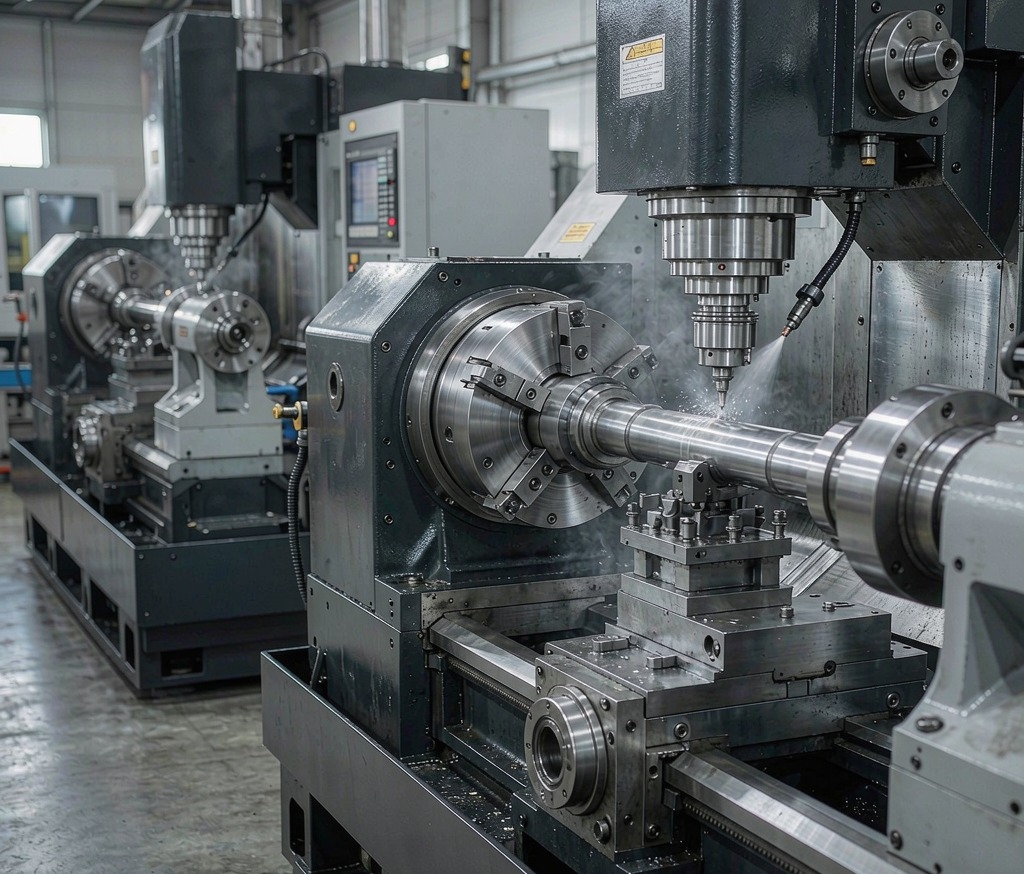
What CNC Lathe Services Cover
A CNC lathe spins the workpiece and feeds cutters against it to remove material from the outside, inside or end. We run CNC turning centres from single-turret bar feeders up to multi-axis machines with sub-spindles. Work that needs milled flats or cross-holes is handled with live tooling so the part is finished in one chucking. Our CNC turning services page details typical capabilities.
Live Tooling and Multi-Axis Lathes
Live tooling turns the lathe into a hybrid mill-turn. A powered cutter mills a flat, drills a cross-hole or taps a side port while the part stays clamped, protecting concentricity. For complex parts this beats turning-then-milling on a separate machine. We also offer CNC milling for prismatic features the lathe cannot reach.
Turning vs Swiss Machining
Swiss-type lathes support the part right at the cut, so they excel at long, slender parts like pins and medical shafts. Our Swiss turning cells hold tight tolerances on parts with high length-to-diameter ratios that a standard lathe would deflect. Both run in the same shop, so we pick the process by geometry, not by habit. Read more in our Swiss turning guide.
Boring, Tapping and Threading
Inside diameters are opened with CNC boring and finished with reaming or boring to tight IT grades. Internal and external threads are cut with CNC tapping and single-point tooling, holding 6H/2B classes even on thin walls. Because everything happens in one setup, thread-to-bore concentricity stays excellent.
Tolerances and Surface Finish
Commercial turning tolerances are around ±0.02 mm, with ±0.01 mm achievable on critical diameters. Surface finish down to Ra 0.4 is routine, and we verify with gauges and CMM. Our precision turned parts programme pushes these limits further for instrument-grade work.
Typical Round Parts Produced
Shafts, bushings, sleeves, spacers, nuts, studs, nozzles and valve stems are everyday lathe work. If your part is round, a CNC lathe is almost always the most efficient route.
Bar Feeding and Unattended Production
For round parts, a bar feeder is what makes turning cheap. A 3-metre bar loads automatically and the lathe runs unattended through the night, so labour is a small fraction of the part cost. We use bar feeders on our CNC turning cells for any volume above a few hundred, and sub-spindles let us part off the finished part and start the next without stopping. The same program that made your prototype makes your millionth piece, which is why turned parts scale so predictably.
Swiss machines take this further for slender parts, feeding bar through a guide bushing so the supported length is almost the diameter. That is why our Swiss turning work holds tolerances other shops cannot on a standard lathe. If your part is long and thin, ask us to quote it Swiss even if a conventional shop says it is impossible.
Cost Drivers in Turning
Turning cost is driven by cycle time, setup and scrap. Cycle time drops when we can take deeper cuts on rigid parts; setup drops when features fit in one chucking with live tooling; scrap drops with in-process gauging. Tight tolerances cost more only where they force slower feeds or extra operations, so open the tolerance anywhere function allows. Our precision turned parts programme shows how we balance cost against the few features that truly need ±0.005 mm.
Gauging and In-Process Control
On production turning we gauge critical diameters at the machine with air or pin gauges so a drift is caught in a few pieces, not a whole batch. First-article inspection sets the baseline, then periodic CMM checks confirm the trend. This is why a turned part from run one matches run fifty. For shafts and pins our precision turned parts programme adds runout checks so the part spins true in its bearing. Good gauging is cheaper than sorting scrap, and it is built into every lathe job we ship.
Materials We Turn Every Day
Beyond brass and aluminium, we turn stainless, mild and alloy steel, copper, titanium and a range of plastics on the same lathes. Each needs its own speeds, tools and coolants — steel wants rigid setups and sharp inserts, plastic wants slow speeds to avoid melting. Because we run all of them, a multi-material assembly is easy: we turn the steel shaft and the plastic bushing on adjoining cells and ship them together. Tell us the full bill of materials and we will plan the routing so nothing waits on a different shop.
Frequently Asked Questions
What is the largest diameter you can turn?
Our chuck lathes handle up to about 300 mm diameter; bar-fed work is typically under 65 mm.
Can the lathe mill a flat on a round part?
Yes, with live tooling we mill flats, slots and cross-holes without unchucking.
When should I choose Swiss over standard turning?
For slender parts (length/diameter above ~8:1) where deflection would hurt tolerance — see Swiss turning.
Do you supply material certificates?
Yes, on request, for any stock we purchase for your order.
Ready to Start Your Project?
Get a build-ready quote on your custom metal parts within 24 hours. Share your drawing and our engineers will respond with process, lead time, and pricing.

