
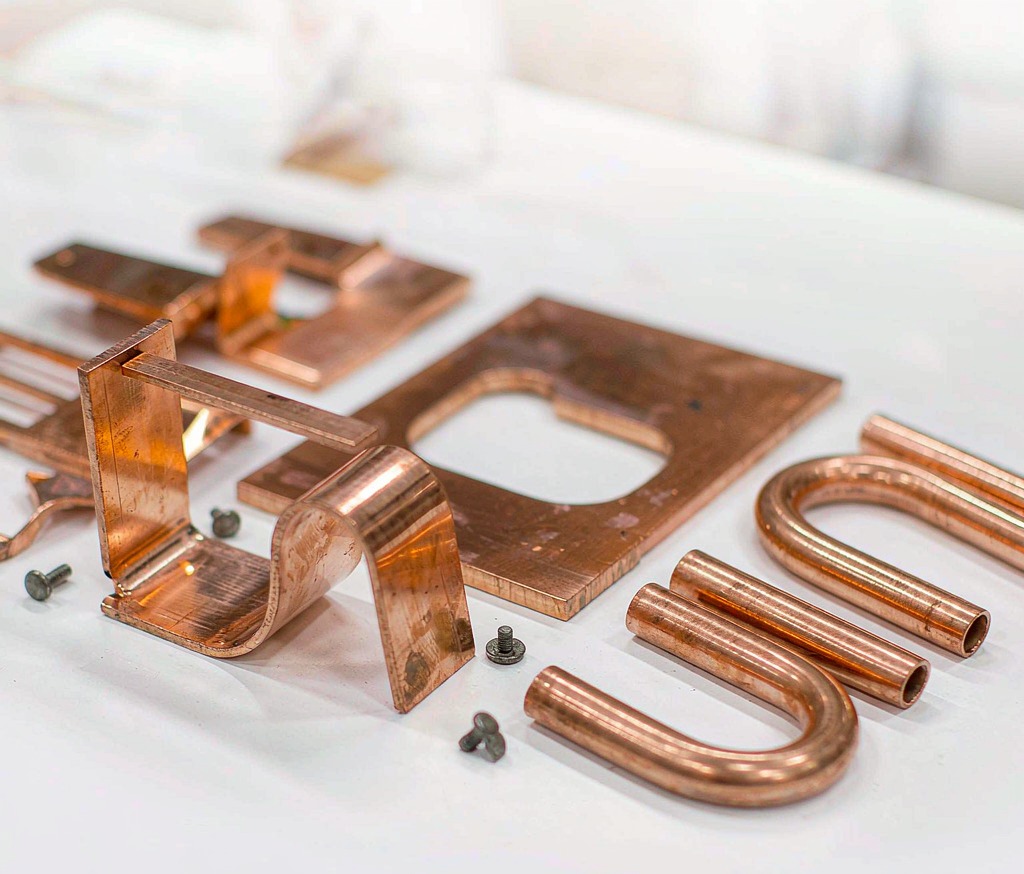
Copper’s unmatched electrical and thermal conductivity makes it essential for busbars, heat exchangers, and RF components—but it is also soft, gummy when machined, and prone to surface oxidation. Delivering a precise copper part requires fabrication know-how that generic machine shops often lack. Here is how professional copper fabrication services turn the metal’s quirks into reliable, repeatable components for power and thermal duty.
Where Copper Wins—and Where It Hurts
Copper carries current with minimal loss and pulls heat away faster than almost any other affordable metal. That makes it the material of choice for copper busbars, grounding straps, and thermal spreaders. The downside is work-hardening and a tendency to gall during machining, which is why process selection matters more than with steel or aluminum. Get the alloy and the cut right and copper is a dream; get them wrong and it smears under the tool.
Cutting & Bending Copper Stock
Flat bar and sheet are best processed with laser cutting or precision shearing to avoid the burrs that sawing leaves on soft copper. For formed busbars, CNC bending with properly radiused tooling prevents cracking at the bend, because copper has limited stretch before it splits. Our copper and brass extrusion line also produces custom profiles—busbar sections, terminals, and hollow shapes—without machining the full cross-section, which dramatically cuts both scrap and lead time on long parts.
Joining: Brazing, Welding & Bonding
Because copper conducts heat away from the joint, welding needs high energy density and often preheat. TIG welding and spot welding both work, but brazing is frequently preferred for dissimilar joints and leak-tight assemblies because it avoids melting the base metal. Silver-bearing filler gives strong, conductive joints for electrical buswork, which is why switchgear manufacturers standardize on it for high-current links.
Mechanical joining via riveting or crimped terminals remains common in equipment where disassembly is required for service. The choice between braze and mechanical join usually comes down to current rating, service temperature, and whether the joint must be field-removable.
Surface Treatment for Conductivity and Protection
Bare copper tarnishes, raising contact resistance and hurting both appearance and performance. Silver plating preserves conductivity at contact faces, while nickel plating adds corrosion resistance where silver is unsuitable or too costly. Our copper machining services and copper CNC machining pages explain how we hold tight tolerances on this tricky alloy using sharp tooling, positive rake, and flood coolant.
Material Options: Pure Copper, Brass & Specialty Alloys
Not every “copper” part needs pure copper. Brass machines beautifully and suits decorative or low-current parts; beryllium copper combines conductivity with spring properties for connectors; cupronickel resists seawater. Our beryllium copper parts and cupronickel machining capabilities cover these specialty needs, and copper casting handles complex shapes that fabrication cannot reach economically.
Quality & Testing for Critical Buswork
For power distribution, we verify plating thickness, check bend radius against crack criteria, and can perform continuity and insulation-resistance testing on finished assemblies. Dimensional inspection confirms hole patterns and flatness so the busbar drops into the cubicle without on-site rework, which is where most field cost overruns actually happen. We treat every busbar as a current-carrying safety component, not a bent strip of metal.
Machining Copper Without the Headaches
Copper’s tendency to work-harden means the cutting edge must stay engaged and fed aggressively enough to cut, not rub. We use razor-sharp uncoated or polished tools, positive rake angles, and generous flood coolant so heat carries away instead of baking into the work-hardened layer. Copper CNC machining of tight-tolerance features such as contact seats and thread forms is routine when the process is set up for the alloy rather than borrowed from a steel playbook. The same discipline applies to copper machining services for turned and milled components where conductivity and dimensional accuracy both matter.
For busbars that need both formed shape and machined features, we sequence forming first, then CNC, then plating, because plating after machining avoids coating the very surfaces you just cut to tolerance. This order-of-operations thinking is the quiet difference between a part that assembles cleanly and one that needs field modification.
Sourcing, Lead Time & Supply Assurance
Copper pricing is volatile and tied to commodity markets, so we help customers buffer that risk through forecast-based buying and staged inventory of common bar and busbar stock. For production programs we can hold safety stock of your specific profile so a spike in spot price or a mill delay does not stop your line. Lead time on fabricated copper parts is usually driven by plating and braze queue rather than machining, and we schedule those shared resources to protect committed ship dates. Our copper busbar manufacturing program is built around exactly this kind of predictable, repeatable supply for switchgear and power customers.
Industries That Rely on Copper Fabrication
Copper fabrication is concentrated wherever current or heat must move efficiently. Switchgear and busway manufacturers are the largest users, followed by EV and battery systems, renewable inverters, and HVAC coil assemblies. Medical and semiconductor equipment use high-purity copper for clean, low-outgassing thermal paths. Each of these industries has its own acceptance culture—medical demands traceability, automotive demands PPAP, energy demands cycle-life data—and we tailor documentation to match. Our copper casting and beryllium copper parts capabilities extend the same material expertise into shapes and spring properties that fabrication alone cannot reach.
Frequently Asked Questions
Why braze instead of weld copper busbars?
Brazing avoids melting the busbar, reduces distortion, and gives a uniform conductive joint—important for high-current switching gear.
How do you stop copper from oxidizing?
Silver or nickel plating at contact faces, plus sealed packaging, keeps resistance low. We plate in-house to control thickness.
Can you make custom busbar profiles?
Yes. Copper extrusion produces bespoke cross-sections far cheaper than machining solid bar.
Is copper hard to machine?
It work-hardens and can be gummy, but with sharp tooling, positive rake, and coolant we hold tight tolerances routinely.
Which copper alloy for marine use?
Cupronickel or tin-bronze resist biofouling and corrosion; we machine and assemble both to spec.
Ready to Start Your Project?
Get a build-ready quote on your custom metal parts within 24 hours. Share your drawing and our engineers will respond with process, lead time, and pricing.

