
An adapter is the quiet hero of any assembly: it lets two components that were never designed to meet actually connect, align, and seal. Custom metal adapters exist because off-the-shelf fittings rarely line up with a bespoke housing, a non-standard bore, or a mating part from another supplier. Custom metal adapters give you the exact interface your design needs rather than forcing a compromise. This guide covers the types, manufacturing routes, and specification details that produce adapters that fit first time.
What a Custom Adapter Has to Do
Adapters perform one or more jobs at once: they change a thread standard to another, step a bore from one diameter to another, bridge a flange pattern to a different one, locate a shaft concentric to a housing, or seal a fluid path between dissimilar ports. A well-designed adapter does all of this without adding play, leak paths, or alignment error. The design intent is always to make two things behave as one.
Because adapters sit at interfaces, their critical features are the mating surfaces: threads, bores, sealing faces, and bolt circles. A 0.05 mm error on any of these means a leak, a bind, or a misalignment that propagates through the whole assembly. That is why adapters are machined to tighter intent than the parts they join.
Common Adapter Families
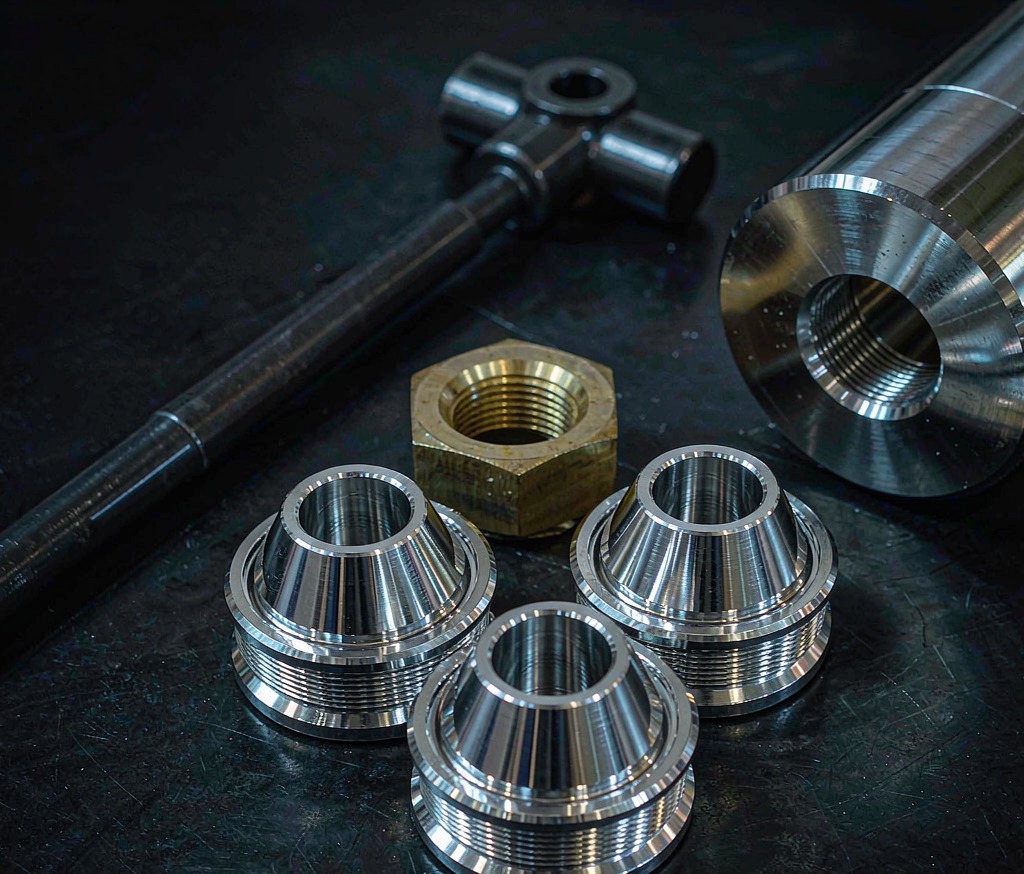
Thread adapters convert between NPT, BSPP, SAE, and metric ports, the four families that cause most field incompatibilities. Bore or sleeve adapters step a shaft or tube to a different diameter while holding concentricity. Flange adapters bridge one bolt pattern to another. Mounting adapters locate a sensor, bearing, or motor to a non-standard surface. Each family stresses a different capability.
We machine these on CNC turning and CNC milling cells, with CNC boring for precise internal diameters and cross-holes. Multi-feature adapters that must hold several datums in relationship are cut on 5-axis CNC machining in a single setup to avoid stack-up error across the interfaces.
Manufacturing Routes
Most adapters are machined from bar, tube, or plate because the volumes are low and the geometry is unique. Machining gives exact threads, bores, and sealing faces with no tooling cost and fast turnaround, which suits prototypes and spares perfectly. For higher volumes, the same part can move to casting or forging followed by finish machining, but the machined route is almost always where an adapter is proven first.
Where the adapter is part of a larger assembly, it is often produced and finished as a unit rather than alone. Our welded assemblies, bolted assemblies, and riveted assemblies capabilities integrate adapters into the structures they serve, and our hybrid assemblies line combines processes where a single material or route will not do.
Bores, Threads, and Sealing Faces
Bore concentricity is usually the make-or-break feature. A stepped adapter must hold the two bores coaxial within a few hundredths of a millimetre, which means turning both in one setup or finishing by centerless grinding or between centres. Thread class and depth must match the mating standard exactly, because mixing NPT with BSPP, for example, causes leaks that no sealant fixes.
Sealing faces need flatness and finish appropriate to the seal: an O-ring groove needs the right cross-section and a clean surface, a metal-to-metal face needs flatness and a controlled finish, and a welded joint needs a prepared edge. Our custom metal flanges guide covers the facing and bolting standards these interfaces are inspected against, and our custom metal fasteners page covers the hardware that holds them together.
Material Selection
Adapter material follows the more demanding of the two mated parts. Stainless or duplex where corrosion resistance is needed, aluminium where weight matters, brass or copper-nickel in potable or marine water, and steel or hardened alloy where strength or wear dominates. The adapter should be at least as noble as the part it protects, or isolation should be designed in to prevent galvanic attack at the joint.
Where an adapter sees both fluid and structural load, a corrosion-resistant grade with appropriate passivation or coating is specified. Our OEM and ODM metal parts guide explains how interface components like adapters are qualified inside a larger supplied assembly.
How to Specify a Custom Adapter
Send both mating drawings or, at minimum, the exact thread standards, bore diameters and tolerances, flange patterns with bolt circle and hole sizes, sealing method, material, and environment. Stating the two interfaces explicitly prevents the classic error of an adapter that fits one side perfectly and binds on the other. For low volumes, machined prototypes confirm fit before any production route is committed.
Frequently Asked Questions
What is the most common adapter mistake?
Mixing thread standards such as NPT with BSPP, which leaks regardless of sealant. Name both interfaces explicitly.
How accurate must bore concentricity be?
Typically within a few hundredths of a millimetre, held by turning in one setup or finish grinding.
Which manufacturing route is best?
Machining from bar or tube for prototypes and spares; casting or forging plus machining for higher volumes.
What material should I choose?
Match the more demanding mated part, or design isolation to avoid galvanic corrosion at the joint.
Can adapters be part of a larger assembly?
Yes, they are often integrated into welded, bolted, or hybrid assemblies rather than supplied alone.
Do you provide prototypes first?
Yes, machined prototypes confirm fit before any production route is committed.
Ready to Start Your Project?
Get a build-ready quote on your custom metal parts within 24 hours. Share your drawing and our engineers will respond with process, lead time, and pricing.

