
A shaft collar looks simple, yet it performs critical jobs: locating, spacing, stopping, and joining components along a shaft. When a catalog collar will not fit the bore, material, or duty, a custom metal collar is the solution. This guide covers the options.
We explain collar types, the materials and machining routes that suit them, the tolerances and finishes that matter, and where custom collars earn their place in real machines. Small part, big responsibility.
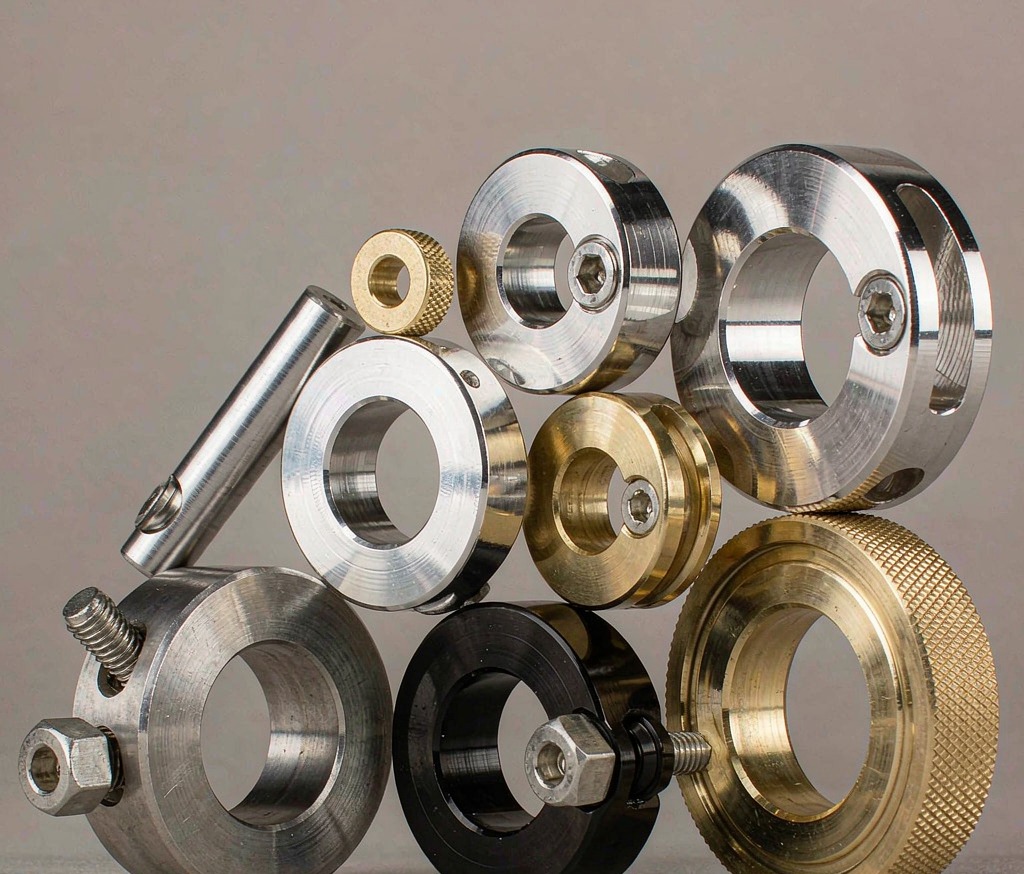
What Are Custom Metal Collars
A collar is a ring fitted to a shaft to control position or transmit force. Custom versions vary bore size, outer shape, material, or features such as set screws, threads, or mounting holes. They are used in conveyors, actuators, medical instruments, and robotics.
Many projects begin alongside custom metal spacers and custom metal rings, since these components are often designed as a set around the same shaft.
Materials and Grades
Steel and stainless are common for strength and corrosion resistance; aluminum keeps weight down; brass suits electrical and low-friction roles. The material should match the shaft and environment so the assembly ages consistently.
For wear surfaces, a hardened grade or a later black oxide finish improves durability without changing the base metal.
Turning and Swiss Machining
Collars are fundamentally round, so CNC turning is the primary process, producing the bore, face, and any grooves in one setup. For very small or slender collars, Swiss turning holds tight tolerances on long, thin parts.
When the collar carries flats or holes, CNC milling adds those features, and CNC boring refines the bore for a precise sliding or press fit.
Types: Split, Set-Screw, and Threaded Collars
Split collars clamp with a screw for easy adjustment; set-screw collars use a point screw to bite the shaft; threaded collars mate with matching shafts for positive axial location. Each type balances holding power against ease of assembly.
Selecting the right type early prevents rework – a clamping collar where a threaded one was assumed can undermine the whole mechanism.
For high-speed or oscillating shafts, a one-piece clamping collar outperforms a set-screw type because it distributes force evenly and will not mark the shaft. Where the collar must also transmit thrust, a threaded or flanged design is usually the safer choice that avoids slip under load.
Finishes and Tolerances
Bore and face-squareness tolerances decide how true the collar sits on the shaft; surface grinding of faces may be specified for critical positioning. Finishes range from plain machined to plated or anodized for corrosion or appearance.
Always state whether the bore tolerance is for a slip fit, press fit, or locational fit so the shop targets the correct interference.
For collars that locate sensitive components, a light grind on both faces guarantees squareness to the bore within a few microns, which prevents wobble in high-speed assemblies. Specifying this explicitly avoids a costly rework loop after first articles are measured and found out of true.
Typical Applications
You will find custom collars in belt drives, linear guides, sensor mounts, and precision turned parts assemblies where exact axial location is required. They are also paired with custom metal bushings to guide and locate shafts.
Because they are cheap insurance against misalignment, specifying them correctly pays back across the life of the machine.
Quality Control and Inspection
Collars are verified for bore size, face squareness, and outer diameter with gauges or CMM. Critical locating faces may be ” + plink(“surface-grinding”,”surface ground”) + ” for flatness. Finish and hardness are checked where specified. Simple, documented checks keep these small parts consistent across a run.
Lead Time and How to Request a Quote
Supply bore, outer diameter, width, type, material, and finish. ” + plink(“cnc-turning”,”CNC turning”) + ” makes even single collars economical, while families of sizes benefit from shared setups. Sharing the mating shaft details prevents fit surprises at assembly.
Common Cost Drivers in Custom Collars
Collars are economical because turning handles them in a single setup, even as one-off pieces. Cost rises with complexity: threaded bores, multiple set screws, cross-holes, and tight face squareness all add operations. Where a family of collars shares diameter and material, combining them into one batch spreads the setup cost and shortens lead time.
Finish is the other lever. Plain machined collars are cheapest; plating, anodizing, or grinding for critical faces adds cost but is sometimes essential for function or appearance. Supplying the mating shaft details up front prevents a fit problem that would otherwise mean rework or a second order, which is far more expensive than a clear first specification.
Frequently Asked Questions
What is the difference between a split and set-screw collar?
A split collar clamps around the shaft for easy adjustment; a set-screw collar uses a screw point to lock position.
Which material is best for corrosion resistance?
Stainless steel is standard for corrosion resistance; brass suits light-duty or electrical roles.
Can collars be made with threaded bores?
Yes. Threaded collars mate with matching shafts for positive axial location and are common in actuators.
How tight can the bore tolerance be?
CNC turning holds tight bores routinely, with boring or grinding for the most critical fits.
Are custom collars good for small batches?
Yes. Turning makes them economical even as prototypes or low-volume runs.
Do you make matching spacers and rings?
Often, since collars, spacers, and rings are usually designed together around one shaft.
Ready to Start Your Project?
Get a build-ready quote on your custom metal parts within 24 hours. Share your drawing and our engineers will respond with process, lead time, and pricing.

