
Custom metal dowel pins are the unsung heroes of accurate assembly. They locate two plates, jigs, or housings to a repeatable position so bolts only clamp, never align. A dowel that is a few microns out throws the whole stack into error. Huaxiao turns and grinds dowel pins to m6, h7, and press-fit tolerances in steel, stainless, and brass, then plates or passivates them for the environment. Here is what buyers should specify, and why the grinding step decides whether a pin is a precision locator or just a rod.
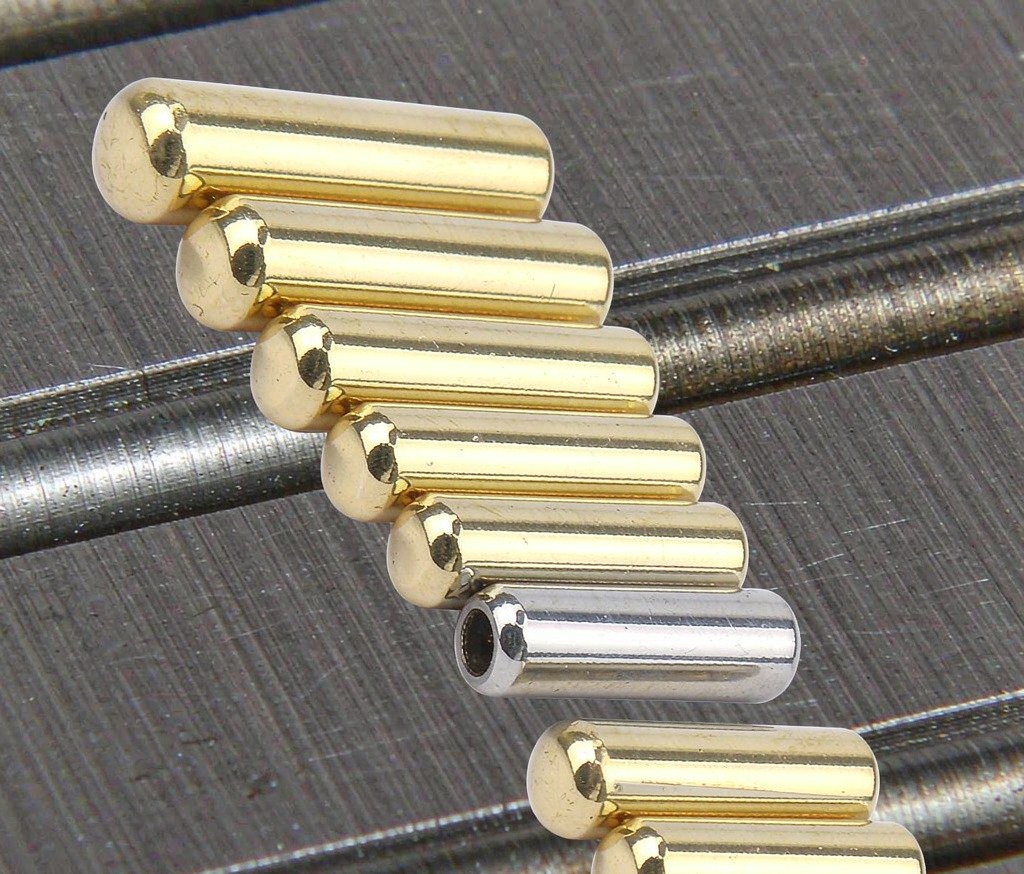
Functions of Custom Dowel Pins
Dowels carry no load in a static joint but enforce location; they also act as hinge or pivot pins in mechanisms. Precision matters because the pin replaces adjustable shimming. Our broader custom metal pins guide covers the full pin family.
They pair naturally with custom metal fasteners in fixture and tooling builds.
In a fixture, the dowel is the datum the rest of the part is built around; get it wrong and every part made on that fixture is shifted. That is why dowel tolerance is treated as a primary characteristic, not a footnote.
Swiss Turning and Centerless Grinding
Long, slender pins are best produced on Swiss turning centers that support the stock right at the cut, keeping diameter true along the length. Diameter and straightness are then perfected by centerless grinding, which removes stock without centers for a consistent, round pin.
The combination of turning and grinding is what delivers press-fit repeatability at volume.
We also watch total indicated runout on the finished pin, because a pin that is round but not straight still shifts the assembly. By measuring runout on a matched-diameter mandrel we catch the subtle bow that a diameter-only check would miss, which is exactly the error that accumulates across a multi-plate stack.
Centerless grinding is deceptively subtle: the relationship between the control wheel, grinding wheel, and work rest sets roundness and taper. We qualify the setup on a sample and measure with a comparator so a full lot stays within the band.
Tolerance Classes (m6, h7, press fit)
h7 is a common slip-fit dowel; m6 is a light press; tighter classes are used where the pin is driven. We hold these classes by grinding to size and verifying on gauging. The fit you choose decides assembly force and re-workability.
See our centerless grinding services page for achievable diameters and finishes.
Fit also interacts with the hole: a press-fit pin in an oversized reamed hole does nothing, so we often supply matched pins and advise on the mate. Coordinating the two features is where location accuracy is actually won.
Materials and Heat Treatment
Low-carbon steel is cheap and case-hardens well; 303/304 stainless resists corrosion; brass suits non-marring tooling. When wear or shear matters, we apply heat treatment such as hardening or carburizing to raise strength.
Material also sets whether the pin can be reused or is a one-time press fit.
For jigs that are hammered apart daily, a hardened pin outlasts a soft one by orders of magnitude. We match the heat treat to the duty cycle so the pin is not the wear item that limits the whole fixture.
Plating and Passivation Options
Steel dowels often get zinc or black oxide for corrosion resistance; stainless is passivated for cleanliness. Plating adds a few microns, so the final ground diameter must account for it. We plan plating after grind so the finished pin still meets class.
Deburring the ends prevents assembly scoring and finger cuts.
Black oxide is popular because it adds almost no thickness, keeping the fit intact while still protecting against rust in indoor use. For outdoor or washdown duty we step up to zinc or stainless instead.
Documenting the plating spec on the drawing avoids ambiguity at reorder: a note like “zinc 8 microns, clear chromate” tells the line exactly what to run and keeps a five-year-old print consistent with the latest batch.
Volume Production Tips
For high volumes, specify a chamfer or radius on both ends, a standard tolerance class, and a finish that survives handling. Sorting and packaging by count keeps the line fed. Prototype pins can ship quickly, then scale once the print is locked.
Consistent raw stock diameter reduces grind time and variation across the lot.
We also offer lot-controlled packaging with a count and cert in each bag, so a line operator grabs exactly what the traveler calls for. That small logistics step prevents the mixed-bag errors that quietly drift an assembly out of tolerance.
Frequently Asked Questions
What tolerance can dowel pins hold?
Typically h7 slip fit or m6 press fit, with centerless grinding holding tight roundness and straightness.
Steel or stainless for my pins?
Steel where strength and cost rule; stainless where corrosion or cleanliness matters.
Can you press-fit diameter a pin?
Yes, we grind to m6 or tighter and verify with gauges before shipment.
Should pins be plated?
Plating protects steel in corrosive use, but we grind first and plate to size so class is preserved.
How are long thin pins made straight?
Swiss turning supports the bar at the cut, then centerless grinding finishes diameter and straightness.
Do you supply in counted packaging?
Yes, pins are sorted and packed by quantity for direct line feeding.
Ready to Start Your Project?
Get a build-ready quote on your custom metal parts within 24 hours. Share your drawing and our engineers will respond with process, lead time, and pricing.

