
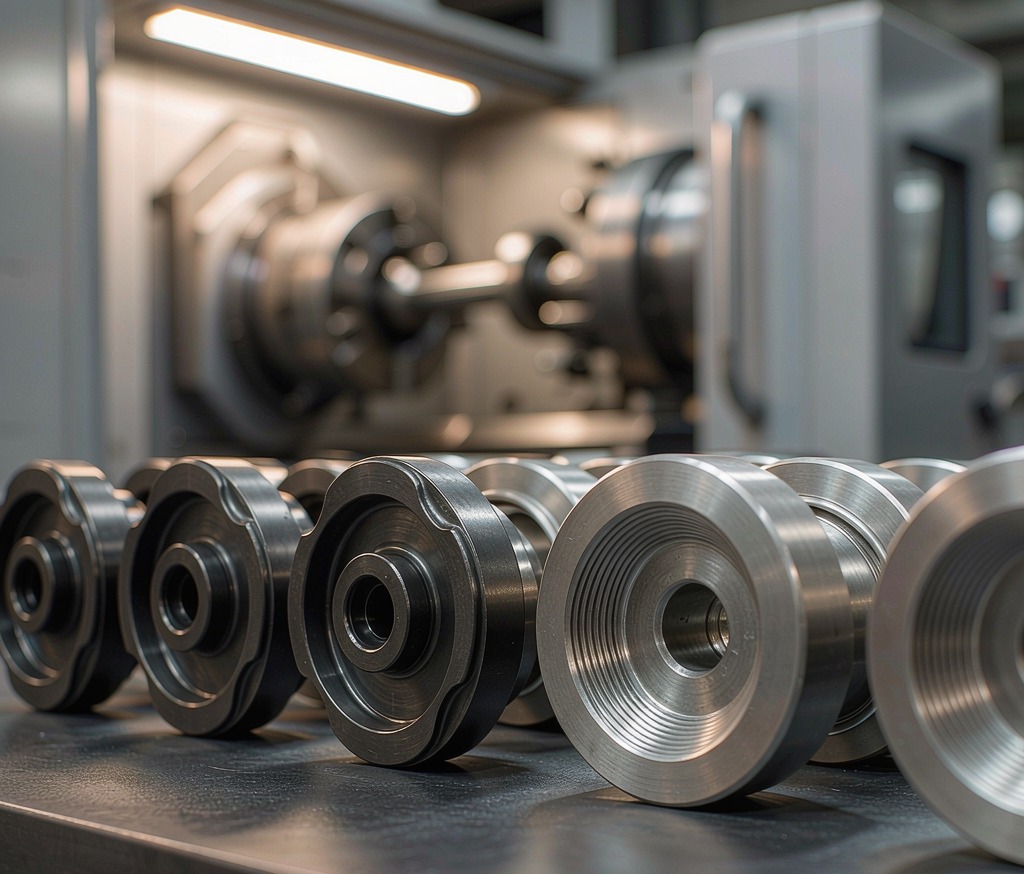
A hub is the quiet workhorse of almost every rotating assembly: it carries the load, locates the shaft, and transmits torque to wheels, pulleys, sprockets, and rotors. When an off-the-shelf part will not fit your geometry, our custom metal hubs are CNC turned or forged to your drawing in steel, stainless, aluminum, or brass. We hold the bearing seat, pilot bore, and bolt circle together so the finished hub drops straight onto your shaft.
What a Custom Metal Hub Is
At its simplest a hub is a short, often disc- or cup-shaped body with a central bore and one or more features that connect it to the rest of the assembly: a keyway, a spline, a flange, or a set of tapped holes. Because the hub controls runout and axial position, its geometry must be machined concentrically. That is why most hubs start as a CNC turning operation, where the bore and OD are cut in a single setup to keep them coaxial within a few microns.
Hubs also come in less obvious forms: a printed-circuit-board spacer, a robotic joint yoke, or a conveyor drive drum. In every case the job is the same: locate something precisely and carry load between it and the shaft. Getting the hub right is often what separates a smooth-running assembly from one that vibrates, leaks, or wears prematurely.
Turning vs Forging for Hubs
Turning from bar stock is ideal for low and medium volumes and for hubs with complex internal features, thin walls, or tight tolerances. Forged hubs win when the part must absorb high shock or bending loads, because the grain flow follows the hub shape and raises fatigue strength. We offer closed-die forging for high-strength hubs, then finish the critical diameters on a lathe. If your hub is small and high-volume, Swiss turning services deliver excellent concentricity at speed.
Materials for Hubs
Steel (1018, 1045, 4140) suits structural and power-transmission hubs; 6061 and 7075 aluminum cut weight for robotics and mobility; 303/304 stainless resists corrosion in food and medical lines; brass is common for instrument and low-friction hubs. Material choice drives both machining strategy and heat treatment. For bearing-grade hubs we often pair a steel body with a separate pressed-in ring, or harden the seat directly through our heat treatment services.
Bores, Keyways, and Bearing Seats
The central bore is the most important feature. We can bore it on the lathe with CNC boring for a close sliding fit, or grind it afterward with cylindrical grinding when the seat must carry a bearing at high speed. Keyways, splines, and set-screw flats are cut in secondary ops and indexed to the bore. When the hub drives a belt or chain, we match it to companion custom metal pulleys or custom metal bearings so the whole rotating group is consistent.
Tolerances and Balancing
For hubs running above a few thousand rpm, we hold diameter and runout to tight limits and can balance the finished part to a specified grade. Multi-face hubs benefit from 5-axis CNC machining to reach features that a standard lathe cannot. We report CMM data on bore position, flange flatness, and bolt-circle accuracy so your assembly team can trust the fit before installation.
How to Order a Hub
Send a drawing or 3D model with the bore size, OD, overall height, material, and any keyway or flange detail. If you also need the mating shaft, explore our precision turned parts or broader CNC machining services. For production runs we can hold first-article approval and then repeat to PPAP-level consistency, so every hub that arrives matches the approved sample.
Hub Inspection and Runout Control
Before a hub ships we verify the features that matter in service: bore size and roundness, flange flatness, bolt-circle position, and keyway alignment to the bore. A first-article inspection sets the baseline, and subsequent parts are checked against it so a production run of thousands stays within the same window. For hubs that carry bearings we also confirm the seat diameter and surface finish, because a few microns of taper there translates directly into noise and premature failure on the line.
If your assembly is sensitive to runout, tell us the allowable TIR and we will measure it on a dedicated fixture and report the numbers with the parts. This closed loop between machining and inspection is what lets a custom hub drop onto a shaft without rework, and it is why engineers trust turned hubs for safety-relevant rotating groups.
Frequently Asked Questions
Should I forge or machine my hub?
If the hub sees shock, bending, or high fatigue, forging gives better grain structure and strength. For complex internal features or low volume, machining from bar stock is faster and cheaper.
What tolerance can you hold on the bore?
On a turned bore we typically hold IT7-IT8; with a follow-up grind we reach IT5-IT6 for bearing seats. The right choice depends on the mating part and speed.
Can you press in a bearing or bushing?
Yes. We regularly supply hubs with pressed-in bearings, bronze bushings, or machined seats so the part arrives as a ready-to-install subassembly.
Do you balance rotating hubs?
For higher-speed applications we can dynamically or statically balance the finished hub to a specified grade and document the result.
Ready to Start Your Project?
Get a build-ready quote on your custom metal parts within 24 hours. Share your drawing and our engineers will respond with process, lead time, and pricing.

