
Custom metal rivets create joints that do not loosen, do not need access to both sides in the blind case, and survive vibration better than many threaded fasteners. They are the quiet workhorse behind aircraft skins, enclosures, and brackets where a permanent bond is preferred over a removable one. In this article we compare blind, solid, and structural rivets, explain when each wins, and show how to specify them so your supplier delivers consistent setting every time. We also connect rivet choice to the riveting processes that install them.
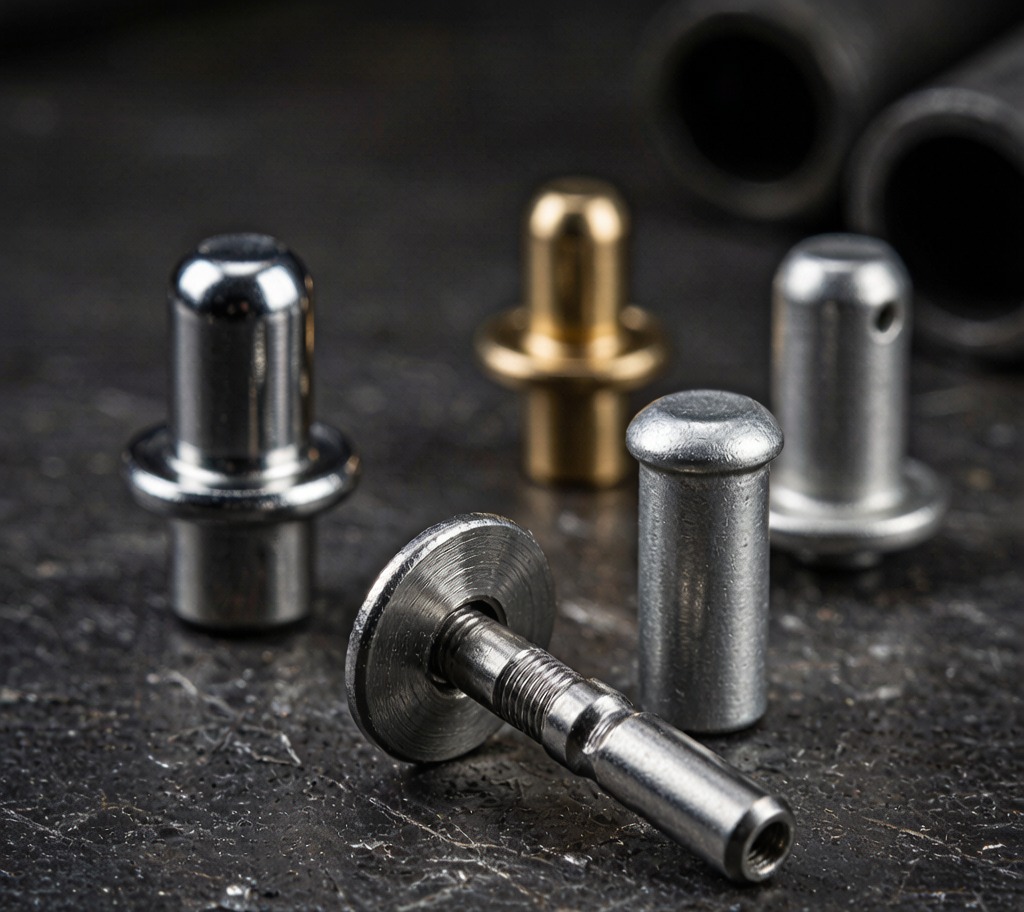
Blind Rivets for Single-Side Access
Blind rivets, often called pop rivets, set from one side using a pulled mandrel. They are ideal when the back of the joint is unreachable, such as a closed enclosure or a bonded panel. Custom diameters, grip ranges, and head styles adapt them to thin sheet without crushing it.
For higher strength, sealed or structural blind rivets replace the open body with a locked mandrel that carries shear and tension closer to a solid rivet. Our riveting services page details the setting equipment we run.
Solid Rivets for Maximum Strength
Solid rivets are hammered or squeezed into place and remain the standard for structural joints that must never come apart. They are cheap per piece and extraordinarily reliable once set, which is why they dominate aerospace and heavy equipment. The trade is access to both sides and slower assembly.
Bodies are usually cold-headed or CNC turned from aluminum, steel, copper, or Monel depending on the environment. For long slender rivets we use Swiss turning to hold straightness.
Structural and Lockbolt Systems
When a joint must carry fatigue load but still install quickly, structural rivets and lockbolts bridge the gap. The permanently locked stem resists vibration loosening better than a bolt and nut, and the installed height is consistent, which helps automated lines.
These are common in truck frames and rail cars. Pair them with a steel fabrication program when the riveted assembly is a larger welded or formed structure.
Material and Finish Pairing
Match the rivet to the parent sheet to avoid galvanic corrosion: aluminum rivets on aluminum, stainless on stainless. Steel rivets on aluminum invite rust staining. Where the joint sees weather, specify a sealed blind rivet with a rubber grommet or a stainless body.
We can finish bodies with heat treatment for higher shear strength, and supply plated or passivated versions on request.
Head Styles and Appearance
Dome, countersunk, large flange, and universal heads change both clamp spread and looks. A large-flange head bridges oversized holes; a countersunk head sits flush for aerodynamic or cosmetic surfaces. Choose the head from the panel thickness and the finish you want.
For decorative trim, a CNC milled specialty head or a colored anodized aluminum rivet gives a clean appearance without a secondary cover cap.
Specifying Grip and Hole Size
Grip range must cover the total joint thickness plus the setting allowance; too short and the mandrel will not lock, too long and the tail protrudes. Hole diameter should match the rivet body within a tight band, usually a few hundredths of a millimeter, or the set will be loose.
Send the stack-up drawing and we will confirm grip and hole before cutting steel. A short custom fasteners review catches these issues before first article.
Quality Control and Inspection
Every custom metal rivets order begins with a first-article inspection. We measure the critical dimensions on a CMM or dedicated gauge and compare them to your drawing before any volume runs start. Only after you approve the report do we release production, so the first batch is already at spec rather than a learning curve.
For functional features we add targeted checks, from thread gauging on fasteners to flatness, squareness, and runout on frames and shafts, and we keep a traveller with the lot so a later question can be traced to the exact machine setup. That discipline is what keeps reject rates low across repeat orders.
We also confirm the finish and any marking against the approved sample, because a good dimension on a badly finished part still fails on the line. Surface, color, and legend are inspected alongside the numbers so what ships matches what you signed off.
Lead Time and How to Request a Quote
Quoting custom metal rivets is fast when you send a drawing, a sample, or even a marked sketch with the key dimensions called out. We return a price with DFM feedback, a recommended material, and a realistic lead time, usually within one business day, so you can plan the build without waiting on a vendor.
Prototype quantities run in days; production batches scale with material and finish, and we can hold your drawing on file for fixed-schedule replenishment so you keep stock without tying up cash in inventory you do not need yet. Tell us annual volume and we set the cadence.
If you are unsure of the best process, ask. A short call before release often saves a costly rework, and we would rather steer you to the cheaper capable route than quote the one you assumed. The goal is a part that assembles first time at the right cost.
Common Specification Mistakes to Avoid
The most expensive mistake on custom metal rivets is over-tightening tolerances the assembly never needed. Every step past process capability adds cost per feature, so call out only the dimensions that locate or seal another part and leave the rest to standard commercial limits. Tight where it counts, loose where it does not.
The second mistake is forgetting the datum and the environment. State which surface everything is measured from, and name the service condition, indoor, outdoor, washdown, or vacuum, so the material and finish are chosen once and not reworked after a field failure.
The third is treating finish as an afterthought. Plating, anodize, or coating change dimensions and must be in the tolerance stack from the start. Tell us the final coated size you need and we will machine to suit, instead of discovering the coat pushed you out of spec at the end.
Frequently Asked Questions
Blind or solid rivets for outdoor use?
Use sealed stainless blind rivets or solid stainless rivets; avoid mixing steel and aluminum to prevent galvanic corrosion.
Can rivets be custom in small batches?
Yes, prototype quantities are available; we turn or head custom bodies from bar or wire.
What rivet carries the most vibration load?
Structural blind rivets and lockbolts resist vibration loosening better than standard blind or threaded fasteners.
Do you supply setting tools?
We can recommend or source the correct setter and supply calibrated tools for production lines.
How do I choose grip range?
Add total joint thickness plus setting allowance; we confirm exact grip from your stack-up drawing.
Ready to Start Your Custom Part?
Send us your drawing or sample and get a competitive quote with DFM feedback, lead time, and material recommendation within one business day.

