
When a part is too complex for machining, too light for casting, and too demanding for wrought stock, electron beam melting (EBM) steps in. EBM is a metal additive manufacturing process that uses a high-energy electron beam in a vacuum to fuse titanium and nickel-alloy powder, layer by layer, into fully dense components. Our metal 3D printing group offers EBM alongside laser processes so you get the right tool for the geometry rather than a one-size-fits-all answer.
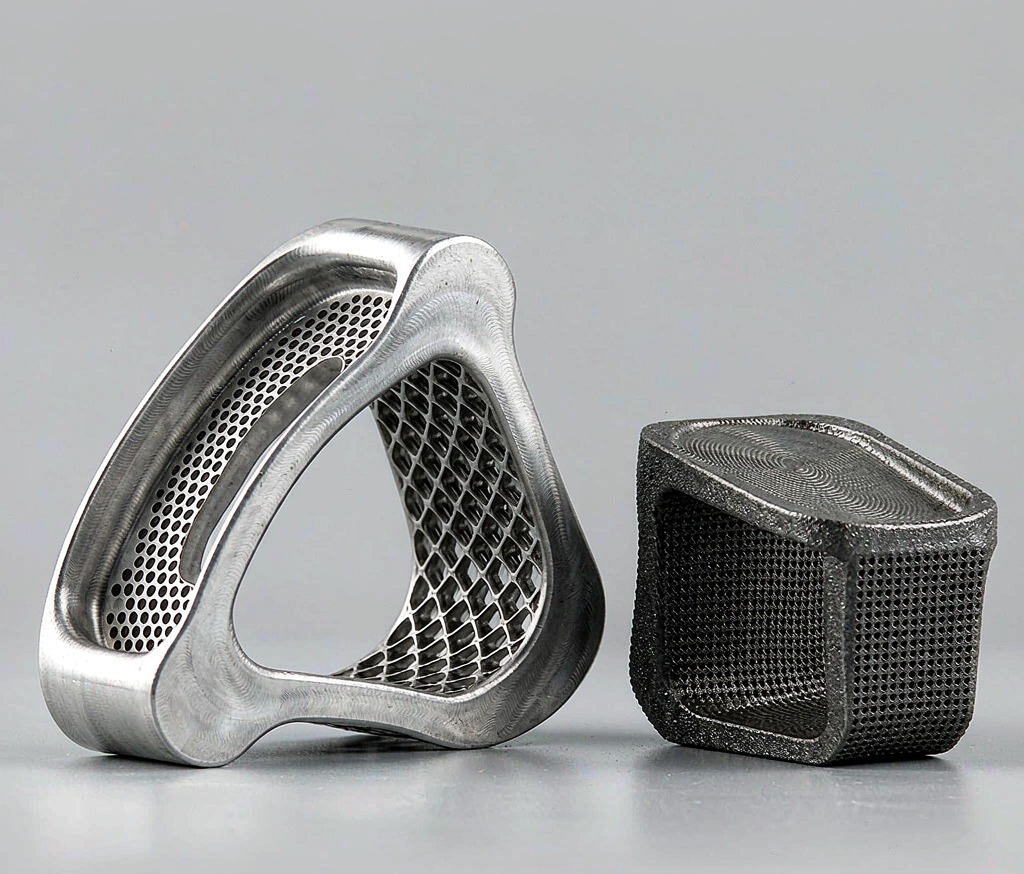
What Is Electron Beam Melting (EBM)?
In EBM, a focused electron beam preheats and then selectively melts a thin bed of metal powder inside a vacuum chamber. The vacuum prevents oxidation, and the elevated build temperature minimizes residual stress — so parts rarely need stress-relief heat treatment afterward. The beam is steered electromagnetically at kilometer-per-second speeds, enabling multiple melt pools and very high build rates that outperform laser methods on large titanium parts.
EBM vs Laser Powder Bed Fusion
EBM and laser processes (like selective laser melting) both make dense metal parts, but differ in key ways. EBM is faster, has near-zero oxidation, low residual stress, and a rougher surface (Ra ~15–25 µm), making it best for titanium and high-temp alloys. Laser (SLM/DMLS) gives finer features and smoother surfaces with a broader alloy range, but is slower on large titanium parts and more prone to thermal stress. For a broader view of our additive options, see our metal 3D printing (DMLS) overview.
Materials: Titanium and Nickel Alloys
EBM truly shines on reactive, high-value metals. Ti-6Al-4V is the aerospace and medical standard — high strength-to-weight and biocompatible. Ti-6Al-2Sn-4Zr-2Mo serves high-temperature titanium structures. Inconel 718 handles turbine and exhaust environments, and CoCr alloys serve medical and wear-critical parts. These same alloys are also available as machined stock through our titanium CNC machining service when hybrid manufacture makes sense, blending printed complexity with machined precision faces.
Design Freedom and Lightweighting
EBM unlocks lattice structures, conformal cooling channels, and part consolidation that traditional methods cannot. A bracket that was five welded pieces becomes one print; a solid rotor becomes a topology-optimized lattice. This is why metal injection molding and EBM are often compared for small, complex runs — EBM wins on size and alloy, MIM on volume cost, and we help you pick the breakpoint.
Post-Processing and Quality
As-printed EBM parts have a matte, slightly rough surface. We offer support removal, CNC finishing of critical features, hot isostatic pressing (HIP), and inspection including CMM and CT scanning. Full traceability from powder lot to finished part supports aerospace and medical programs, and we can facilitate third-party non-destructive testing where certification demands it.
When EBM Beats Subtractive Machining
EBM is the stronger choice when a titanium part has internal channels, lattice structure, or consolidated assemblies that would require welding or extensive five-axis machining. For solid, prismatic titanium parts, conventional metal binder jetting and CNC routes may be cheaper, so we compare total cost — print, support removal, HIP, and finish machining — before recommending a process.
Certifications and Quality Systems
EBM production for aerospace and medical follows AS9100 and ISO 9001 discipline with full powder-lot traceability, build-parameter logging, and documented inspection. We can facilitate third-party NDT such as CT and fluorescent penetrant inspection, and we issue Certificates of Conformance with every shipment.
Design Rules for Printable EBM Parts
Good EBM results start in CAD. Keep minimum wall thickness around 0.8–1.0 mm, avoid fully enclosed cavities that trap unsintered powder, and design generous radii on overhangs to reduce support needs. Orientation on the build plate strongly affects strength and surface finish, so we simulate the build and choose the layup that matches your loading direction. Following these rules cuts support removal, shortens post-processing, and improves as-built mechanical properties.
Another lever is feature consolidation. EBM excels when you merge an assembly — a bracket with integral cooling channels, a hinge with built-in bushings — into a single print, removing welds, fasteners, and potential leak paths. We help you identify those opportunities during design review, then validate the consolidated part against the original assembly’s function. The payoff is lighter weight, fewer failure points, and lower total cost even at modest volumes.
Cost is easiest to judge when you compare EBM to the alternative, not in isolation. A titanium bracket that would need five welded pieces, extensive machining, and inspection can become one print with fewer failure points — and the weld and assembly labor disappears. At low volumes that consolidation usually wins; at very high volumes, machining or MIM may undercut printing. We model both paths with you, including support removal and any HIP or machining, so the quote reflects true landed cost rather than a headline per-part number.
Frequently Asked Questions
Is EBM stronger than cast titanium?
Fully dense EBM Ti-6Al-4V meets AMS 4999 mechanical properties and often exceeds cast equivalents.
What is the typical surface finish?
As-built Ra is about 15–25 µm; machining or polishing improves it where needed.
Can EBM replace machining?
For complex, low-volume titanium parts, yes — but precision faces are usually finished by CNC afterward.
Quote Your EBM Part
Upload your STL or STEP file with material and certification needs. We will review printability and return a build-ready quote.
Ready to Start Your Project?
Get a build-ready quote on your custom metal parts within 24 hours. Share your drawing and our engineers will respond with process, lead time, and pricing.

