
The choice of EDM vs CNC machining comes down to material hardness, feature geometry, and surface needs. CNC milling and turning remove metal with a cutting tool; EDM erodes it with sparks and no contact force. That makes EDM the answer for hardened steel, tiny corners, and fragile features. This guide explains when each wins. Our EDM machining services and CNC machining services cover both.
How EDM Works
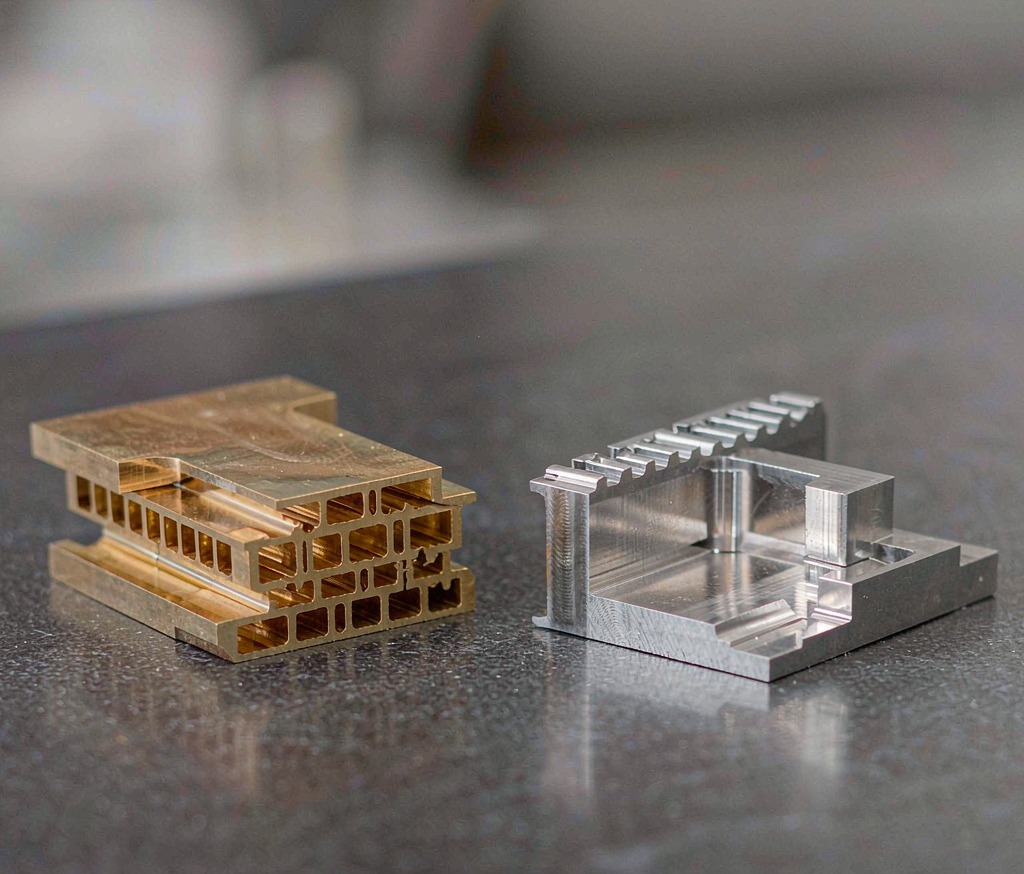
Electrical discharge machining uses repeated sparks between an electrode and the workpiece to vaporize microscopic amounts of metal. Wire EDM feeds a thin brass wire to cut profiles through hardened stock; sinker EDM uses a shaped electrode to form cavities. Because there is no cutting force, EDM machining never deflects a thin wall or stresses a fragile part. The process leaves only a thin recast layer that is easily removed, so the underlying material keeps its properties and the part stays dimensionally stable after the sparks stop.
EDM vs Milling: Where Each Wins
CNC milling is faster and cheaper for most free-form and volume removal in aluminum, steel, and titanium. CNC milling is the default for brackets, housings, and general features. EDM wins on hardened tool steel, razor-sharp internal corners, and deep narrow slots that a rotating cutter cannot reach. Wire EDM cuts through hardened plate with no heat-affected zone worth mentioning. The two are complementary, not competing, on most hard-metal programs where roughing and finishing split between them.
Best Materials for EDM
Anything conductive can be EDM’d, but the biggest payoff is on hard-to-machine metals: hardened tool steel, tungsten carbide, and exotic alloys. CNC turning still owns round, ductile parts; EDM owns the post-heat-treatment detail work where a cutter would chatter or wear out. Conductive ceramics and some cermets can also be processed with the right parameters, extending EDM’s reach beyond ordinary metals into the hardest wear components shops see.
Tolerances and Surface Finish
Wire EDM holds micron tolerances and excellent straightness on thin sections. Surface finish ranges from rough-roughing sparks to mirror-fine. Surface grinding competes on flat faces, but EDM reaches internal and 3D features grinding cannot. 5-axis CNC machining pairs with EDM when a part needs both milled contours and spark-eroded cavities. A typical mold is roughed on a mill, hardened, then finished on sinker and wire EDM for accuracy no grinder can reach.
When to Choose EDM
Choose EDM for hardened steel dies and molds, tight internal corners, fragile thin features, and exotic hard alloys. Choose CNC machining for speed and cost on everything else, and combine the two: rough and heat-treat with CNC, then spark the final detail. Our wire EDM services page details the profile-cutting capability. If the feature has a sharp internal corner a mill radius cannot reach, EDM is the only answer that preserves the design intent without a relief.
Secondary Operations and Workflow
EDM is rarely the only step. A hardened die is roughed on a mill, heat-treated, then finished on sinker and wire EDM, with surface grinding cleaning the datums between stages. Because EDM leaves no burr, downstream cleaning is minimal, which shortens lead time on precision tooling. 5-axis CNC machining handles the contour roughing so the spark erosion only removes the final stock. A planned sequence keeps the hard-metal part accurate from first operation to ship and avoids re-clamping errors.
Common EDM Parts We Make
Typical EDM work includes injection mold cavities, extrusion dies, stamping punch and die details, turbine seals, and medical implants with sharp internal corners. These parts are often hardened and would chatter or distort under a cutter, so spark erosion is the only clean route to the final feature. EDM machining paired with CNC milling lets us rough fast and finish precise: mill the body, harden it, then spark the detail that a radius tool cannot reach. The result is a tool that holds tolerance through its whole life instead of drifting after the first heat cycle in production.
Cost and Lead Time Notes
EDM is slower per cubic millimeter than milling, so we use it only where it earns its place: hardened steel, tiny corners, fragile features. For everything else, CNC turns and mills faster and cheaper. Wire EDM cutting a plate is economical for prototypes and low volumes because there is no electrode to make. Our EDM machining services page explains when we recommend it. A planned split between the two processes keeps both accuracy and cost under control across the program from first article to full production run.
EDM Surface Finish and the Recast Layer
Wire EDM leaves a thin recast layer and a small heat-affected zone on the cut face. For most tools it is harmless and can be left as-is, but for fatigue-critical or medical parts we skim it off with a light finish cut or grinding to expose clean base material. Surface grinding pairs with EDM when the same face must be flat and stress-free. Because there is no mechanical force, EDM also avoids the micro-cracks a cutter can leave in hardened steel, which is why dies and surgical components are so often finished this way rather than milled to final size in one risky pass.
Frequently Asked Questions
Is EDM more accurate than CNC machining?
For hardened steel and tiny internal corners, yes. For general free-form parts, CNC milling is faster and accurate enough.
What materials can EDM cut?
Any conductive metal, with the biggest advantage on hardened tool steel, carbide, and exotic alloys that are hard to mill.
Does EDM damage the part?
No cutting force means no deflection; a small heat-affected zone is easily removed, leaving burr-free, stress-free features.
EDM vs CNC machining is about matching the process to material and feature. Send us your drawing and we will combine both for the best result.
Ready to Start Your Project?
Get a build-ready quote on your custom metal parts within 24 hours. Share your drawing and our engineers will respond with process, lead time, and pricing.

