
EV battery packs are metal-intensive assemblies. End plates, side plates, cooling plates, busbars, module frames, enclosure trays and terminal hardware all have to hit tight flatness and thickness targets, carry structural and crash loads, manage heat, and pass electrical isolation and sealing tests, usually at automotive volumes and automotive prices.
This guide walks through the main metal part families in a pack, the processes and alloys that suit each, the tolerance and quality expectations of battery programmes, what drives cost, and how to structure an RFQ so quotes come back comparable. We build these parts in aluminium, copper and steel from prototype through series production.
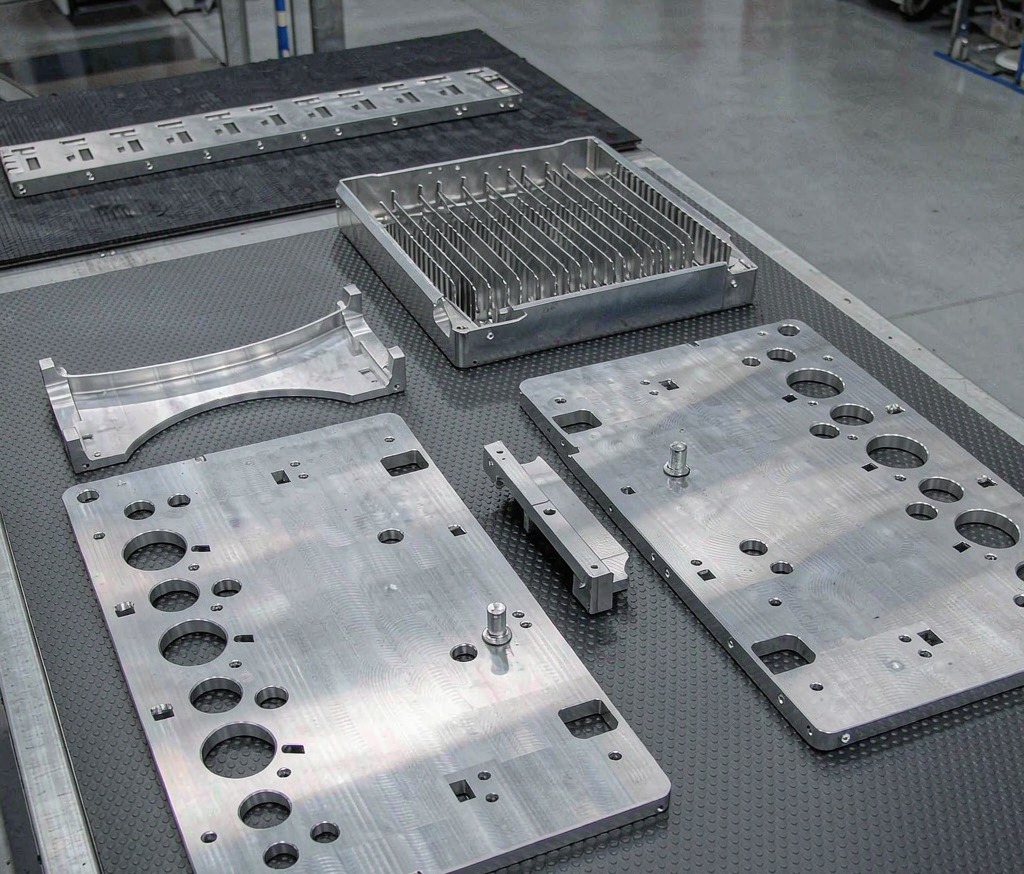
The Metal Part Families Inside a Pack
Module end plates and side plates take cell swelling load and hold stack compression, so they are typically 6061 or 6063 extruded profiles finished by machining. Cooling plates and cold plates carry the thermal circuit and demand leak-tight internal channels. Busbars and interconnects move current and are copper or aluminium, often plated.
The enclosure adds a tray or lower housing, cross members, a lid, mounting brackets and dozens of fastener bosses. Terminal hardware, sensor brackets, module carriers and vent housings fill out the list. Each family has its own process economics, so quoting a pack as one line item hides where the money actually goes.
Aluminium extrusion is the backbone of the structural parts, and our aluminum extrusion services guide explains profile design, die cost and secondary machining, which is where most EV structural parts are finished.
Processes and Alloys That Fit Battery Hardware
End plates and frames start as aluminum extrusion profiles, then get bolt holes, locating features and sealing faces cut on CNC milling centres. Trays and covers are usually laser cut sheet followed by CNC bending and welding, with 5052 and 5754 the common alloys for formability plus corrosion resistance.
Cold plates are brazed or friction-stir welded aluminium assemblies. Busbars are C11000 copper, punched or laser cut then formed and plated. Steel shows up in crash structures and threaded inserts where strength per cost wins over weight.
Where several operations combine on one part, we route it as a single laser cut, bend, weld and coat package, so tolerance stack-up and responsibility stay with one supplier instead of three.
Tolerances, Flatness and Electrical Requirements
Flatness is the requirement buyers underestimate. A cooling plate mating to a cell face typically needs 0.1 to 0.3 mm over its length, and a module end plate needs consistent thickness so stack compression is even. Both are controlled by fixturing strategy and by stress-relieving the extrusion or weldment before final machining.
Electrical isolation and creepage distances drive edge condition and coating specification. Burr-free edges are mandatory around cells, and coating must be complete on insulating surfaces while absolutely bare on grounding and bonding pads, which means masking or post-coat machining.
Sealing surfaces on trays and lids need controlled flatness and surface finish for gasket or adhesive joints, plus documented leak testing on the enclosure. Copper busbar work has its own set of plating and joint-resistance requirements, covered in our copper busbar manufacturing guide.
Finishing, Isolation and Corrosion Protection
Trays and structural parts usually get a conversion coating plus powder coating for corrosion and dielectric performance. Busbars are tin, nickel or silver plated at the joints to control contact resistance over life. Fastener hardware is zinc or zinc-nickel plated.
Thermal interface faces must stay bare and flat, so masking plans need to be agreed at drawing stage. We generally recommend deciding masking versus post-coat machining early, because it changes both cost and the achievable flatness.
Salt spray, thermal cycling and dielectric withstand tests are typical validation requirements. Programmes that also feed grid storage should look at our renewable energy metal parts guide, since enclosure and busbar requirements overlap heavily.
Cost Drivers and Volume Strategy
Extrusion die cost, stamping tooling and fixture investment dominate early. At prototype volumes we machine parts from plate or use soft tooling so you can validate the pack before committing die money; at series volume we move the same geometry to extrusion or progressive stamping and the unit price drops sharply.
Material yield matters on aluminium, so nesting and profile design are worth engineering time. Machining time on end plates is driven by the number of setups, so design features onto as few faces as possible. Welding cost is driven by joint length and access, and robotic cells only pay off with stable geometry.
Programme scale also decides the inspection plan. A PPAP-level submission with capability studies on critical dimensions is normal for automotive; asking for it on a 20-piece prototype lot adds cost with no benefit. Buyers new to this hardware may find our automotive metal parts guide a useful baseline on documentation expectations.
Lead Time and What to Send in the RFQ
Machined prototype end plates and brackets ship in 10 to 15 working days. Sheet metal trays and covers take 15 to 20 days. Extruded profiles require die manufacture, typically four to six weeks for the first article, then two to three weeks per release afterwards.
For a comparable quote please send 3D models and 2D drawings with GD&T, alloy and temper per part, flatness and sealing requirements, coating and masking callouts, electrical isolation or contact resistance targets, quantity per release, annual volume and the required quality documentation level.
If the pack architecture is still moving, send the parts that are frozen and we will quote those while advising on the rest. Our DFM support and material consulting teams routinely help battery engineers convert a concept into a set of manufacturable, cost-balanced metal parts.
Frequently Asked Questions
Which aluminium alloys are standard for EV battery structures?
Extruded structural parts are usually 6061 or 6063 for strength and machinability. Formed sheet trays and covers favour 5052 or 5754 for formability and corrosion resistance. Cold plates are commonly 3003 or 6061 depending on the joining method.
How flat does a cooling plate need to be?
Most programmes call for 0.1 to 0.3 mm flatness across the cell interface so thermal contact is even. Achieving it reliably depends on stress relieving before final machining and on fixturing that does not clamp the part into a false shape.
Can you supply both prototype and production volumes?
Yes. We typically machine prototypes from plate or use soft tooling to validate fit and function, then transition the same geometry to extrusion or progressive stamping for series production so the design does not have to change twice.
How are busbars finished for low contact resistance?
Copper busbars are tin, nickel or silver plated at the joint areas, with the plating chosen for the operating temperature and the mating material. Joint resistance is verified after plating, and edges are deburred to avoid insulation damage.
Do you support PPAP and capability studies?
Yes, for series automotive programmes we provide control plans, PFMEA input, measurement system analysis and capability studies on the critical dimensions you nominate. For early prototype lots a first article inspection report is usually the sensible level.
What lead time should I plan for extruded parts?
Allow four to six weeks for die manufacture and first articles, then two to three weeks per release. Machined-from-plate prototypes are available in 10 to 15 working days if you need parts before die money is committed.
Ready to Start Your Project?
Get a build-ready quote on your custom metal parts within 24 hours. Share your drawing and our engineers will respond with process, lead time, and pricing.

