
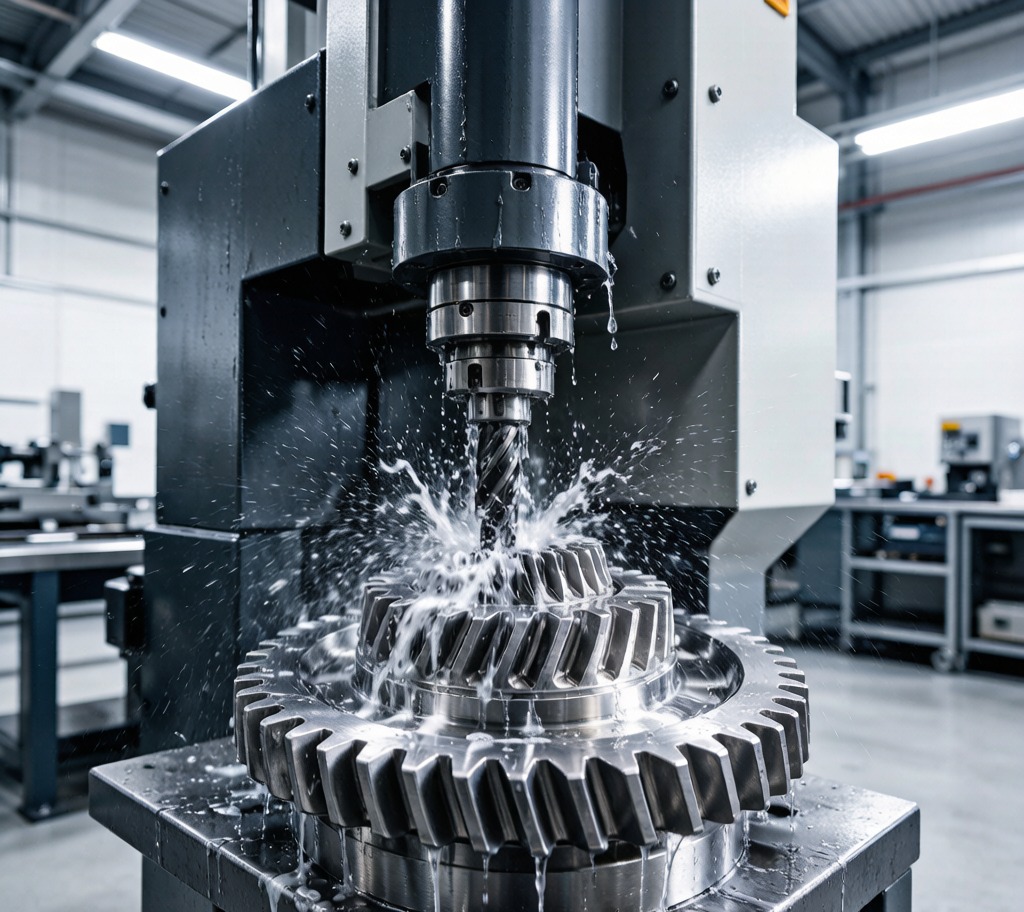
Gear hobbing is still the most productive way to cut external gear teeth, more than a century after the process was industrialised. A helical cutter called a hob rotates in timed synchronisation with the workpiece and feeds axially through it, generating tooth after tooth in one continuous pass. There is no indexing, no dwell, and no separate operation per tooth. A 40-tooth spur gear in 20MnCr5 can be roughed in under two minutes. When buyers ask us for gear hobbing services, they are usually chasing three things at once: correct tooth geometry, a hardness profile that survives the duty cycle, and a delivery date. This guide covers how those three interact.

What Gear Hobbing Is and What It Can Produce
The hob is essentially a worm with gashes cut into it to form cutting teeth. As it turns, each successive cutting edge takes a slice out of the blank at a slightly different position, and the envelope of all those cuts is the involute tooth flank. The tooth form is generated, not copied — which means a single hob can cut any number of teeth at a given module and pressure angle. That is enormously economical compared with form-milling, where each tooth count needs its own cutter.
Hobbing handles spur gears, helical gears, worm wheels, splines, sprockets, serrations, and timing pulleys. Module range in production runs from about 0.3 up to 12, with diameters from 8 mm to over 1,500 mm on large gantry hobbers. What hobbing cannot do is cut internal gears, bevel gears, or any tooth that ends in a shoulder without runout clearance — the hob has to run past the end of the tooth.
Blanks arrive from turning or forging. Most of our gear work starts on CNC turning for bore, face, and outside diameter, since gear quality depends absolutely on how concentric and square the blank datums are. A blank with 0.05 mm of runout will produce a gear with 0.05 mm of runout, no matter how good the hobber is.
Hobbing vs Shaping vs Broaching vs Grinding
Gear shaping uses a reciprocating cutter shaped like a gear. It is slower than hobbing but can cut internal gears and can work up close to a shoulder, so it wins on cluster gears and internal ring gears.
Broaching produces splines and internal forms in a single stroke at extremely high rates, but only for through-features and only with dedicated tooling. Our article on broaching services explains the volume threshold where a broach beats a shaper.
Gear grinding is a finishing operation, not an alternative. Hobbing before heat treatment leaves teeth at roughly AGMA 8 to 10 (DIN 8 to 9). Heat treatment then distorts them. Grinding after hardening recovers and improves the geometry to AGMA 12 to 14 (DIN 4 to 6), which is what gearboxes with noise, efficiency, or high-speed requirements need. We use cylindrical grinding for journals and mounting diameters in the same setup family to preserve the datum relationship.
Sintered powder metallurgy is worth considering for high-volume, moderate-load gears — no chips, near-net teeth, and excellent unit economics above about 20,000 pieces. Our sintered gears capability covers that route, and the broader trade-offs are set out in our guide to custom metal gears.
Materials and Heat Treatment
Case-hardening steels dominate: 20MnCr5, 16MnCr5, 8620, and 9310 for aerospace. These are hobbed soft at around 180 HB, then carburised to give a 0.6 to 1.2 mm case at 58 to 62 HRC over a tough 30 to 40 HRC core. That combination — hard surface for pitting resistance, ductile core for bending fatigue — is what lets a small gear transmit large torque.
Through-hardening steels like 4140 and 4340 are used where case depth is not required and where distortion must be minimised. Induction hardening of the tooth flanks is a good middle path for larger gears; we cover it in detail in our guide to heat treatment services.
Stainless 303, 316, and 17-4 PH appear in food, marine, and medical gearing. Brass and bronze are standard for worm wheels because they run well against a hardened steel worm. Plastics such as POM and PEEK are hobbed too, for quiet, unlubricated, low-load drives.
Distortion during heat treatment is the recurring headache. We compensate by hobbing a deliberate pre-correction into the helix angle and lead, sizing the bore for post-hardening grinding, and fixturing parts to control sag. Where a gear is integral with a shaft, the whole assembly needs to be planned as one part; our notes on precision shaft manufacturing cover the straightening and grinding sequence that follows.
Quality Grades, Inspection and Cost Drivers
AGMA 2000 grades run from 3 (crude) to 15 (aerospace master gear); the newer AGMA 2015 and ISO 1328 scales run in the opposite direction. Most industrial gearboxes specify AGMA 8 to 10, which as-hobbed quality delivers. Automotive transmissions and servo reducers want AGMA 11 to 13, which requires grinding or honing. Do not over-specify: moving from AGMA 9 to AGMA 12 can double the cost of the gear.
Inspection uses a dedicated gear analyser to measure profile deviation, lead deviation, pitch error, and runout, producing the four-chart report that quality departments expect. Composite testing on a double-flank rolling tester provides a fast production check. Tooth thickness is verified over pins or balls. Where the gear carries a serial number or heat-lot code, we add it with controlled heat treatment traceability and permanent marking.
Cost is driven by module and face width (chip volume), tooth count, material, quality grade, and quantity. Hob amortisation is minor — a hob costs a few hundred to a few thousand dollars and cuts thousands of gears. Setup time dominates at low volumes, so batching related parts helps materially. For prototype and pre-production quantities we hob from bar stock on CNC machining centres and skip the forging tooling entirely, and 5-axis milling on our CNC milling cells can generate one-off gears where a hob change is not justified.
Frequently Asked Questions
What is the largest gear you can hob? Up to 1,500 mm outside diameter and module 12 in our current machine envelope. Larger rings are quoted through partner capacity with the same inspection standard.
Can you hob a gear onto an existing shaft? Yes, provided there is hob runout clearance beyond the tooth end. If the tooth must run into a shoulder, we shape rather than hob, or design a relief groove into the shaft.
Do I need my gears ground? If pitch line velocity exceeds about 20 m/s, if noise is a specified requirement, or if the gearbox is rated above AGMA 10, then yes. Below that, hobbed and hardened teeth with a light honing pass are usually sufficient and considerably cheaper.
What tolerance can I expect on the bore? H7 as standard after hard turning or grinding, and H6 with a dedicated grinding operation. Bore-to-pitch-circle concentricity holds within 0.02 mm on ground parts.
What is the minimum order quantity? One. We regularly hob single prototype gears, though unit cost is dominated by setup. Cost per piece drops sharply between one and fifty pieces and then flattens.
What do you need to quote? A 2D drawing with the gear data block — module or DP, tooth count, pressure angle, helix angle and hand, tooth thickness or backlash, quality grade, and material — plus a 3D model and the required quantity. If you only have a sample gear, we can reverse engineer the tooth data and issue a drawing for approval.
Ready to Start Your Project?
Get a build-ready quote on your custom metal parts within 24 hours. Share your drawing and our engineers will respond with process, lead time, and pricing.

