
Grade 5 titanium—Ti-6Al-4V—is the workhorse of aerospace, medical, and high-performance engineering because it pairs high strength with low weight and excellent corrosion resistance. It is also notoriously difficult to machine. This guide explains what makes Grade 5 titanium machining hard and how experienced shops hold tight tolerances without burning through tooling.
Why does the difficulty matter to a buyer? Because it shows up as cost and lead time. A shop that under-estimates titanium will either quote high to protect itself or quote low and struggle, producing scrap and delays. Understanding the challenge helps you read a quote and pick a supplier who actually machines Ti-6Al-4V routinely, not one learning on your parts. The difference is paid for in your delivery date.
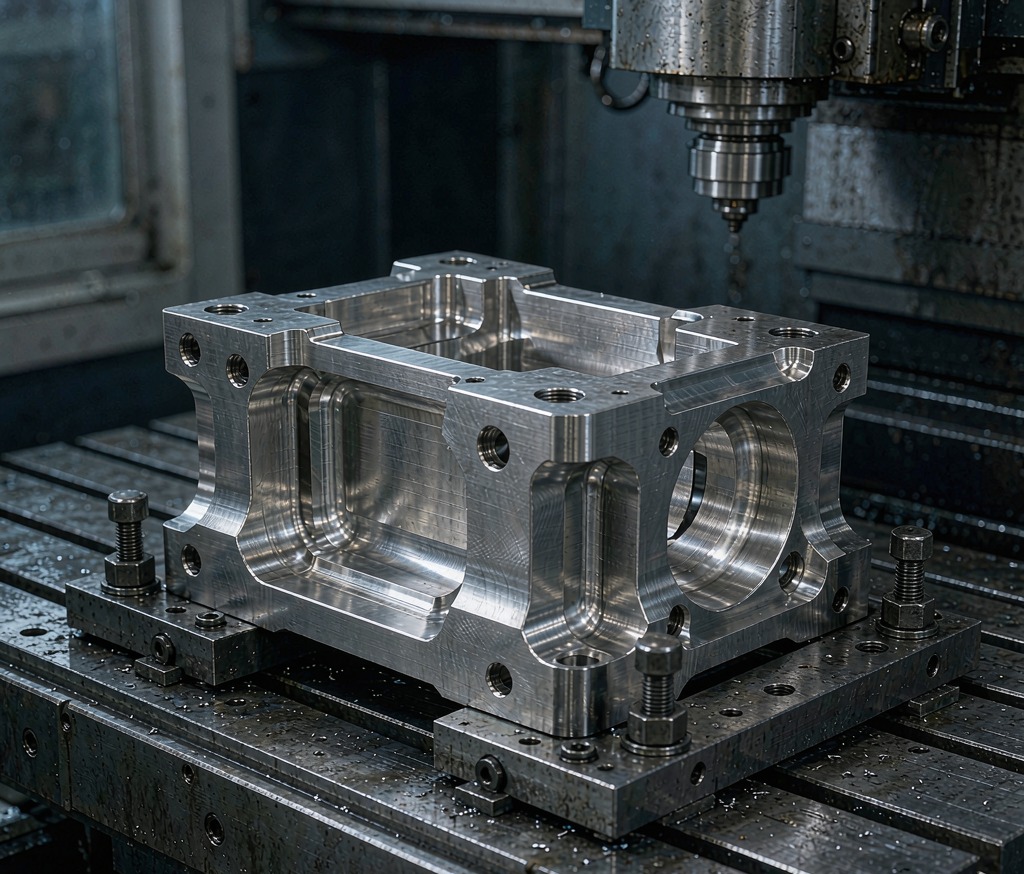
Why Grade 5 Titanium Is Hard to Machine
Titanium’s low thermal conductivity traps heat at the cutting edge instead of carrying it into the chip. Combined with its tendency to work-harden and its springiness, that means tools overheat, edges chatter, and dimensions drift if parameters are wrong. CNC milling and CNC turning of Ti-6Al-4V therefore demand purpose-built cutting data, not the same feeds used on aluminum or steel.
Tooling and Cutting Parameters
Use sharp, positive-rake carbide tools with generous coolant and moderate speeds with higher feeds—rubbing is worse than cutting. Climb milling reduces work hardening. Tool life improves dramatically with the right coating and chip evacuation. The goal is to cut cleanly and get heat out fast, because the tool tip is where failure starts.
Cutting fluid matters more on titanium than on most metals. High-pressure through-tool coolant keeps the edge cool and flushes the gummy chip that titanium tends to weld to the tool. Some shops prefer flood, others a carefully controlled mist; what matters is that heat leaves the cut, not soaks into the part. A supplier who treats titanium like “just another alloy” with standard coolant will see premature tool failure and dimensional drift you end up paying for.
Workholding and Heat Control
Titanium’s elasticity makes it deflect under load, so rigid workholding is essential to avoid chatter and preserve tolerance. Flood coolant or through-tool delivery manages temperature. For deep features and thin walls, pecking and balanced passes prevent the part from moving mid-cut. When a feature is too deep or narrow for a cutter, EDM machining finishes it without heat-affected stress.
Chatter is the silent killer of titanium tolerance. Because the material springs back, a flexible setup lets the tool bounce and the surface finish degrades while dimensions wander. Proper fixturing—often custom locators rather than three jaw chucks—holds the part still so the cutter can do its job. This is why titanium quotes from a capable shop include fixture design, not just cycle time; the fixture is half the battle for accuracy.
5-Axis and Complex Geometry
Grade 5 parts are often sculpted—impellers, brackets, implants—where 5 axis CNC machining earns its keep by cutting complex surfaces in fewer setups. Fewer setups means better feature alignment and less handling of a part that is expensive to scrap. For high-value titanium, the cost of an extra axis is trivial next to the cost of a rejected component.
Surface Finishing
Ti-6Al-4V finishes well but reacts chemically, so choose processes carefully. Anodizing adds color and mild corrosion resistance (Type II/III), while Passivation removes free iron and boosts inherent oxidation protection. Polishing and bead blasting improve appearance and cleanability for medical use. Avoid processes that embed contaminants into the reactive surface.
For medical implants, finish is also a regulatory topic: surface roughness and cleanliness affect biocompatibility, so the process is validated, not just applied. Specify the required Ra and any standard (such as ASTM) in the RFQ so the shop plans the right sequence. A titanium part that looks finished but fails the cleanliness spec is not actually done—finish requirements should be written, not assumed.
Quality and Inspection
Because titanium parts are usually safety-critical, inspection is rigorous: CMM for dimensions, surface checks for defects, and material traceability with mill certificates. Tight tolerances on Grade 5 are absolutely achievable—down to ±0.005 mm on qualified features—with the right process plan.
Traceability is non-negotiable for aerospace and medical buyers. The raw billet’s mill certificate ties to the finished part’s inspection report, so if a batch ever fails in the field, the source is known. Ask for this documentation in the RFQ; a supplier who cannot provide EN 10204 3.1 certificates and first-article inspection is not set up for critical titanium work, no matter how good the price looks.
Pair this with our Titanium Machining Services and titanium CNC machining overviews, the Aerospace Machining Services context, and the CNC machining tolerances guide for what CNC can hold on hard alloys.
Frequently Asked Questions
Why is Grade 5 hard to machine?
Low thermal conductivity traps heat at the tool, plus work hardening and springiness. Wrong parameters burn tools fast.
What tools work best?
Sharp positive-rake carbide with coatings, climb milling, strong coolant, and rigid workholding to stop chatter.
How tight can tolerances be?
Down to about ±0.005 mm on qualified critical features with proper process control and inspection.
Can titanium be anodized?
Yes—Type II/III anodizing adds color and corrosion resistance. Passivation is also common for cleanliness.
When is 5-axis worth it?
For sculpted, multi-sided, or thin-walled parts where fewer setups improve alignment and cut scrap.
Is EDM used on titanium?
Yes, for deep or narrow features a cutter cannot reach, without adding heat-affected stress.
Ready to Start Your Project?
Send us your drawings and requirements. Our engineering team will review manufacturability and return a competitive quote with realistic lead time—usually within 1–2 business days.

