
When a product moves from prototype to mass market, the rules of manufacturing change completely. A part that was easy to make ten times becomes a different challenge when you need ten thousand, or a million. This is where high volume manufacturing separates capable suppliers from shops that only handle low quantities. The goal is simple to state and hard to execute: hold tight tolerances, repeat them across every shift, and keep unit cost low enough that the program stays profitable.
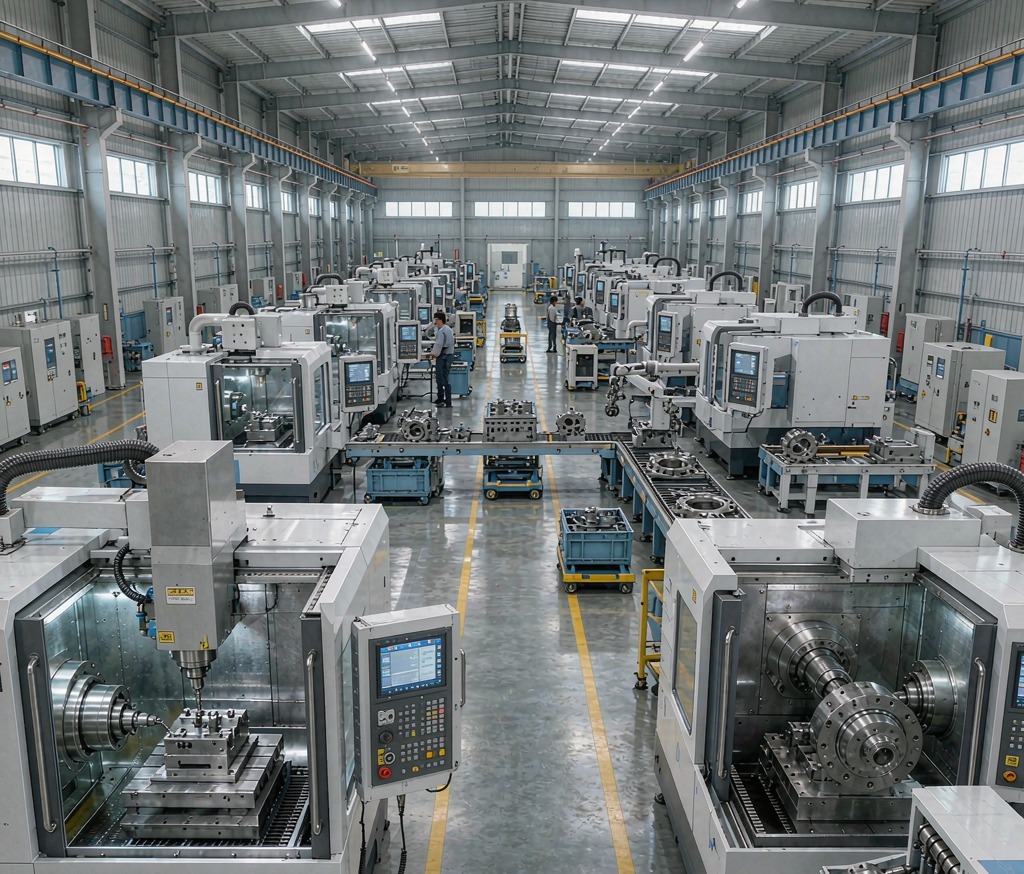
What Is High Volume Manufacturing
High volume manufacturing means producing large recurring quantities of a part or assembly under a controlled, repeatable process. It is not defined by a single machine but by the system around the machine: standardized setups, documented work instructions, in-process inspection, and supply chains that can deliver material on a fixed cadence. For metal components this usually combines machining, forming, welding, finishing, and assembly into one coordinated flow rather than separate one-off jobs.
For OEMs, the appeal is consistency. A OEM services partner that runs your part every day builds muscle memory into the process, so the thousandth unit matches the first. That predictability is what downstream assembly lines depend on.
Process Engineering for Scale
Scaling a part starts long before the first production run. Strong suppliers invest in DFM support—design for manufacturability—because small drawing decisions decide most of the cost. Features that need five setups at low volume may collapse to one fixture at high volume. Tolerances that are uniform where they do not matter free up process capability for the dimensions that do.
Equipment choice follows volume. Spindle-intensive CNC milling and CNC turning cells handle complex geometry, while dedicated forming and joining stations absorb the repetitive work. The best layouts minimize handling: parts move in sequence, not in batches that sit waiting between operations. Suppliers also standardize tooling and fixtures so a changeover between similar parts takes minutes, not hours, which keeps the line productive even when the mix shifts. That flexibility is what lets a high-volume program absorb demand swings without buying entirely new capacity.
Automation and Repeatability
Repeatability is the core promise of high volume production. Automation—pallet changers, robotic loading, in-line gauging—removes the variability that comes from manual handling. A Laser Cut Bend Weld Coat cell can take a flat sheet and deliver a finished, coated bracket with minimal human touches, which is exactly what high-volume programs need to stay both fast and uniform.
Automation also protects lead time. When one operation is automated, the bottleneck shifts to a different station, and a good production engineer rebalances the line instead of adding overtime. That is how mature programs hold delivery dates even as orders grow.
Quality Control at Volume
Inspecting every part is expensive; inspecting nothing is reckless. High volume manufacturing uses statistical process control—measure a sample, track the trend, and act before a dimension drifts out of tolerance. Heat Treatment and other process-critical steps get their own verification because a bad batch there ruins everything downstream.
Traceability matters too. At volume, a single material certificate covers a coil or lot, and the supplier must tie finished parts back to that source. Buyers in automotive, medical, and energy markets expect this as table stakes, not a premium service.
Material and Cost Strategy
Unit cost at volume is driven by material yield, scrap, and cycle time. A design that machines away 80 percent of a billet is expensive at ten pieces and unsustainable at ten thousand. Rethinking the part for near-net-shape forming, or combining operations, often cuts cost more than any negotiation on hourly rate. This is why Assembly is planned up front—fewer components and fasteners means fewer failure points and lower landed cost.
How to Start a High-Volume Program
Begin with a clear RFQ: drawings, quantities, annual forecast, material grade, finish, and the dimensions that are truly critical. Share the forecast even if it is rough—suppliers size tooling and capacity around it. Ask for a pilot run before committing to the full volume so both sides prove the process on real parts.
If you are weighing scale against flexibility, compare this path with our Low Volume Manufacturing and Metal Contract Manufacturing guides, and use the CNC machining cost breakdown to sanity-check quotes. A capable partner will also walk you through supplier selection in our choosing CNC supplier article.
Frequently Asked Questions
What volume counts as “high volume”?
Generally tens of thousands of units per year and up, though the threshold depends on part complexity. A tight-tolerance machined component may be “high volume” at 20,000 pieces, while a simple stamped clip needs far more.
Is high volume manufacturing only for machining?
No. Forming, casting, welding, finishing, and assembly are all scaled the same way. The system thinking is what matters, not the specific process.
How do I protect quality as quantities rise?
Use statistical process control, first-article inspection, and material traceability. Require your supplier to show trend data, not just a pass/fail on a sample.
When should I move from low to high volume?
Once demand is stable and the design is frozen. Scaling a part that still changes wastes tooling and rework budget.
Can a supplier handle both prototype and volume?
Yes, and it is preferable. A partner who proves the part at low volume understands the failure modes before scaling, which lowers risk.
What slows lead time most at volume?
Material availability and unbalanced lines. Locking material supply early and rebalancing stations prevents most delays.
Ready to Start Your Project?
Send us your drawings and requirements. Our engineering team will review manufacturability and return a competitive quote with realistic lead time—usually within 1–2 business days.

