
When a part needs a permanent mark — a serial number, a barcode, a logo or a calibration scale — laser engraving is the cleanest way to put it there. Our laser engraving services burn crisp, durable marks into metal without contact, ink or wear-prone tags. This guide compares engraving with etching and marking, and shows where it beats labels and silk screening.
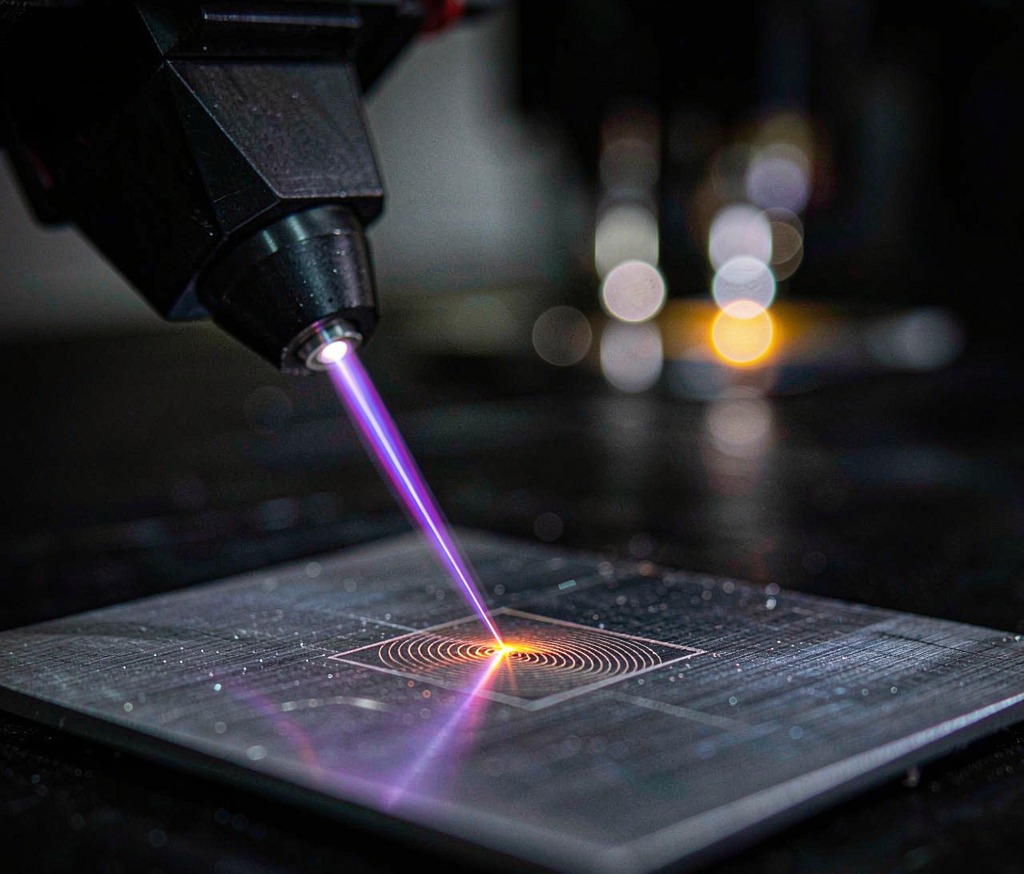
Laser Engraving vs Etching vs Marking
Engraving removes a thin layer of material to leave a recessed, tactile mark. Etching is a shallower thermal process, and marking (especially on coated metal) can colour the surface without cutting it. We choose the method by how deep and durable the mark must be. Our laser marking services page covers the colour-change route for subtle logos.
Fiber and CO2 Laser Sources
Fibre lasers are the workhorse for metals — fast, fine and permanent. We run fiber laser cutting sources adapted for marking, and CO2 lasers for coatings and some non-metals. For sheet parts we also use sheet laser cutting cells that can mark and cut in one setup. See our fiber laser cutting overview for metal-specific detail.
What You Can Mark
Serial numbers, QR and barcodes, part numbers, logos, calibration scales and warning text. Because the mark is burnt in, it survives paint, abrasion and most chemicals. For metal nameplates we often engrave the data plate directly rather than applying a label.
Serialization and Traceability
Laser is ideal for unique, variable data — each part gets its own number straight from a database. That supports traceability for aerospace, medical and automotive programmes where every component must be identifiable. Marks read reliably by both humans and scanners.
Engraving vs Silk Screening
Silk screening prints ink that can scratch or fade; laser engraving is permanent. We still offer silk screening for colourful, large-area branding, but for durable identification engraving wins. The choice comes down to whether the mark must outlast the product.
Materials and Finish
We engrave stainless, aluminium, anodised parts, brass, titanium and coated steels. Depth is tuned so structural parts are not weakened. On anodised aluminium the mark can be left bare or re-anodised for contrast.
Preparing Artwork for Engraving
Good engraving starts with good vector art. Supply logos and text as vector files (SVG, AI, DXF) at the actual marked size, with fonts converted to outlines so they render exactly as drawn. Barcodes need quiet zones and the right module width for your scanner; we will check the contrast and density before we burn. For serialisation, send the data as a CSV or database export and we map each row to a part, so there is no manual typing and no transcription error. Our laser marking services team reviews artwork the same way for colour-change marks.
Placement matters too. Put the mark on a flat, accessible face away from welds or bends that could distort it, and leave room for a human to read it during assembly. If the part is small, we can mark several at once in a fixture grid to keep cost down.
Depth, Contrast and Readability
Engraving depth sets both durability and readability. A shallow 0.02 mm mark reads fine on bright metal and will not weaken a thin wall; deeper marks up to 0.1 mm survive abrasion and survive re-anodizing. On anodised aluminium we can leave the mark bare (contrasting silver on colour) or re-anodize for a flush, sealed result. For metal nameplates we often engrave through the coating so the base metal shows, which is the most permanent option. If a scanner must read the code, we tune density and add a margin so it passes first time — rework on a finished part is far costlier than getting the mark right up front.
File Formats, Setup and Lead Time
Send vector art for logos and a CSV for serials; we return a proof before burning the run so you can confirm placement and size. Setup is minutes, not hours, which is why engraving suits both one-off plates and ten-thousand-piece serialization. Typical lead time is three to five working days for a marked batch, faster for repeats where the program is already stored. Because the mark is permanent, we proof on a scrap of the same material first — anodised aluminium reads differently from bare steel, and we tune depth and power to each so the first good part is also the production standard.
Durability and Compliance
Engraved marks survive paint, solvents and abrasion that printed labels do not, which is why they appear on aerospace and medical parts where traceability is audited. For regulated industries we can encode UID or GS1 data in a 2D mark and verify it reads on our scanner before shipment. Because the mark is permanent, it also outlasts the part’s service life for recycling and recall tracing. If your standard requires a specific mark format, send it and we will prove compliance with a read test on the first article.
Frequently Asked Questions
Will engraving weaken a thin part?
No. We keep depth shallow (typically 0.02-0.1 mm) so strength is unaffected.
Can you engrave a unique serial on every part?
Yes. Variable data is driven from a file so each piece is serialised automatically.
Does engraving work on curved surfaces?
Often yes with rotary or 3-axis marking; we confirm on a sample for tight radii.
Is the mark readable by barcode scanners?
Yes, we optimise density and contrast for 1D/2D scanner readability.
Ready to Start Your Project?
Get a build-ready quote on your custom metal parts within 24 hours. Share your drawing and our engineers will respond with process, lead time, and pricing.

