
Mining metal parts operate in some of the harshest conditions in industry: constant abrasion, heavy impact, vibration, and often corrosive or dusty environments. Components that fail in the field mean downtime, safety risk, and lost production, so reliability and wear resistance are engineered in from the first drawing rather than added as an afterthought. The right combination of material, heat treatment, and geometry is what keeps a machine running through its maintenance interval.
This article outlines the parts we build for mining equipment, the materials that survive the abuse, and the forging, machining, and fabrication routes that deliver them cost-effectively.
The Demands of Mining Environments
Mining components face abrasion from ore and slurry, shock loads from crushing and digging, and continuous vibration that fatigues poorly designed features. A part must resist both wear and fatigue while remaining serviceable in the field. Our experience with oil and gas machined parts and hydraulic components transfers directly to these heavy-service requirements, where failure is not an option.
Common Mining Metal Parts We Build
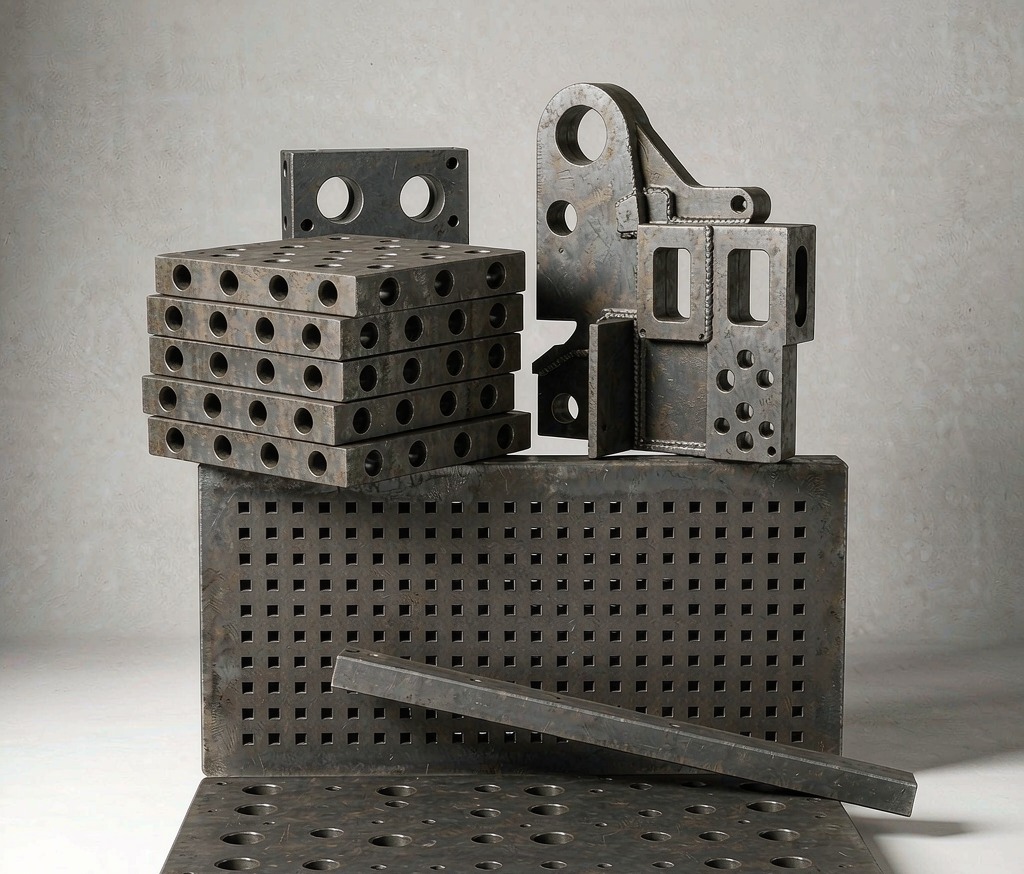
We produce wear plates, bucket and excavator components, bushings, brackets, spacers, and structural supports. CNC turning“>CNC turning and CNC milling“>CNC milling handle precision features, while larger features are forged or fabricated to balance cost and lead time against the strength the application demands.
Materials for Wear and Impact Resistance
Hardened alloy steels, wear-resistant grades, and abrasion-tolerant alloys are typical choices for the most exposed surfaces. Where combined features are needed, hot forging“>hot forging improves grain flow and toughness for impact-loaded parts, giving better service life than a simple machined bar in a shock-loaded joint.
Forging, Machining, and Fabrication
Complex or near-net parts benefit from casting plus machining“>casting plus machining to balance cost and accuracy. We select the route that meets both the mechanical and economic targets of the program, so you are not paying for forged strength where a cast and machined part will perform just as well in service.
Welding and Assembly of Large Components
Large structures are built through welded assemblies“>welded assemblies with controlled procedures and post-weld stress management. heat treatment“>Heat treatment is used where strength or dimensional stability must be guaranteed, particularly on fabricated assemblies that will see heavy cyclic loading in the field.
Inspection and Hardness Verification
Wear parts are verified for hardness, dimensions, and weld integrity before shipment. Our custom metal bushings program applies the same hardness and fit controls that mining buyers expect, because a bushing that fails early takes the whole linkage down with it.
Lead Time and Quote Process
Send drawings with material, hardness, and service conditions. We quote a process route and lead time, and can supply first articles before volume production so you can validate performance in the actual machine.
Cost Drivers in Mining Components
Mining parts are judged on total cost of ownership, not just piece price. A component that lasts twice as long can be worth far more than one that is cheaper to buy, because field change-outs cost labor, downtime, and safety exposure. We work with you to match material and heat treatment to the actual wear and impact the part sees, rather than over-specifying an expensive alloy where a hardened steel would do.
Process route is the other lever. Forging improves toughness for shock-loaded joints, while cast-and-machined routes can cut cost on complex shapes. Choosing the right balance between strength, lead time, and price is where most of the savings are found, and it starts with an honest review of the service condition.
How We Ensure Quality on Mining Parts
Wear and structural parts are verified for hardness, dimensions, and weld integrity before they ship, because a failed bushing or bracket takes a larger assembly down with it. We document the heat treatment and inspection so your maintenance team knows what they are installing.
For ongoing programs we can hold first-article approvals and repeat the same controls on every batch, keeping replacement parts consistent with the originals that proved themselves in the field.
For replacement programs we can keep drawings and first-article approvals on file, so a repeat order ships to the same standard as the original that proved itself in the field. That continuity matters when a single worn part can stop a production line.
We treat every order, whether a one-off replacement or a full production run, with the same documentation and inspection discipline your equipment deserves.
Frequently Asked Questions
What mining parts do you manufacture?
Wear plates, bushings, brackets, spacers, excavator and bucket components, and structural supports for heavy equipment.
Which materials resist mining abrasion?
Hardened alloy steels and abrasion-tolerant grades, often paired with forging for impact-loaded components.
How are large mining components assembled?
Through welded assemblies with controlled procedures and post-weld stress relief where needed.
How is wear-part quality verified?
By hardness testing, dimensional inspection, and weld-integrity checks on every batch.
Can you match an existing worn sample?
Yes. Send the sample and we can reverse-engineer the geometry and propose an improved material or heat treatment.
What are typical lead times?
Dependent on size, material, and volume; prototypes are usually fast, with production quoted per program.
Ready to Start Your Project?
Get a build-ready quote on your custom metal parts within 24 hours. Share your drawing and our engineers will respond with process, lead time, and pricing.

