
Sinker EDM — also called die-sinking EDM — is the process buyers turn to when a feature is simply impossible to cut. Deep cavities with sharp internal corners, intricate mold cores, hardened-steel dies, turbine blade cooling holes and fine textured surfaces all fall into territory where a rotating cutter cannot reach or would distort the part. Sinker EDM removes material with controlled electrical sparks instead of cutting force, which makes the impossible routine.
This guide explains sinker EDM services in practice: what the process is, when to choose it, electrode materials, achievable tolerances and finishes, how it compares with wire EDM, and which materials and design choices keep cost under control. If your part has a cavity, a die or a hard-material feature, the points below show where sinker EDM fits.
What Sinker EDM Is
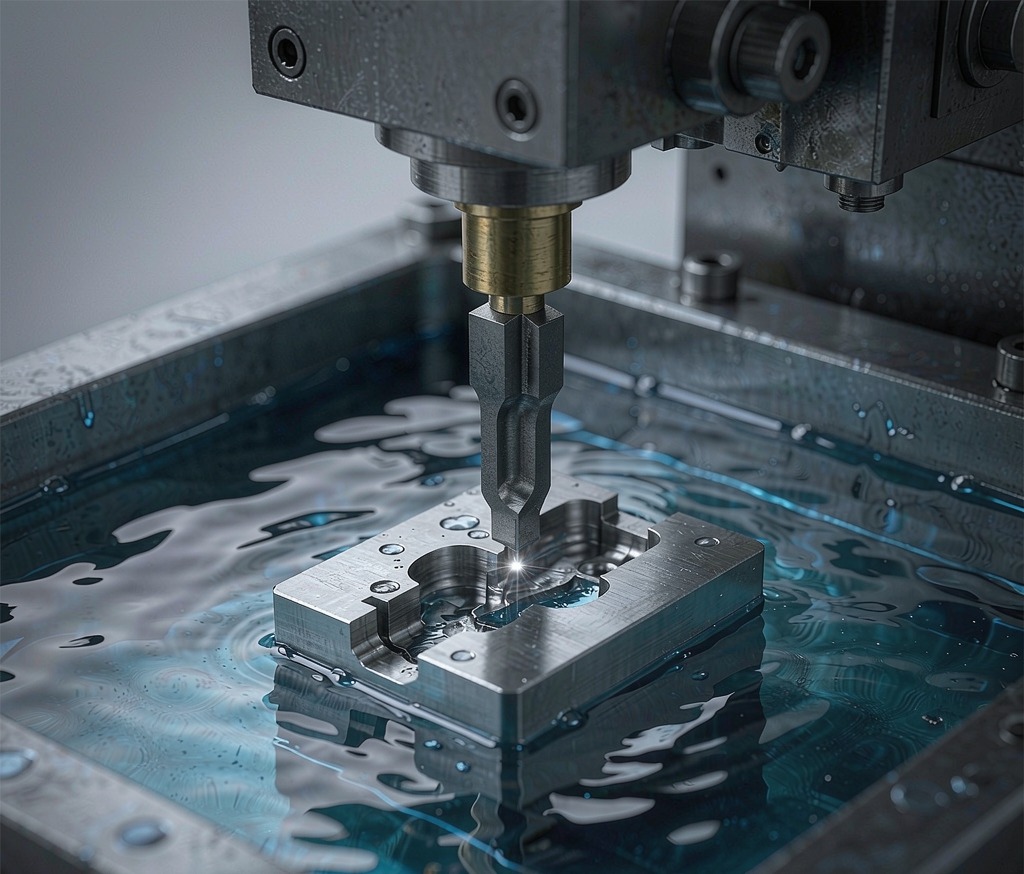
Sinker EDM uses a shaped electrode — typically graphite or copper — submerged in dielectric fluid with a small gap between it and the workpiece. A controlled electrical discharge erodes the workpiece material point by point, replicating the electrode’s inverse shape into the part. Because there is no mechanical contact, there is no cutting force, no tool deflection and no work hardening, and the process works regardless of how hard the material is.
The electrode is the heart of the process. We machine it from graphite, copper or copper-tungsten to the cavity geometry, then burn the inverse into the workpiece. For many mold and die applications this is the only way to achieve the required detail; our general EDM machining capability covers the wider family alongside wire EDM for through-features.
When to Choose It
Sinker EDM is the right call when the feature has sharp internal corners, deep blind cavities, thin ribs, complex 3D contours, or when the part is already hardened and cannot be cut conventionally without distortion. Typical work includes plastic injection molds, die-cast dies, stamping dies, turbine cooling passages, gear-form cavities and textured surfaces. Our EDM machining services page covers when EDM generally beats conventional cutting.
Electrode Materials
Graphite is the workhorse: it machines quickly, wears slowly in many applications and handles fine detail, though it can leave a carbon residue that needs cleaning. Copper gives excellent surface finish and low wear on fine-feature work but is slower to machine into an electrode. Copper-tungsten combines wear resistance and fine finish for demanding dies but costs more. Electrode choice trades speed, wear and finish against cost.
Process and Parameters
The burn runs in roughing and finishing passes. Roughing removes the bulk with higher energy and faster erosion; finishing uses lower energy for a clean, stress-free surface. We tune discharge current, pulse on-time and flushing to balance material removal rate against surface quality and electrode wear. Dielectric filtration keeps the gap clean so the spark stays stable.
Achievable Tolerances and Finish
Sinker EDM holds tight geometries — cavity features to roughly ±0.01 mm and repeatability within a few microns on well-controlled machines. As-burned surface finish ranges from rough Ra several µm in roughing to mirror-like finishes below Ra 0.2 µm in finishing, so the process can deliver a ready-to-use molded surface without polishing. Reference faces that must be ground are completed by surface grinding or cylindrical grinding where needed.
Compared to Wire EDM
Wire EDM cuts a travelling wire through the part and thus only makes through-features and 2D profiles; sinker EDM makes blind, 3D cavities that wire cannot. Many programs use both: sinker for the cavity, wire for the parting-line profile or slug. Complex 3D bodies are often pre-shaped on 5-axis CNC machining centres before EDM finishes the features cutting cannot reach. Our wire EDM services page details the complement.
Materials
Because EDM is non-contact, it cuts hardened tool steels, carbides, exotic alloys and any conductive material without regard to hardness — in fact hardened stock is ideal, since there is no distortion to worry about. That is why EDM is central to tool-and-die work where the part is hardened before the cavity is finished. For micro-features our micro machining services can pair with EDM on fine work.
Cost and DFM
Sinker EDM cost is driven by electrode fabrication, burn time and finish requirements. The biggest savings come from designing cavities that need fewer electrodes, specifying only the finish the mold actually requires, and avoiding unnecessarily tight tolerances on non-functional surfaces. Pre-machining the bulk on CNC centers before EDM also slashes burn time. For buyers comparing process routes, our precision machined parts overview explains how blank strategy is matched to tolerance and volume.
Frequently Asked Questions
When should I choose sinker EDM over wire EDM?
When the feature is a blind cavity, has sharp internal corners, or is a 3D contour that a travelling wire cannot make. Wire EDM only cuts through-features and 2D profiles.
What electrode material is best?
Graphite for speed and wear on most dies; copper for fine finish and low wear on detailed work; copper-tungsten for demanding, high-wear dies at higher cost.
What tolerances and finishes can sinker EDM hold?
Cavity features to about ±0.01 mm with finish from rough Ra several µm down to mirror-like below Ra 0.2 µm, often ready to mold without polishing.
Does the material need to be hardened?
No, but hardened stock is ideal because EDM causes no distortion — which is exactly why it is central to finishing tool-steel dies after heat treat.
How can I reduce sinker EDM cost?
Design cavities needing fewer electrodes, specify only the finish the mold requires, and pre-machine the bulk on CNC centers so the EDM burn time is minimal.
Ready to Start Your Project?
Get a build-ready quote on your custom metal parts within 24 hours. Share your drawing and our engineers will respond with process, lead time, and pricing.

