
Tubular parts move fluids, carry loads, and route energy in almost every machine—yet bending and shaping tube without wrinkling, flattening, or cracking is a discipline of its own. Tube forming services turn straight stock into precise, leak-tight, load-bearing geometry. This guide covers the processes that matter and how to specify them so your assemblies fit the first time and hold pressure in service.
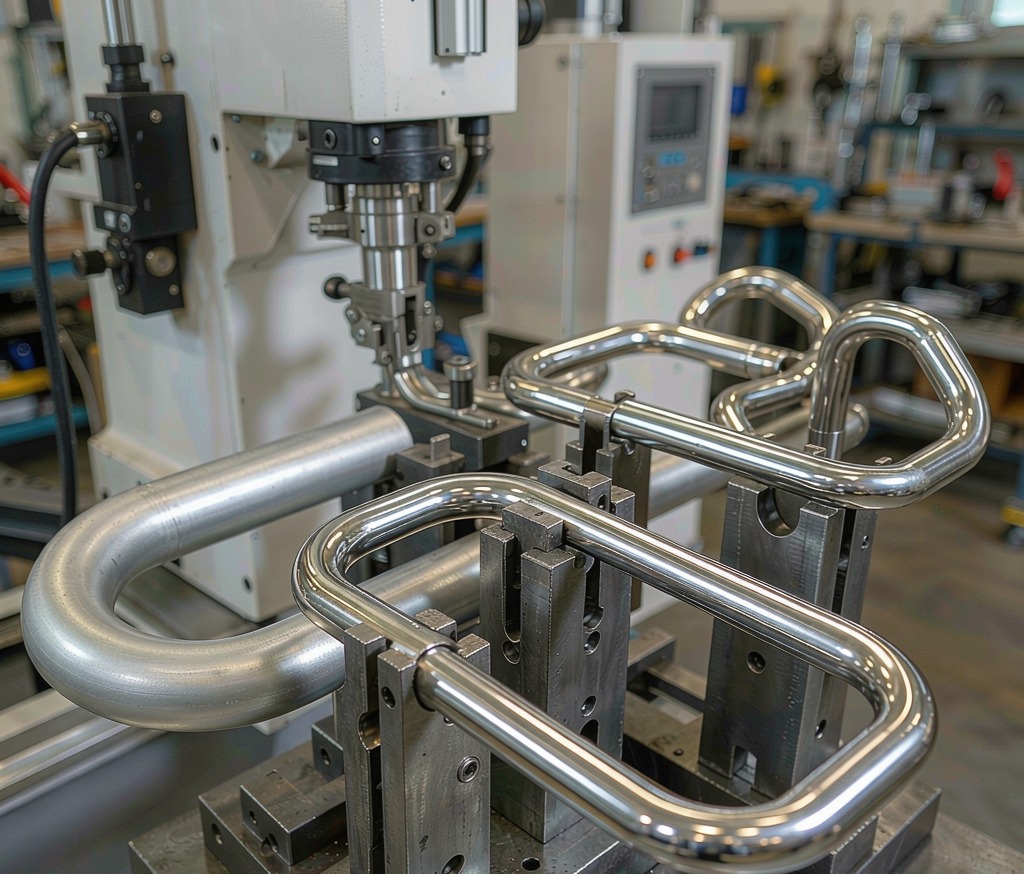
Cutting & Bending Tube Precisely
Accurate tube work starts with clean cuts. Tube laser cutting produces square, burr-free ends and even pierced features in one setup, which eliminates a separate machining operation. For bends, CNC tube bending with mandrel support keeps the wall round and wrinkle-free through tight radii—critical for fluid flow and appearance. Our tube bending services and tube fabrication services pages detail typical radii, wall limits, and QA approaches for production runs.
End Forming, Swaging & Expansion
Beyond bends, tube often needs flared, bulged, or reduced ends for joining. Swaging compresses the tube onto a fitting or forms a taper without removing material, preserving wall integrity better than cutting or machining. Expansion and reduction operations create solder or weld prep. These are the steps that make a tube assembly actually connect to the rest of the system instead of leaking at the joint.
Joining Tubular Assemblies
Tubes are rarely shipped alone. TIG welding gives clean, strong joints on thin-wall stainless and aluminum; MIG welding is faster for structural steel tube frames; spot welding suits stacked sheet-and-tube brackets. For hydraulic components, weld cleanliness and post-braze testing prevent leaks that would otherwise show up only after installation, where repair cost multiplies.
Material Choices & Finishing
Stainless dominates hygiene and corrosion duties; aluminum is chosen for weight; copper and its alloys serve thermal and electrical runs. After forming, parts may be riveted into assemblies or finished by laser-cut bracketry that locates the tube precisely. Our welded assemblies program integrates tube into complete structures so you receive a tested subassembly rather than a box of loose parts.
Design for Manufacture
Good tube design specifies bend order, fixed versus free lengths, and tolerances that account for springback. Over-constraining every dimension forces costly secondary operations; instead, tie critical features to a single datum. We review drawings for clamp clearance, minimum straight length between bends, and wall-thinning risk, and we feed that back before cutting so the first article is right. The payoff is a tube that needs no shimming or re-bending on the assembly line.
Tolerances, QA & Leak Testing
Tube bending holds centerline-to-centerline tolerances in the range of ±0.5 mm for production tooling, while cut lengths are typically ±0.2 mm. Wall thinning at the bend is the key failure risk, so we measure wall thickness at the extrados and reject any part that drops below your minimum. For fluid-carrying assemblies we offer pressure decay, dye penetrant, or helium leak testing depending on the medium and safety class, and we mark tested units so they are traceable back to the weld procedure that produced them. That documentation is often what your end customer’s quality audit demands.
Common Tube Defects & How We Avoid Them
The defects that wreck tube assemblies are predictable: wrinkling from unsupported bends, wall thinning that bursts under pressure, and ovality that prevents a clean fit into a fitting. We defeat all three with the right combination of mandrel, wiper, and clamp tooling, plus bend-parameter tuning per material and wall. For thin-wall stainless we slow the feed and support the extrados; for aluminum we manage heat so the tube does not work-harden mid-bend. Tube fabrication services live or die on these details, and our first-article inspection catches any drift before a full lot is cut. The result is a tube that bends true, holds pressure, and seats first time.
Materials We Form
Tube forming is material-specific in the details. Stainless (304, 316) dominates hygiene, marine, and corrosion duties and needs the most careful bend support. Aluminum (3003, 6061) is formed for lightweight frames and coolant lines, with heat managed to avoid cracking. Copper and cupronickel serve thermal and marine runs, while carbon and alloy steel tube is bent for exhaust, structural, and hydraulic lines. Each material has its own springback factor and minimum bend radius, which we capture in a_setup sheet so repeat orders are consistent. For non-round or clad tube, we validate the process on a sample before committing the lot, because exotic sections behave unpredictably until proven.
From Drawing to Assembled Tube
Most tube programs do not end at a bent length. We routinely deliver subassemblies: tube brazed or welded to fittings, bracketed with laser-cut tabs, and pressure-tested as a unit. Consolidating cutting, forming, joining, and test under one roof removes the interface errors that appear when each step sits with a different supplier. It also shortens lead time because there is no waiting on a third party between operations. The result is a tube assembly that drops into your product rather than a pile of parts you must still coordinate and inspect yourself.
Frequently Asked Questions
What is the minimum bend radius?
Roughly 1× to 1.5× the OD for thin walls with mandrel support; tighter needs special tooling. We confirm on your print.
Can you bend thin-wall stainless without wrinkling?
Yes—mandrel and wiper-tool bending keeps the section round. This is standard for sanitary and hydraulic tube.
Do you supply complete tube assemblies?
Yes. From cut and bent tube to welded brackets and custom tubing, we deliver finished assemblies.
Which weld process for aluminum tube?
TIG for cosmetic and thin-wall; MIG for speed on structural frames. Both are qualified in-house.
How are leaks prevented?
Clean joint prep, qualified procedures, and pressure or dye-test verification on critical runs.
Ready to Start Your Project?
Get a build-ready quote on your custom metal parts within 24 hours. Share your drawing and our engineers will respond with process, lead time, and pricing.

