
Medical Device Components Manufacturing: Precision Processes for Surgical, Implant & Diagnostic Parts
From surgical instruments to orthopedic implants — a complete process selection framework for medical component buyers and engineers. Learn which manufacturing method suits every device part, and how to meet ISO 13485 compliance.
Table of Contents
- 1. Surgical Instruments: CNC Machining & Swiss Turning
- 2. Orthopedic Implants: Titanium CNC & Surface Treatment
- 3. Endoscopic & Minimally Invasive Parts
- 4. Diagnostic & Imaging Equipment Housings
- 5. Material Selection for Medical Components
- 6. Process Comparison Table: Medical Applications
- 7. Quality & Compliance: ISO 13485 and Traceability
- 8. How to Choose a Medical Parts Supplier
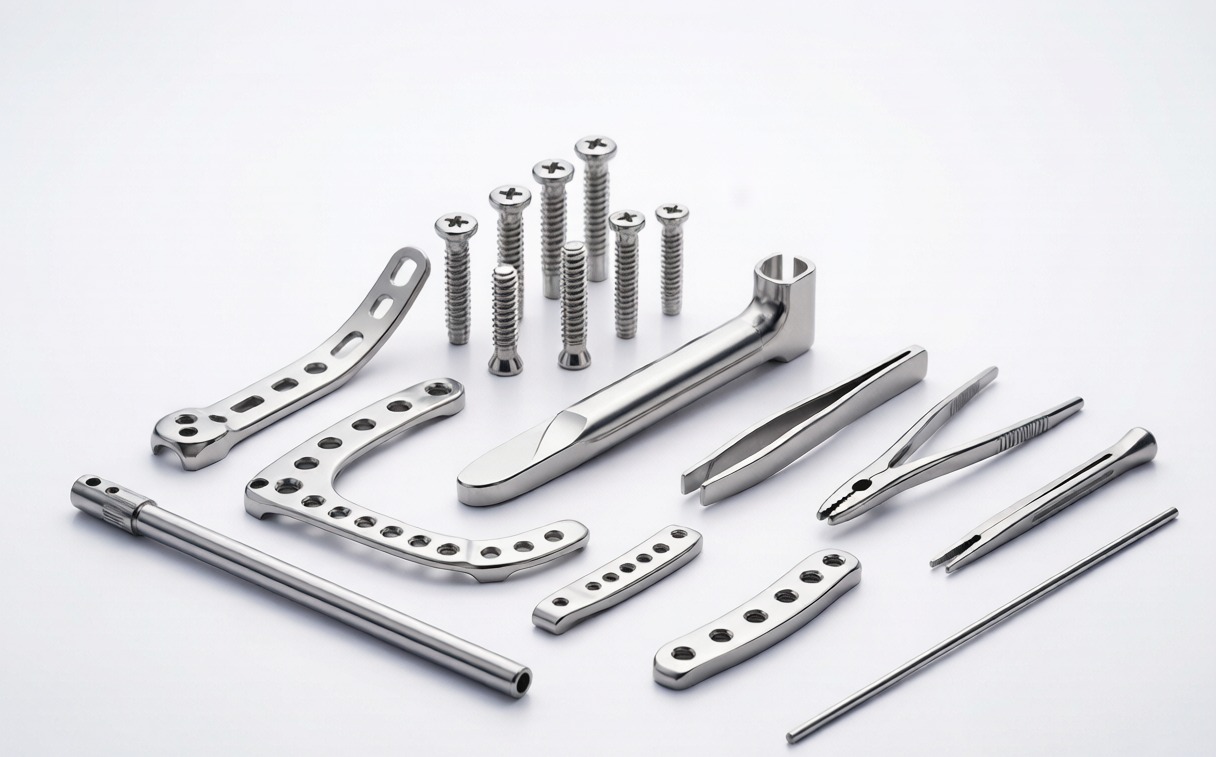
->
1. Surgical Instruments: CNC Machining & Swiss Turning
Surgical instruments demand a combination that few other industries require: micron-level precision, absolute biocompatibility, and the ability to survive hundreds of sterilization cycles. A scalpel handle that is 0.1mm out of tolerance can compromise an entire procedure. That is why the dominant processes are CNC machining and Swiss-type turning.
Scalpels, Forceps & Clamp Bodies
Recommended process: CNC Swiss Turning + Precision Grinding ( martensitic stainless steel 420 / 440C )
Swiss-type lathes hold tolerances of ±0.005mm on long, slender parts while the sliding headstock minimizes deflection. After machining, passivation per ASTM A967 ensures the chromium oxide layer that prevents corrosion in autoclave environments. For cutting edges, finish grinding achieves a mirror surface below Ra 0.2μm.
Drill Bits, Reamers & Bone Saws
Recommended process: 5-Axis CNC Grinding (tungsten carbide / cobalt-chrome)
Rotary cutting instruments require geometrically complex flutes and edges that only 5-axis CNC grinding delivers consistently. Tungsten carbide blanks are ground to cutting geometry, then coated with TiN or DLC to extend service life 3–5×.
Key Takeaway for Surgical Instrument Buyers
- ✓ Long, slender parts → Swiss-type turning for tight tolerances
- ✓ Cutting edges → 5-axis CNC grinding + PVD coating
- ✓ Always require ASTM A967 passivation certificate
- ✓ Prototype instruments → CNC machining; volume → Swiss turning
2. Orthopedic Implants: Titanium CNC & Surface Treatment
Implants live inside the human body for decades. They must be osteoconductive, fatigue-resistant, and manufactured with zero defects — a single inclusion can trigger rejection. Titanium Grade 5 (Ti-6Al-4V) and cobalt-chrome dominate, and multi-axis CNC machining is the primary process.
Bone Plates & Screws
Recommended process: 5-Axis CNC Machining (Titanium Grade 5) + Anodizing / HA Coating
Locking plates are milled from titanium bar stock on 5-axis machines to achieve the contoured anatomical shape and threaded screw holes. Surface treatments — anodizing for color coding or hydroxyapatite (HA) coating for bone bonding — are applied after machining. Screw threads are rolled, not cut, to preserve grain flow and fatigue strength.
Hip & Knee Implants
Recommended process: CNC Machining + Investment Casting (high volume) + Surface Texturing
Femoral stems and tibial trays are CNC-machined for the articulating surfaces where ±0.01mm matters most. At production volumes above 20,000/year, investment casting produces near-net-shape blanks that are then CNC-finished — cutting material waste by 60% versus full machining from bar. The bearing surface receives a porous or textured finish to promote osseointegration.
⚠ Implant Quality Warning
Never accept implants without full material certification (EN 10204 3.1) and batch-level traceability. For titanium, confirm ELI (Extra Low Interstitial) grade for fracture-critical applications.
3. Endoscopic & Minimally Invasive Parts
Minimally invasive devices push miniaturization to the limit: tubes with 1–3mm inner diameters, articulated jaws, and laser-welded assemblies. The defining processes are micro-CNC turning, laser cutting, and micro-welding.
Catheter & Endoscope Shafts
Recommended process: Micro Swiss Turning + Electropolishing (316L stainless)
Thin-wall stainless tubes are turned to wall thicknesses below 0.1mm, then electropolished to a smooth, debris-free inner surface that resists bacterial colonization. Laser welding assembles multi-lumen tips without heat-affected-zone cracking.
Biopsy Forceps & Graspers
Recommended process: Wire EDM + Micro CNC Machining + Laser Welding
The working jaws are cut from sheet by wire EDM for sharp, burr-free edges, then laser-welded to actuation cables. Joints are designed for 200,000+ actuation cycles without fatigue failure.
4. Diagnostic & Imaging Equipment Housings
MRI, CT, and ultrasound systems need non-magnetic, EMI-shielded enclosures that protect sensitive electronics. CNC machining and sheet metal fabrication dominate here.
Scanner Frames & Covers
Recommended process: Aluminum CNC Machining + Sheet Metal Fabrication
Aluminum is preferred for its non-magnetic property and EMI shielding. Large covers are fabricated from laser-cut and bent sheet; precision instrument mounts are CNC-machined to hold optical or detector alignment within 0.05mm.
5. Material Selection for Medical Components
| Material | Use Case | Key Property | Machining Note |
|---|---|---|---|
| 316L Stainless Steel | Instruments, endoscopes | Corrosion-resistant, non-magnetic | Easy to machine; electropolish for finish |
| Titanium Grade 5 (Ti-6Al-4V) | Implants, plates, screws | High strength-to-weight, biocompatible | Use sharp tools, low RPM, flood coolant |
| Cobalt-Chrome (CoCrMo) | Joint bearings, cutting tools | Wear-resistant, high hardness | Grind rather than cut; very abrasive |
| PEEK (polymer) | Spacers, non-magnetic parts | Radiolucent, chemical resistant | CNC mill; lower cutting forces |
| Nitinol (NiTi) | Stents, guidewires | Shape memory, superelastic | Specialized; laser cut + heat treat |
6. Process Comparison Table: Medical Applications
| Component | Primary Process | Volume Range | Typical Tolerance | Notes |
|---|---|---|---|---|
| Scalpel / forceps | Swiss turning + grind | 1K–500K | ±0.005mm | Passivation required |
| Bone plate / screw | 5-axis CNC + anodize | 500–100K | ±0.01mm | Thread rolling for strength |
| Hip / knee implant | Casting + CNC finish | 5K–200K | ±0.01mm | HA coating on bearing |
| Endoscope shaft | Micro turning + e-polish | 5K–300K | ±0.01mm | Thin-wall <0.1mm |
| Scanner housing | Aluminum CNC + sheet | 100–20K | ±0.05mm | Non-magnetic required |
7. Quality & Compliance: ISO 13485 and Traceability
Medical manufacturing is governed by ISO 13485 and, in the US, FDA 21 CFR 820 (QSR). The non-negotiables for any supplier are: full material certificates, batch-level traceability from raw stock to finished part, validated cleaning and passivation processes, and a documented CAPA system. A supplier without these cannot legally supply finished device components.
⚠ Compliance Red Flag
If a supplier cannot provide a Device Master Record, risk management file (ISO 14971), and cleanroom capability for implantable parts, do not proceed — regardless of price.
8. How to Choose a Medical Parts Supplier
Supplier Checklist for Medical Components
- ✓ ISO 13485 certified with current audit report
- ✓ Material traceability (EN 10204 3.1) on every lot
- ✓ Cleanroom for implantable and invasive parts
- ✓ In-house passivation, anodizing, and HA coating
- ✓ CMM inspection with First Article Inspection (FAI) reports
- ✓ Experience with Ti-6Al-4V and 316L stainless
Ready to Start Your Project?
Our engineering team will respond within 24 hours with a detailed quotation.