
Aluminum heat sink manufacturing turns one of the best thermal conductors into the fins, plates, and enclosures that keep electronics from overheating. From LED lighting and power supplies to EVs and data centers, custom heatsinks move heat away from sensitive components efficiently and cheaply. This guide covers how heatsinks are made, why fin geometry matters, and how to order a part that actually meets your thermal budget.

Why Aluminum Heat Sinks
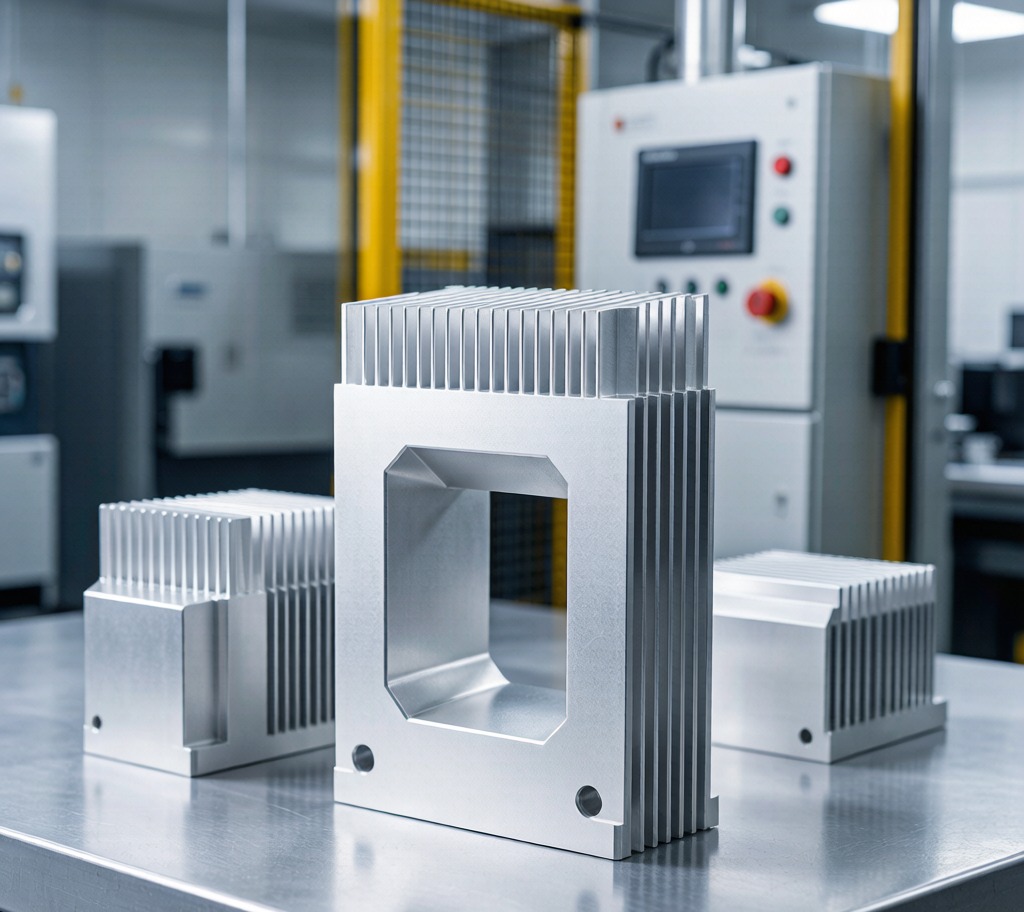
Aluminum combines high thermal conductivity, low weight, and low cost, making it the default for most cooling jobs. Extruded profiles give long fin arrays; CNC-machined blocks allow complex mounting pockets. A supplier offering both aluminum extrusion and precision machining can optimize the shape for both performance and manufacturability rather than forcing one method.
Extrusion vs. CNC Skived
Extrusion is ideal for long, uniform fin arrays and is the most economical at volume. CNC machining (or skiving) creates denser, more complex fin fields and integrated mounting features in lower volumes. CNC milling also cuts the base flat and drills holes so the sink mounts directly to the device. Our aluminum CNC machining guide explains how alloy and temper affect cut quality.
Fin Design and Thermal Performance
Thermal performance depends on fin height, spacing, thickness, and the base-to-component interface. Taller, thinner, closely spaced fins increase surface area but can choke airflow, so the optimum is application-specific. CNC drilling and tapping create the clearance and threaded holes needed for clips and standoffs. For enclosures that double as heatsinks, see our custom metal enclosures guide.
Machining Mounting Features
A heatsink is only as good as its contact with the heat source. Flat, smooth bases and accurate hole patterns ensure even pressure and low thermal resistance. Surface grinding flattens the base to a tight plane, and deburring removes sharp edges from fin tips. These finishing steps are what separate a functional sink from a merely shaped one.
Anodizing and Finish
Most heatsinks are anodized—clear or black—to improve emissivity and protect the surface. Anodizing also gives a clean, uniform look for visible electronics. Black anodize slightly improves radiation, while clear keeps the natural metal. The trade-offs sit alongside other finishes in our metal surface treatment comparison.
How to Order Custom Heatsinks
Provide the heat load (watts), the allowable temperature rise, the envelope, and the mounting pattern, plus a drawing if you have one. State the alloy and finish. Early thermal and DFM feedback prevents a sink that is either over- or under-built, saving both cost and rework.
Interface and Thermal Interface Material
A heatsink is only effective if heat moves freely from the component into the base, and that depends on the interface. The mounting surface must be flat and smooth—achieved with surface grinding—so the thermal interface material (TIM) layer stays thin and uniform. Air gaps from warp or rough finish are the enemy of cooling, raising resistance far more than fin design can compensate for. Most assemblies use a TIM such as thermal paste, pad, or phase-change material between device and sink; the choice balances ease of assembly, rework, and long-term stability. Bolt pattern and clamping pressure also matter: even pressure across the base prevents localized hot spots. For higher power, vapor chambers or embedded heat pipes can be integrated, though they add cost and complexity. Designing the interface together with the fin field—rather than optimizing each in isolation—yields the lowest junction temperature for the given envelope. Our custom enclosures work often combines these considerations when the sink and housing are one part.
Heatsink cost scales with complexity and volume in predictable ways. Extrusion tooling is modest and amortizes quickly, making it the default for any recurring need; CNC-machined sinks carry no tooling but cost more per part, suiting prototypes and low runs. Fin density and base thickness drive material and machining time, so a small design simplification often yields a large saving without hurting performance. Anodizing adds a modest, fixed-ish step; custom colors cost more than standard clear or black. When volume is uncertain, start with CNC to validate thermal performance, then transition to extrusion once the design and demand are proven—the same ramp strategy used across our machined aluminum parts work.
When sourcing a custom heatsink, start with a thermal budget and envelope rather than a fixed shape; an experienced supplier can often propose a simpler, cheaper geometry that meets the same spec. Request a machined or extruded sample to validate temperature under real load before committing to volume tooling. Confirm the finish and any regulatory needs such as RoHS-compliant anodizing early, since they affect both cost and lead time. Treating the first article as a validation step retires thermal risk before production.
Frequently Asked Questions
Extruded or CNC— which is better?
Extrusion wins on cost and length for uniform fins; CNC wins on complexity and low volume with dense fin fields.
Does anodizing help cooling?
Black anodize modestly improves radiative cooling and protects the surface; the bigger gains come from fin design.
What tolerances can the base hold?
Ground bases are held flat to tight planes, and drilled holes are positioned to standard CNC tolerances.
Can the sink be part of the enclosure?
Yes—integrated enclosure-heatsinks are common; our custom enclosures guide covers the approach.
Ready to Start Your Project?
Get a build-ready quote on your custom metal parts within 24 hours. Share your drawing and our engineers will respond with process, lead time, and pricing.

