
Steel casting services pour molten steel into a mold to create parts that would be difficult or impossible to machine or weld from stock—valve bodies, pump housings, brackets, and heavy wear components. Casting lets you place material only where it is needed, achieving complex internal shapes with good strength. This guide compares sand, investment, and die casting for steel, the grades available, and how to choose a foundry you can trust.

What Steel Casting Is
Casting melts steel and pours it into a cavity shaped like the final part. After solidification, the part is knocked out, cleaned, and machined to final dimensions. A foundry that also offers sand casting and investment casting can match the process to your geometry and volume rather than pushing one method.
Sand vs. Investment vs. Die
Sand casting handles the largest and heaviest parts economically, with looser tolerances and rougher surfaces that are cleaned up by machining. Investment (lost-wax) casting delivers fine detail and tight tolerance for smaller, complex parts. Die casting is fast and repeatable but is usually associated with lower-melting alloys; for steel it applies mainly to specialized high-pressure routes. Our investment casting guide digs deeper into that process.
Grades: Carbon, Alloy, and Stainless
Carbon steel castings are the economical default for strength; alloy steels add hardenability and toughness for demanding loads; stainless grades resist corrosion in food, marine, and chemical service. The grade sets weldability, machinability, and heat-treat response, so it should be chosen with the duty in mind. For a forged alternative, our metal forging services guide compares grain-flow strength.
Tolerances and Machining
As-cast tolerances are wider than machined ones, so critical faces and holes are finished afterward on CNC milling centers. Draft angles and fillets designed in at the drawing stage reduce machining and rejection. The relationship between cast and machined states mirrors the discussion in our forging vs. casting comparison.
Heat Treatment and Finish
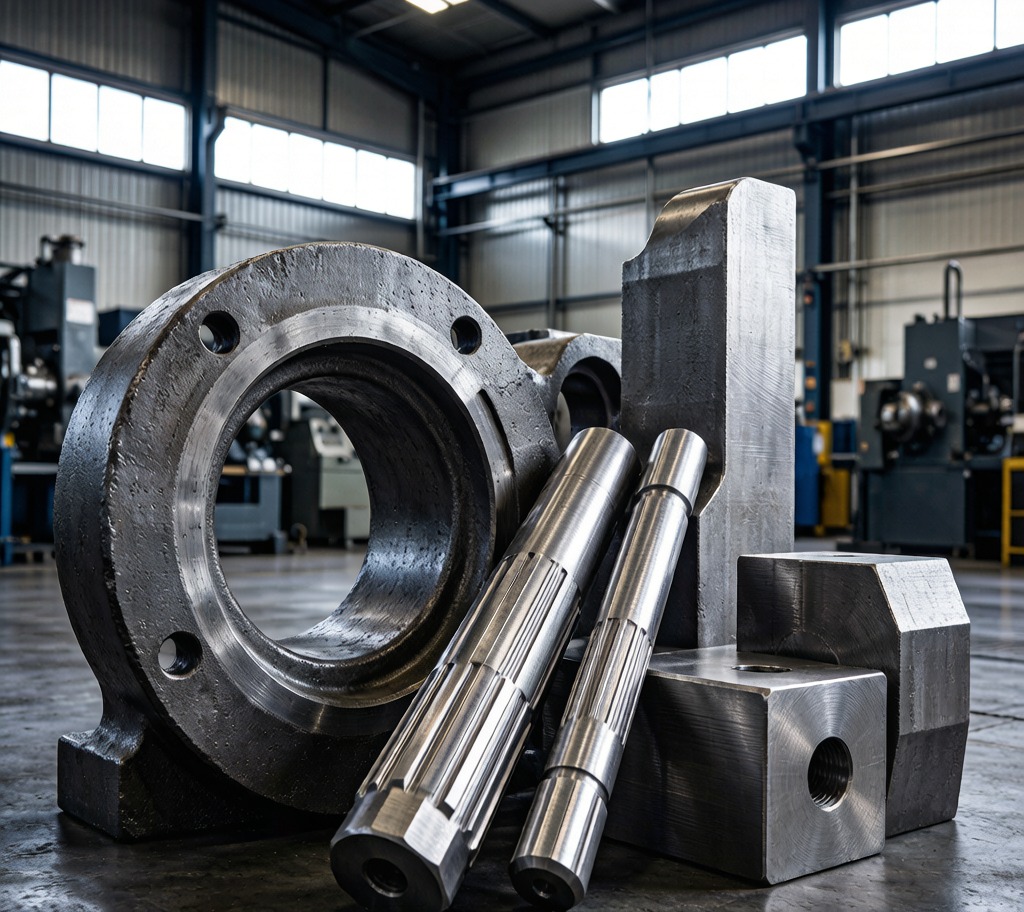
Most steel castings are normalized, quenched, or tempered to reach target strength and toughness. Heat treatment is followed by surface grinding of seating faces and protective coatings where needed. Correct heat treatment is what turns a sound casting into a durable service part, especially under fatigue or impact.
How to Choose a Foundry
Look for material certification, in-house machining, and inspection capabilities such as spectroscopy and dimensional reporting. Ask about pattern and tooling storage, and request samples before a large release. A foundry that controls melting, cleaning, heat treat, and machining under one roof gives the most predictable quality and lead time.
Defects and Quality Control
Casting quality lives in controlling the variables that cause defects. Porosity from trapped gas or shrinkage, cold shuts from poor fill, and inclusions from slag are the usual suspects, and each is managed by mold design, pouring practice, and gating rather than by inspection after the fact. Reputable foundries use spectroscopy to verify chemistry, dye-penetrant or magnetic-particle testing to find surface cracks, and dimensional checks against the pattern. Heat treatment is verified by hardness and sometimes impact testing, while critical bores and faces are confirmed after CNC milling. Designing with adequate draft, fillets, and feeding paths at the drawing stage is the single biggest lever for clean castings, because it lets metal flow and solidify without stress. A foundry that controls melting, cleaning, heat treat, and machining internally can correlate any defect back to its cause and close the loop quickly. This vertical integration is why we pair casting with finishing in our forging vs. casting recommendations rather than treating them as separate buys.
Lead time in casting is dominated by tooling and sampling. A new pattern or die can add weeks before the first sound casting, while reorders from existing tooling are far quicker. Minimum order quantities depend on the process—sand casting handles smaller lots economically, investment casting needs enough volume to justify the wax tooling. Early engagement with the foundry lets pattern and gating be designed for your specific alloy and geometry, shortening the correction loop. If you also need machined features, confirming them up front avoids a second supplier and a second quality gate. Planning the first article as a validation step, with dimensional and material reports, retires the most risk before a full release and protects both schedule and budget.
Casting is usually the right call when the part is large, complex, or low in volume, where machining from solid would waste most of the material and forging would need costly tooling. It also excels at consolidating several welded pieces into one robust component, reducing assembly and potential leak paths. Where weight and simple shapes dominate, forging or fabrication may win instead—our metal forging services guide helps you compare. The decision should follow the geometry and volume, not habit.
Frequently Asked Questions
Which process is cheapest for steel?
Sand casting is usually most economical for low-to-mid volumes and large parts; investment casting costs more but yields finer detail.
Can cast steel be heat-treated?
Yes—normalizing, quenching, and tempering are standard to achieve the required mechanical properties.
What are typical casting tolerances?
As-cast dimensions are looser than machined; critical features are finished on CNC equipment afterward.
Is casting or forging stronger?
Forging generally offers better fatigue strength via grain flow; casting wins for complex internal geometry. See our forging vs. casting guide.
Ready to Start Your Project?
Get a build-ready quote on your custom metal parts within 24 hours. Share your drawing and our engineers will respond with process, lead time, and pricing.

