
Every engineer who has watched a precision gear come back from carburising with 0.15 mm of distortion understands the appeal of nitriding services. Nitriding hardens the surface of a steel part at 500-570 °C, well below the transformation temperature, so there is no quench and almost no dimensional movement. You get a wear-resistant, fatigue-resistant, corrosion-resistant case on a part that comes out of the furnace essentially the same shape it went in. For finish-machined components, thin-walled parts, and complex geometries where a post-hardening grind is impossible, that single property is worth more than the extra hardness itself.

What Nitriding Actually Does to the Steel
Nitriding diffuses atomic nitrogen into the steel surface. The nitrogen reacts with alloying elements — chromium, molybdenum, aluminium, vanadium — to form extremely hard, finely dispersed nitride precipitates. Two layers result. On top sits the compound layer, or white layer, typically 5-25 µm of iron nitride that provides corrosion and scuff resistance. Below it is the diffusion zone, which can extend 0.1-0.8 mm and carries compressive residual stress that dramatically improves fatigue strength.
Because the process runs below the austenitising temperature, there is no phase transformation and no quench, which is precisely why distortion stays low. That distinguishes nitriding from every other case-hardening method covered in our broader heat treatment services overview, and it is the reason nitriding is normally the last operation before final inspection.
Gas, Plasma and Salt Bath: Choosing the Right Route
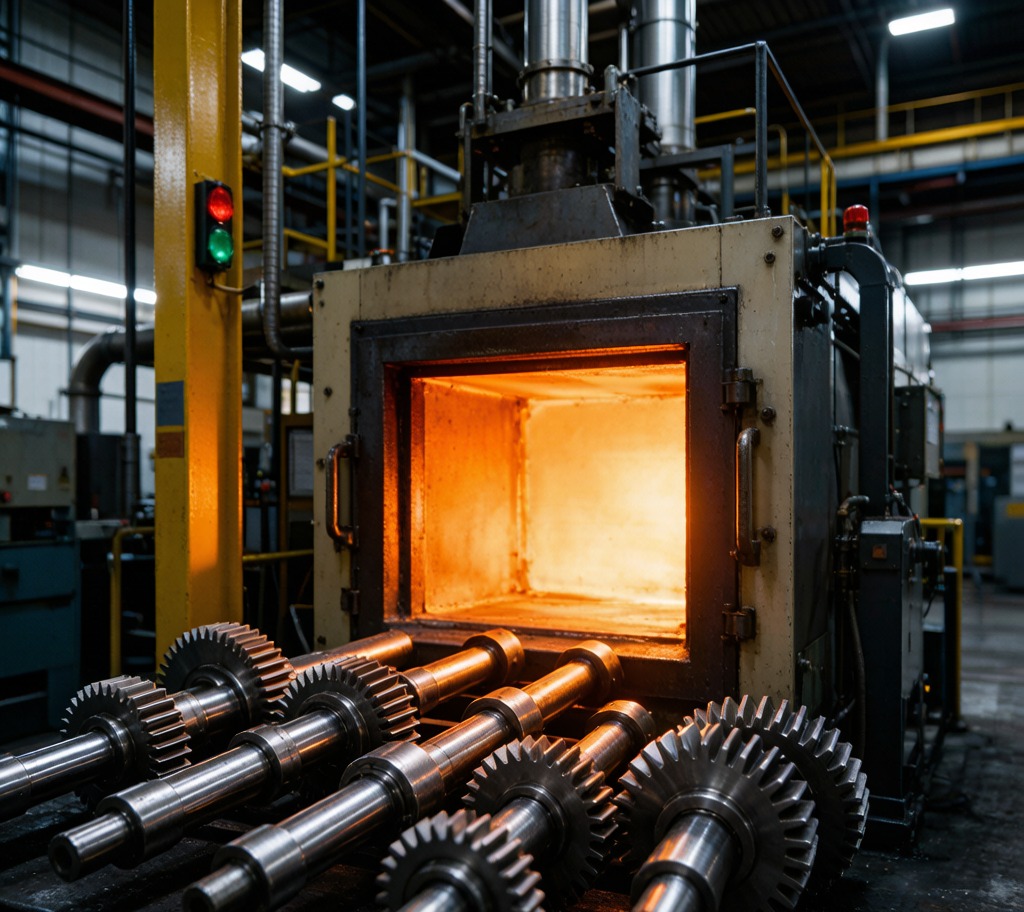
Gas nitriding is the workhorse. Parts sit in a retort furnace with dissociated ammonia for 10-90 hours depending on the case depth required. It is economical for batch loads, handles complex internal passages well, and is the standard choice for crankshafts, gears, and moulds. The trade-off is cycle length and slightly less control over the white layer.
Plasma (ion) nitriding uses a glow discharge in a low-pressure nitrogen atmosphere. Cycles are shorter, the white layer can be precisely controlled or eliminated entirely, and selective masking is straightforward — you simply mechanically shield the areas you do not want treated. It also passivates stainless steel effectively, which gas nitriding struggles with. Plasma is the premium option and costs accordingly.
Salt bath nitrocarburising (ferritic nitrocarburising, often known by trade names) runs in a molten cyanate salt at around 570 °C for only 1-4 hours. It produces a thin, very hard compound layer with excellent scuffing and corrosion resistance, and is extremely cost-effective for high volumes of small parts. Case depth is shallow, so it suits wear and corrosion applications rather than heavy load-bearing ones.
Case Depth, Hardness and What to Specify
Typical results across common grades:
- Nitralloy 135M / 34CrAlNi7: surface hardness 1000-1200 HV, the highest achievable — aluminium forms exceptionally hard nitrides
- 4140 / 42CrMo4: 600-750 HV, the most common general-purpose nitriding steel
- H13 tool steel: 900-1100 HV, standard for die casting dies and extrusion tooling
- Stainless 316 / 17-4 PH: 1000-1300 HV with low-temperature plasma nitriding, retaining corrosion resistance
- Case depth range: 0.1-0.3 mm typical, up to 0.8 mm with long gas cycles
On your drawing, specify surface hardness in HV or HR15N (not HRC — the case is too thin for a standard Rockwell C indent to be valid), the required case depth measured to a defined hardness limit, and whether a white layer is acceptable. That last point matters: for gears in rolling contact the brittle white layer is often removed or suppressed, whereas for a sliding surface it is exactly what you want. Say so explicitly.
Which Steels Nitride Well — and Which Do Not
Nitriding needs nitride-forming alloying elements. Plain low-carbon steel gains very little hardness because there is nothing for the nitrogen to react with. The ranking runs roughly: aluminium-bearing nitriding steels best, then chromium-molybdenum grades, then tool steels, then stainless. Cast iron responds moderately; austenitic stainless requires the low-temperature plasma variant to avoid chromium nitride precipitation destroying corrosion resistance.
Critically, the part must be hardened and tempered before nitriding, at a tempering temperature at least 30 °C above the nitriding temperature. Otherwise the core softens during the nitride cycle and you lose the load-carrying substrate. Sequence therefore matters:
- Rough machine
- Quench and temper to core hardness (tempering above the nitriding temperature)
- Finish machine to final dimensions, typically via CNC machining and cylindrical grinding
- Stress relieve if heavy stock was removed
- Clean thoroughly — any oil, oxide, or passive film blocks nitrogen diffusion
- Nitride
- Light polishing or lapping only if a mirror finish is needed
Note step 3. Because there is no post-hardening grind, whatever surface finish you send in is essentially what you get back, slightly matted. Nitriding will not fix a poor finish, and heavy stock removal afterwards will cut straight through the case. Where a component also needs a decorative or additional corrosion barrier, black oxide over a nitrided surface is a common and inexpensive combination.
Nitriding vs Carburising vs Induction Hardening
Each method wins in a different scenario:
- Carburising gives deep cases (0.5-2.5 mm) and the best load-carrying capacity for heavily loaded gear teeth, but requires a quench and therefore distortion control plus post-grinding.
- Induction hardening is fast, localised, and inexpensive per part, ideal for shaft journals and selective areas. Our induction hardening guide covers where it beats furnace routes; it also distorts more than nitriding.
- Nitriding wins whenever distortion is the binding constraint, when the part is already finish-machined, when you need corrosion plus wear resistance together, or when the operating temperature is high enough that a carburised case would temper back.
Nitriding also stacks well with mechanical surface treatments. Combining it with shot peening compounds the compressive stress benefit for fatigue-critical parts. For gear applications specifically, the trade-offs are discussed further in our custom metal gears guide, and mechanical peening is available in-house via our shot peening line.
Frequently Asked Questions
How much distortion should I expect from nitriding?
Typically under 0.02 mm on well-designed parts, and mostly a small predictable growth of 5-15 µm rather than warping. Parts with heavy asymmetric machining or residual stress from prior operations move more, which a pre-nitride stress relieve largely prevents.
Can nitrided parts be machined afterwards?
Only very lightly. The case is 1000+ HV, so conventional cutting is impractical. Small corrections are made by grinding or lapping, but removing more than about 20-30 µm eats into the case. Finish machine before nitriding.
Does nitriding improve corrosion resistance?
Yes, substantially on carbon and alloy steels — the iron nitride compound layer is a genuine barrier, and salt bath nitrocarburising followed by oxidation is often specified as a chrome-plating replacement. On stainless steel, only the low-temperature plasma process preserves the existing corrosion resistance.
How long does a nitriding cycle take?
Salt bath nitrocarburising takes 1-4 hours. Plasma nitriding runs 4-30 hours. Gas nitriding for deeper cases runs 10-90 hours. Add furnace loading and cooling, and typical shop turnaround is 3-10 working days depending on process and batch scheduling.
Can I mask areas that must stay soft?
Yes. Plasma nitriding uses simple mechanical masks, which is clean and reliable. Gas nitriding uses stop-off paints or copper plating. Tell us which surfaces must remain unaffected, ideally marked on the drawing.
Is nitriding suitable for stainless steel?
Yes, with low-temperature plasma nitriding below about 450 °C. This forms expanded austenite (S-phase), giving very high surface hardness while keeping chromium in solution so corrosion resistance survives. Standard high-temperature nitriding will ruin stainless corrosion performance.
Get Your Nitriding Specification Reviewed
Send us the part drawing with material grade, required core and surface hardness, case depth, and any areas to be masked. If you are unsure whether nitriding, carburising, or induction hardening is right, send the load case and operating environment instead and let our metallurgists recommend. Because we run machining, grinding, heat treatment, and finishing in one facility, we can quote the complete routing — so you receive a part that is hardened, in tolerance, and ready to assemble rather than a stack of subcontractor invoices.
Ready to Start Your Project?
Get a build-ready quote on your custom metal parts within 24 hours. Share your drawing and our engineers will respond with process, lead time, and pricing.

