
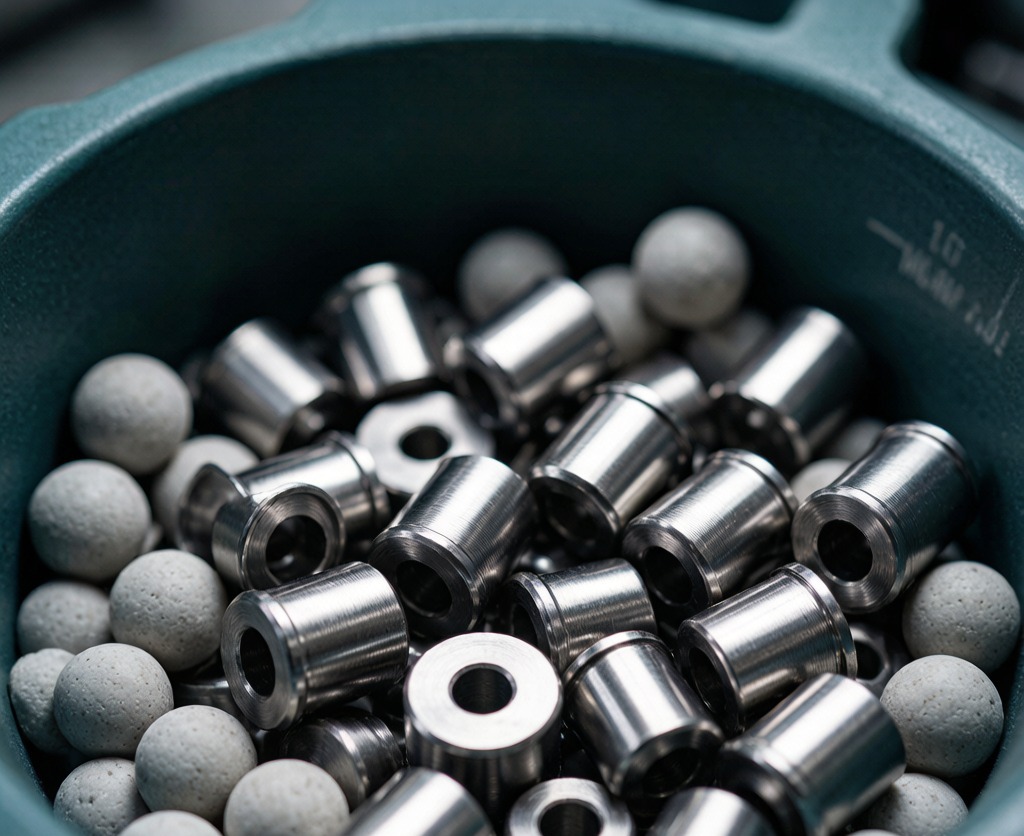
If you have ten thousand small parts that all need deburring, edge radiusing and a consistent satin finish, doing it by hand is slow, uneven and expensive. Vibratory finishing—also called mass finishing—solves this by tumbling the parts together with abrasive media in a vibrating bowl or trough, so every piece is processed identically at once. It is one of the most cost-effective surface treatments in metal manufacturing, and at Huaxiao we run it as a high-volume service that can feed straight into deburring, passivation or plating in the same program.

What Vibratory (Mass) Finishing Is
A vibratory bowl or trough is set into a controlled oscillation. Parts and ceramic or plastic media tumble against each other, and the relative motion gradually removes burrs, rounds edges and smooths the surface. Compounds in the slurry control cut rate and cleanliness. Our polishing and sandblasting lines handle lower-volume or appearance-critical work, while vibratory finishing is the champion for bulk consistency.
Media, Compounds and Process Control
The media shape and hardness set the result: angles and cones reach into corners, cylinders and stars deburr gently, and pre-forms protect delicate features. Compounds range from aggressive cut-down to bright burnish. We tune media size to the part so small holes are not plugged and thin sections are not hammered. After the run we separate parts from media and can move them to shot peening or electropolishing for further enhancement.
Deburring, Radiusing, Polishing and Cleaning
A single vibratory cycle can deburr, radius edges to a safe break, descale and even bright-polish, depending on the media and time. This consolidation is why mass finishing beats sequential manual steps on cost. As our deburring services overview explains, vibratory is the scalable way to remove burrs left by machining and stamping.
Advantages for High-Volume Production
Because thousands of parts process together with no operator at each piece, unit cost is very low and results are repeatable batch to batch. There is no heat-affected zone and no dimension loss beyond the few microns of cut. Many programs pair it with our passivation services so stainless parts leave clean, deburred and corrosion-resistant in one flow.
The hidden value of vibratory finishing is consistency across the whole batch. Because every part shares the same media, compound and motion, the result is statistically uniform in a way hand deburring can never match, and that uniformity matters for downstream operations like plating and assembly, where sharp edges or mixed surface states cause rejects. It also removes the labor variability of manual work—no operator-dependent results, no fatigue-driven shortcuts—so your first part and your ten-thousandth part look the same.
Lead time is another benefit. A bulk run processes thousands of parts in a single cycle with minimal staffing, so a large order that would take days by hand completes in hours. For seasonal or spiky demand this elasticity keeps you responsive without adding headcount, and we stage media and compounds by program so a repeat order picks up exactly where the last one left off, holding the same finish specification order to order.
Materials and Part Geometries Suited to It
Most metals—steel, stainless, aluminum, brass, zinc—finish well, as do many plastics and ceramics. Small to medium parts with no fragile protrusions are ideal; very large or thin-wall parts may be better served by polishing services or hand finishing. We review geometry during quoting to avoid media trapping.
Pairing Vibratory Finishing with Other Treatments
- Deburr and radius, then passivate stainless for corrosion resistance.
- Burnish, then electropolish for a hygienic, bright medical finish.
- Clean and descale, then plate or coat for best adhesion.
- Radius edges before shot peening to avoid stress raisers at sharp corners.
Our electropolishing services team often receives vibratory-prepped parts and finishes them to a specular, passivated surface.
One more reason teams standardize on vibratory finishing is supplier simplification. Instead of sending parts to a deburrer, then a polisher, then a plater, a single bulk process plus one follow-on treatment covers most of the surface prep, and you manage one supplier and one shipment. For procurement that means fewer POs, fewer quality interfaces and a shorter, more controllable chain—benefits that rarely show up in a per-part quote but matter to total program cost.
Frequently Asked Questions
Will vibratory finishing change my dimensions?
Only by the small amount of material removed at edges and peaks—typically a few microns. Critical diameters are held by choosing the right media and time.
Can it deburr internal holes?
Small blind holes can trap media; through-holes and accessible edges deburr well. We assess geometry before recommending the process.
Does it work on aluminum and zinc?
Yes, with softer media and compounds to avoid over-cutting or staining. Stainless and steel are the easiest, but all common alloys are routine.
How consistent is the finish?
Very. Because every part shares the same media and motion, batch-to-batch results are repeatable once the cycle is qualified.
Can I get a bright polish from vibratory finishing?
A burnishing cycle with the right media and compound gives a consistent satin-to-bright finish; for mirror we add electropolishing.
Is it suitable for prototypes?
Yes, but the real economy shows at volume. For one-offs we may suggest hand or tumble alternatives to avoid media setup cost.
Ready to Start Your Project?
Get a build-ready quote on your custom metal parts within 24 hours. Share your drawing and our engineers will respond with process, lead time, and pricing.

