
Metal nameplates carry the information a product cannot: model numbers, serials, ratings, and brand. They outlast paper labels and plastic tags in heat, solvent, and weather, which is why they appear on machines, panels, and enclosures that must stay identified for decades. This guide compares the three dominant processes, laser marking, screen printing, and anodized etching, and explains how to pick material, adhesive, and finish so the plate reads clearly for the life of the equipment. We also show where laser marking and screen printing fit in a production line.
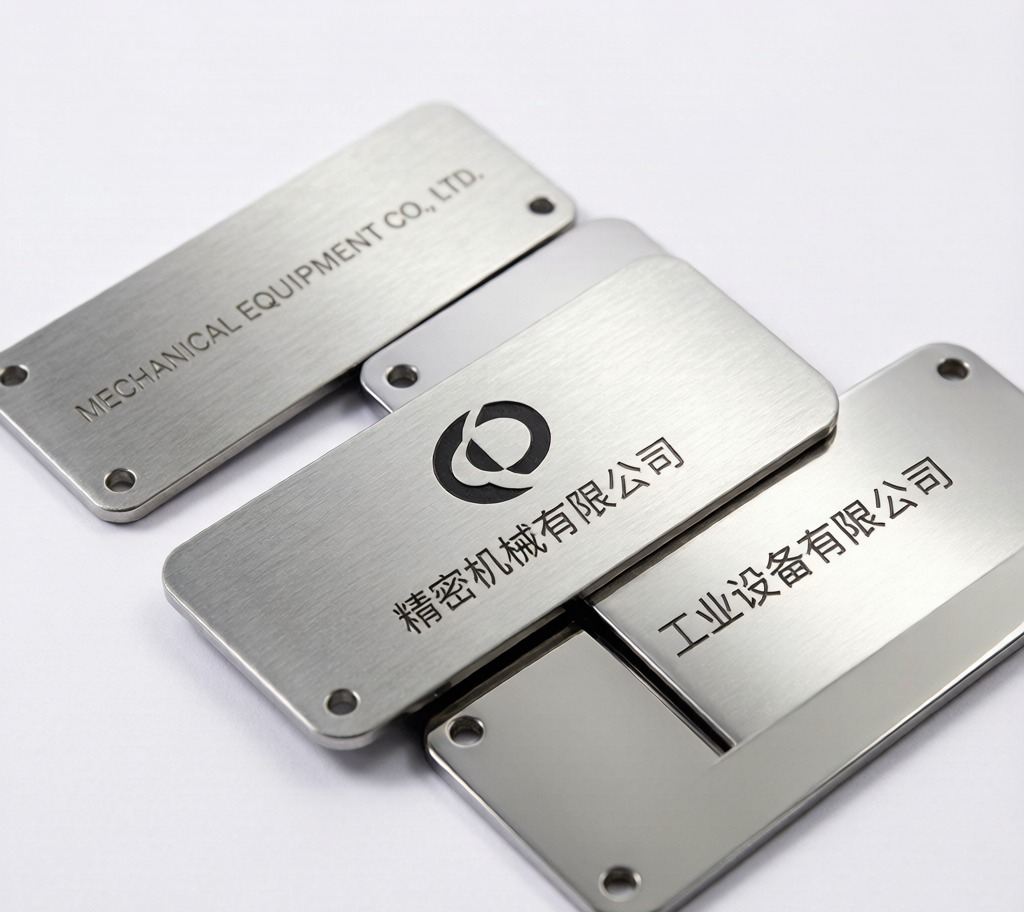
Laser Marking for Permanent Text
Fiber laser marking burns or foams a crisp, permanent mark into the surface without ink. It survives abrasion, chemicals, and UV, and it needs no consumable, which makes it the default for serial numbers and compliance codes. The mark is monochrome unless you anodize first and ablate the dye.
Our laser marking services handle stainless, anodized aluminum, and coated steel at production volume with a fixed focal setup that keeps depth consistent across a sheet.
Screen Printing for Color and Logos
Screen printing lays cured ink into the plate, so you get brand colors, gradients, and fine logos that laser alone cannot. It is the right choice for marketing-facing plates where appearance sells. The ink is tough but can fade under years of direct sun, so specify UV-stable ink for outdoor use.
We pair printing with silk screening on flat or slightly curved surfaces and bake the ink for adhesion before packing.
Anodized and Etched Plates
On aluminum, you can dye the anodized layer black and then laser-ablate the dye to reveal bright silver text, or etch and fill the recess with ink. The result is a plate where the legend is physically part of the coating, not sitting on top of it, so it will not peel.
This is the premium option for control panels. We run anodizing in-house and can combine it with laser or fill processes in one flow.
Material Choice by Environment
304 and 316 stainless resist almost everything and look right in food and medical gear. Anodized aluminum is light and takes color. Brass ages to a patina that suits heritage equipment. Pick the substrate from the service environment and the look you want.
For painted enclosures, a powder coated backing plate first, then mark it, keeps the plate color-matched to the housing.
Cutting and Shaping the Blank
Blanks are cut from sheet by laser or punched to shape. Laser cutting gives crisp custom outlines and inner cut-outs for mounting; CNC punching is faster for repeated rectangular or round tags with lanced features.
Add radii, holes, and adhesive backing during the same operation so the plate arrives ready to apply, which cuts assembly time on the line.
Adhesive, Holes, and Mounting
Pressure-sensitive adhesive works for smooth painted surfaces; mechanical fixing with rivets or screws is mandatory where the plate could be pulled or heated. Specify the mounting method from how the product is handled in service.
When the plate belongs on a larger assembly, consider a custom metal enclosure program so the identification is integrated at build rather than stuck on later.
Quality Control and Inspection
Every metal nameplates order begins with a first-article inspection. We measure the critical dimensions on a CMM or dedicated gauge and compare them to your drawing before any volume runs start. Only after you approve the report do we release production, so the first batch is already at spec rather than a learning curve.
For functional features we add targeted checks, from thread gauging on fasteners to flatness, squareness, and runout on frames and shafts, and we keep a traveller with the lot so a later question can be traced to the exact machine setup. That discipline is what keeps reject rates low across repeat orders.
We also confirm the finish and any marking against the approved sample, because a good dimension on a badly finished part still fails on the line. Surface, color, and legend are inspected alongside the numbers so what ships matches what you signed off.
Lead Time and How to Request a Quote
Quoting metal nameplates is fast when you send a drawing, a sample, or even a marked sketch with the key dimensions called out. We return a price with DFM feedback, a recommended material, and a realistic lead time, usually within one business day, so you can plan the build without waiting on a vendor.
Prototype quantities run in days; production batches scale with material and finish, and we can hold your drawing on file for fixed-schedule replenishment so you keep stock without tying up cash in inventory you do not need yet. Tell us annual volume and we set the cadence.
If you are unsure of the best process, ask. A short call before release often saves a costly rework, and we would rather steer you to the cheaper capable route than quote the one you assumed. The goal is a part that assembles first time at the right cost.
Common Specification Mistakes to Avoid
The most expensive mistake on metal nameplates is over-tightening tolerances the assembly never needed. Every step past process capability adds cost per feature, so call out only the dimensions that locate or seal another part and leave the rest to standard commercial limits. Tight where it counts, loose where it does not.
The second mistake is forgetting the datum and the environment. State which surface everything is measured from, and name the service condition, indoor, outdoor, washdown, or vacuum, so the material and finish are chosen once and not reworked after a field failure.
The third is treating finish as an afterthought. Plating, anodize, or coating change dimensions and must be in the tolerance stack from the start. Tell us the final coated size you need and we will machine to suit, instead of discovering the coat pushed you out of spec at the end.
Frequently Asked Questions
Which process lasts longest outdoors?
Laser-marked or anodized-and-etched stainless outlasts screen printing under direct sun.
Can you print a color logo?
Yes, screen printing handles brand colors and gradients; laser is monochrome unless anodized dye is ablated.
What adhesive holds on powder coat?
A high-bond acrylic foam tape rated for the temperature range; for harsh duty we recommend mechanical fixing.
Do you keep serials unique?
We serialize from a start number you set and verify uniqueness on the job traveller.
Minimum order?
Prototypes from a few dozen; volume pricing improves past a few hundred plates.
Ready to Start Your Custom Part?
Send us your drawing or sample and get a competitive quote with DFM feedback, lead time, and material recommendation within one business day.

