
Pumps move the world’s fluids, and every one of them is a small library of precision parts: impellers, casings, shafts, wear rings, and seals. Pump components manufacturing sits at the intersection of casting, machining, and finishing, because a part that is right on the drawing but wrong on the hydraulic profile leaks and vibrates. This guide walks the workflow we use for reliable pump parts from prototype to volume.
The Pump Part Families
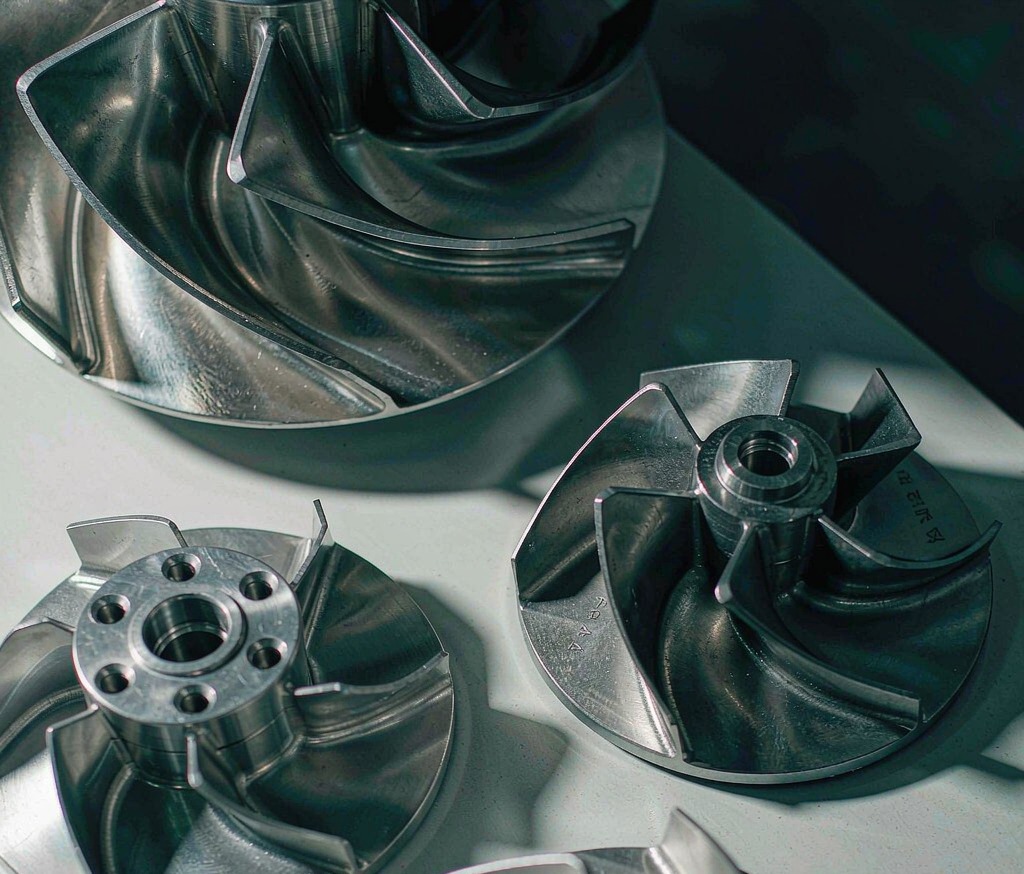
Impellers are the dynamic heart; casings (volutes) shape the flow; shafts carry torque; wear rings protect the fit. Each has its own best process. Hydraulic suppliers share the casting-plus-machining logic, so the skills transfer directly and a pump program rarely needs a second source for the static parts.
Casting the Body
For complex volutes we use investment casting for fine surfaces or sand casting for larger bodies, holding ±0.05 mm and uniform walls for clean hydraulics. Marine pumps lean on the same foundry discipline for pressure integrity, because a thin spot is where a casing bursts and a thick spot is where flow stalls.
Machining the Impeller
Impellers are balanced by 5-axis milling the vane profile, then turning the bore and hub in one clamp for runout control. Tight hydraulic tolerances and a smooth vane surface cut losses, so we finish to Ra ≤ 1.6 µm where flow matters and skip the polish where it does not, which is how we keep cost honest.
Finishing and Balance
After machining we grind seats, polish flow surfaces, and deburr every edge. Shafts are straightened and balanced to grade before shipment. A smooth vane and a true bore are what let a pump hit its curve, so we treat the last 0.1 mm of finish as a performance step, not a cosmetic one.
Material Choices
304/316 and 17-4PH for corrosion, duplex for seawater, bronze for non-sparking lines, and ductile iron for cost. Match the alloy to the fluid, not the catalog, because the wrong choice fails quietly as cavitation or crevice corrosion. Valve programs face the same trade and use the same selection worksheet we can share with you.
Design Tips to Save Cost
Uniform wall thickness casts cleaner and machines faster, and a generous fillet at the vane root avoids a stress riser that shortens impeller life. If the part is large, cast near-net and machine only the seats; if it is small, bar-stock may beat casting entirely. We will show you the crossover in the quote so the shape serves the volume.
Quality Control and Inspection
We CMM the critical bores, balance each rotor to grade, and pressure-test casings on demand. Foundry NDT catches porosity before it becomes a leak, and a dimensional layout proves the hydraulic profile matches the drawing. For API-style work we bundle full traceability so your test rig accepts the part without a second inspection.
Lead Time and How to Request a Quote
Send the model, the fluid and temperature, the material, and the quantity. Prototypes run in days from bar or rapid cast; production adds foundry lead. We quote the route and flag any feature that would be cheaper another way, and a short call on the duty point usually prevents a material change later in the program.
Closing the Loop on Pump Reliability
A pump part is only as good as the hydraulic profile it holds in service, and that profile is set by the last 0.1 mm of finish plus a true bore. We treat those as performance steps, not cosmetics. Smooth vane surfaces and a true impeller bore are what let a pump hit its curve, so we finish to Ra 0.8–1.6 µm where flow matters and skip the polish where it does not, keeping cost honest. Valve programs face the same trade and use the same selection worksheet we can share. Balance is the other half: we straighten and balance each rotor to grade before shipment, because an unbalanced impeller vibrates the seal into failure regardless of how tight the machining was. Material choice closes the loop—match the alloy to the fluid, not the catalog, since the wrong choice fails quietly as cavitation or crevice corrosion. For audit-style work we bundle full traceability and foundry NDT so your test rig accepts the part without a second inspection. Send the model with the fluid, temperature, material, and quantity and we will flag any feature that would be cheaper another way, because a short call on the duty point usually prevents a material change later in the program and keeps the pump on its curve from day one.
Prototypes run in days from bar or rapid cast; production adds foundry lead, and we quote the route so you see exactly where the money goes before you commit. When the rotor is balanced and the casing is pressure-tested, the pump you receive is the pump the drawing promised.
Frequently Asked Questions
Can you cast and machine in one order?
Yes—vertical integration from foundry to final CMM keeps lead time down.
What balance grade do you offer?
ISO G6.3 standard, G2.5 on request for high-speed impellers.
Do you handle API specs?
We can machine to API 610-style requirements with full traceability.
How do you prevent porosity leaks?
Foundry gating control plus NDT and pressure test on demand.
What is the typical lead time?
Prototypes in days, production in weeks depending on casting route.
Ready to Start Your Project?
Get a build-ready quote on your custom metal parts within 24 hours. Share your drawing and our engineers will respond with process, lead time, and pricing.

