
Custom metal clamps look simple until a catalog part fails in service. A hose clamp that loses tension after twenty thermal cycles, a cable clamp that saws through insulation, a pipe clamp that rattles loose on a vibrating skid — every one of those failures traces back to a clamp that was selected instead of engineered. When the clamping band, the spring rate, the coating, and the fastener are all specified for your assembly, the clamp stops being a warranty risk and becomes a part you never think about again.
This guide covers how buyers specify custom metal clamps that hold their load: which clamp families fit which duty, how material and temper set the clamp force, which manufacturing route is cheapest at your volume, and what to send us so a quote arrives with real tooling numbers instead of a placeholder price.
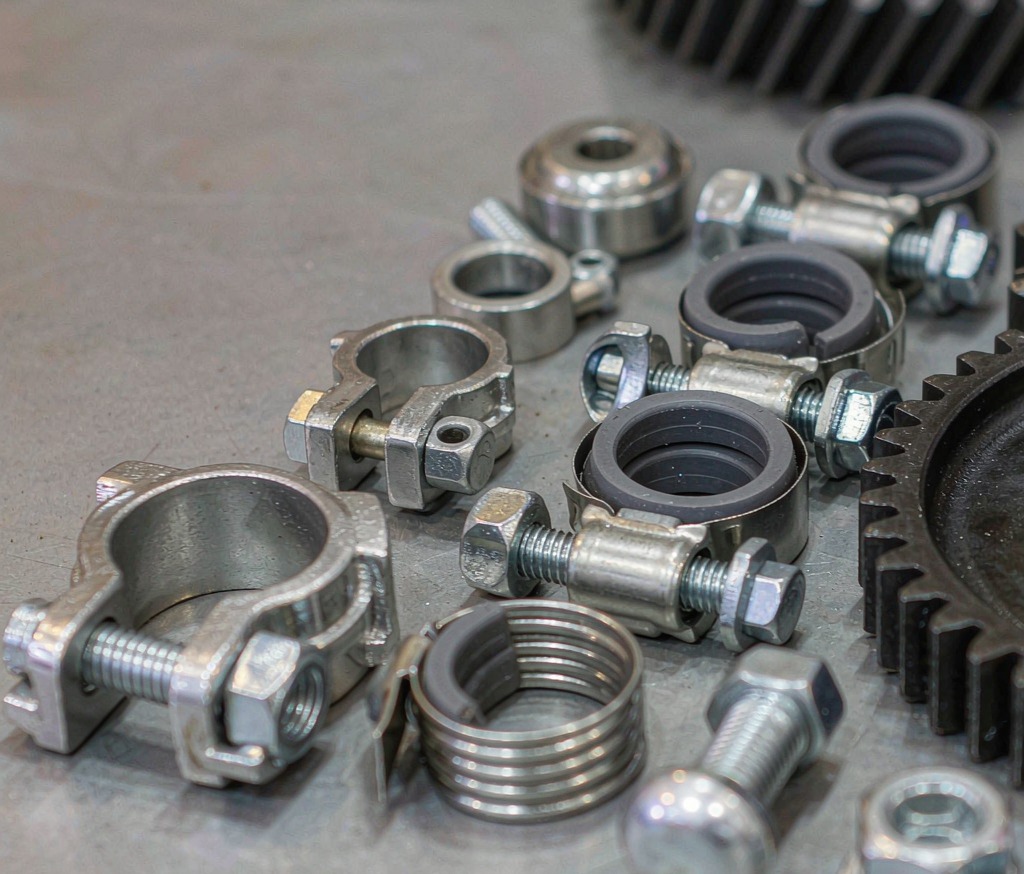
Where Custom Clamps Beat Catalog Parts
Standard worm-drive and P-clip clamps cover generic plumbing, but they lose on three fronts: envelope, load, and finish. Custom geometry wins when the clamp has to wrap a non-round profile, clear a neighbouring boss, carry a captive nut, or index to a mounting hole that already exists in your chassis. Once the clamp integrates a mounting tab, you delete a bracket, a fastener, and an assembly step, which usually pays for the tooling inside the first production year.
Load is the second driver. A catalog clamp is rated for a nominal diameter, not for your gasket compression or your vibration spectrum. Engineering the band thickness, width, and temper lets you hit a target clamp force and keep it after relaxation. Finish is the third: plated carbon steel is fine indoors, but a salt-spray or wash-down environment needs stainless or a duplex coating system chosen deliberately, not by default.
Most clamp programs we quote sit alongside other fabricated hardware. Buyers who already source custom metal brackets or custom metal fasteners from one supplier usually fold clamps into the same package so the finish, packaging, and paperwork match.
Clamp Types and How They Load
Band clamps distribute pressure around a hose or tube and are ideal when the sealing surface is soft. Saddle and P-clips locate a line against a panel and take mostly shear at the fastener. Spring clips and beam clamps deflect elastically and hold by stored energy, so they tolerate thermal growth better than a bolted band. Toggle and over-centre clamps deliver high repeatable force in fixtures and access panels. Structural pipe clamps carry static weight and are sized on stress, not on grip.
Deciding the family early matters because it dictates the process. A band clamp is a blanked strip, rolled and welded. A P-clip is a stamped and formed blank with a cushioned inner face. A beam clamp may be a machined or forged body. Getting this right before tooling saves a redesign later, and it is the first thing our engineers confirm when a drawing arrives through our DFM support service.
Material Selection and Corrosion Strategy
Carbon steel strip in grades such as SPCC, SAE 1050, or 65Mn covers the widest cost band and takes a spring temper well. 301 and 304 stainless give general corrosion resistance with usable spring properties in the cold-worked condition; 316 adds chloride resistance for marine, food, and chemical duty. Spring steel and beryllium copper appear where the clamp must flex thousands of cycles. Aluminium is used for weight-sensitive cable routing but needs galvanic separation from steel fasteners.
Corrosion strategy is a system decision, not a coating line item. Match the clamp, the fastener, and the clamped part so the least noble metal is not the thinnest one. Where a stainless clamp meets an aluminium tube, an insulating cushion or a non-conductive liner is cheaper than a warranty claim. Buyers who need a formal material trade-off can use material consulting before tooling is cut.
Manufacturing Routes for Clamp Bodies
Volume decides the route. Below a few thousand pieces, laser cutting the blank and forming it on a press brake keeps tooling near zero and lets you iterate. From roughly five thousand pieces a year, a compound or progressive die pays back quickly because the per-piece labour collapses; that is the same economics described in our guide to precision metal stamping.
Assemblies that combine a band, a bracket, and a nut plate move into stamping and welding cells, where projection or spot welding joins the components with no consumable and no post-weld cleaning on the visible face. Wire-based clamp families follow a different route entirely — see wire forming services for how bent-wire clips are formed and end-treated. Machined bodies remain the answer for heavy structural clamps where the section is thick and the tolerance is tight, typically produced through CNC machining.
Spring Temper, Heat Treatment, and Clamp Load
Clamp force is a function of section modulus, span, deflection, and modulus of elasticity — not of how hard the part feels. A clamp that is heat treated too hard cracks at the radius; one that is too soft relaxes and loses grip. For spring-steel clamps we specify an austenitise-and-temper cycle to a target hardness band, usually HRC 42–48, then verify with a load-deflection test rather than a hardness reading alone.
Stainless spring clamps take their strength from cold work, so the temper is set at the mill and protected during forming. Stress relieving after severe forming keeps parts from distorting during plating and in service. Where distortion control or a bright surface matters, a controlled-atmosphere cycle through heat treatment replaces open-air furnaces.
Surface Finishing and Galvanic Compatibility
Zinc plating with a trivalent passivate is the volume default for carbon steel clamps and gives 96–240 hours of neutral salt spray depending on thickness and topcoat. Powder coating suits outdoor structural clamps: it builds a thicker film, adds colour and edge coverage, and gives painted cable and pipe clamps a cushioning layer, so it is common on visible assemblies.
Stainless clamps are usually passivated to restore the chromium-rich film after forming, and polished where a bright cosmetic face is required. Add a laser-etched part number through laser etching when field service teams need to reorder the exact clamp instead of guessing.
Quality Control and Inspection
A clamp drawing should carry three controlled features: the free-state dimension, the installed clamp force or torque, and the coating specification. We inspect blanks and formed parts on first-article and in-process plans, sample clamp load on a calibrated fixture, and run salt-spray coupons with each plating lot. Dimensional records reference the same datum scheme used on your assembly print so the numbers mean something on your line.
Functional testing matters more than dimensions on flexible parts. Cycle testing to the expected installation count catches radius cracking; torque-to-failure on the fastener catches a band that yields before the screw does. For clamps in regulated assemblies we supply material certificates, plating thickness readings, and a signed first-article report with the initial shipment.
Cost Drivers, Tooling, and Lead Time
Four things move the unit price: strip width and thickness, number of forming stations, whether a weld or an insert is required, and the finish. Nesting the blank efficiently is the single largest saving on high-volume band clamps — a two-millimetre change in band width can shift material yield by several percent. Tooling for a compound die is typically two to four weeks; progressive tooling runs longer but drops the piece price further.
Typical schedules: 7–12 days for laser-cut and formed prototypes, 3–5 weeks for the first production lot from new tooling, and 2–3 weeks for repeat orders including plating. Send a 2D drawing with the free-state and installed conditions, the target clamp load or torque, annual volume, and the mating part geometry, and we will return a route, a finish recommendation, and a firm price.
Frequently Asked Questions
What is the minimum order quantity for custom metal clamps?
Laser-cut and formed clamps start at 50–100 pieces for prototypes. Stamped clamps from dedicated tooling are usually quoted from 2,000–5,000 pieces, where the die cost amortises sensibly.
Which material should I choose for outdoor clamps?
304 stainless is the safe default for general outdoor duty; 316 is worth the premium near salt water or chlorides. Zinc-plated or hot-dip galvanised carbon steel is acceptable for sheltered structural clamps at lower cost.
How do you control clamp force in production?
We tie clamp force to a load-deflection test on a calibrated fixture, sampled per lot, in addition to hardness and dimensional checks. The drawing should state the target force and the acceptable band.
Can you supply clamps with captive nuts or cushions?
Yes. Captive nuts and studs are added by projection welding or clinching, and EPDM, PVC, or nylon cushions are applied inline. Both are quoted as part of the clamp assembly.
Do you provide tooling ownership?
Tooling built for your part is dedicated to your part. Ownership and storage terms are stated on the quotation, and tools are maintained at no charge for the life of the program.
What lead time should I plan for the first production lot?
Allow 3–5 weeks from tooling release for stamped clamps including plating, or 7–12 days for prototype quantities produced by laser cutting and press-brake forming.
Ready to Start Your Project?
Get a build-ready quote on your custom metal parts within 24 hours. Share your drawing and our engineers will respond with process, lead time, and pricing.

